Feedback from SENCOs indicates schools want:
- More face-to-face time with their EP.
- More time to discuss and agree intervention plans.
- More time for their EP to consult with parents and staff.
SENCO feedback: “The best way for us to receive support is face to face, consultative time with people, problem solving.”
In response to your feedback the EPS (Educational Psychology Service) has remodelled our approach to service delivery. We will be using a consultation-led approach to working with schools, which is a common approach used by Educational Psychology Services nationally. This means that where we are involved in supporting children and young people we will consult with key adults to agree and review action plans that aim to meet children’s needs within their setting.
Research shows that:
- EP involvement is more effective when they collaborate and problem-solve with school staff and/or parents, rather than when they assess a child in isolation, and provide a long report.
- Teachers’ confidence about their ability to manage problems and carry out agreed interventions is significantly higher following EP consultation.
Psychology Works consultations
How Psychology Works consultations support Ordinarily Available Inclusive Provision (OAIP) and targeted support
School staff bring a concern to the Psychology Works consultation. The process can be used to support settings and staff with individual, group or whole school issues – such as complex learning needs, alternative curriculum routes and whole school behaviour systems.
Sharing the psychological approaches explicitly in this way aims to leave staff with a growing knowledge and confidence, which will enhance the schools’ universal and targeted provision.
Benefits of Psychology Works consultation support
- Children’s needs are identified and supported early on through a graduated approach
- Parents, carers and school staff are actively involved and contribute their expertise
- An efficient use of EP time
- A flexible approach which can be used to support schools with a range of concerns
- Face-to-face time with an EP
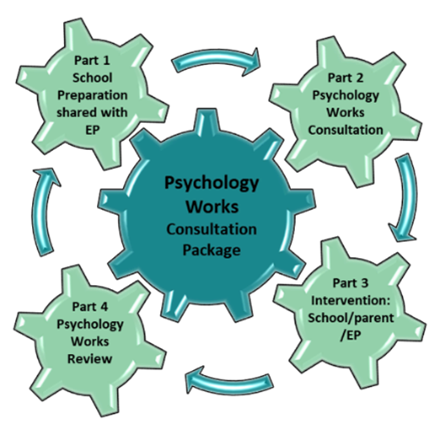
Part 1 Psychology Works – Preparation
All Psychology Works consultations will be planned at the termly School Review Consultation (currently targeted schools only).
How can I prepare for the meeting?
- Complete of the ‘Request for Educational Psychologist involvement’ form and, if the focus is an individual child, the ‘Parent Carer Consent form’ before the Psychology Works consultation.
- The Psychology Works consultation will need to take place in a private space or data secure virtual meeting room, where people feel comfortable to speak freely.
- The SENCo should invite agreed people (for example parents, staff), to the Psychology Works Consultation meeting.
- The Psychological Works consultation leaflet provides more information.
Considering the following questions may help your preparation:
- What is it you are most concerned about?
- How would you like the situation to change?
- What actions have you taken so far to try to help?
- What is working well?
- If this is about a child then what are the child or young person’s strengths?
- What are the child or young person’s views and have these been sought?
- Any relevant background
Part 2 Psychology Works – Consultation
- The EP leads the consultation and provides the structure that means the situation is thoroughly explored.
- A Psychology Works consultation takes up to 60 minutes.
- The EP will support others to develop an understanding of the concern by sharing relevant psychological knowledge.
- A brief consultation record will be produced which details agreed actions from the meeting, this can be used immediately by anyone supporting the situation.
- An agreed date will be set for a review consultation, typically 6 weeks later.
Part 3 Psychology Works – Intervention
- As agreed in the consultation record some interventions will be delivered ahead of the review. These may include school or home-based actions.
- From time to time this may include actions for the EP, such as a short observation.
Part 4 Psychology Works – Review
- The Psychology Works review session is an essential second part of the consultation process (around 45 mins).
- A planned review helps to keep the momentum going with the action plan and provides clear evidence of the impact of this support.
- The key people who know the situation well, and attended the first consultation session, need to attend this review for it to be effective.
- The EP leads an in-depth review of the actions agreed in the first consultation session.
- Based on the review, one of the following may happen:
- no further EP involvement as good progress has been made
- agree new actions and set date for a further review
Impact of Psychology Works consultations
We have undertaken some small-scale evaluations of this work with Devon schools as well as parents and carers who have been involved. This has indicated that Psychology Works is effective in the following key areas:
- Gaining a better understanding children and young people’s needs
- Agreeing action plans and reviewing them
- Developing positive working relationships between parents, carers and schools