Relational practice describes ways of working that position relationships at the heart of the school experience, for all.
Relational practice seeks to explore the sorts of behaviours and skills that support school communities to feel safe, connected, understood and cared for, through their way of being together.
As well as skills, relational practice also describes the conditions or context that enables people to be relational in their practice, and includes culture and ethos, processes and systems as well as policies.
Materials
The below materials translate psychological theory into practical, accessible descriptions of what relational practice looks like in everyday school life.
Our aim was to create materials that feel relevant and easy for staff to use, while still allowing each school the flexibility to adapt and shape relational practice in a way that fits their own unique context.
The guidance draws on research and theory from the fields of attachment and trauma, effective support for inclusion and on improving behaviour in schools. It includes detailed descriptions of relational practice in terms of whole school approaches, Ordinarily Available Inclusive Provision, everyday practice, systems and process as well as implication for policies.
- Guidance for developing relational practice and policy
A whole school approach to understanding the power of relationships in school.
This document describes an approach to teaching and learning which influences whole school ethos and systems as well as universal teaching practice and targeted support. It supports the development of relational behaviour policies which take into account current research and theory from the fields of attachment and trauma, effective support for inclusion and on improving behaviour in schools.
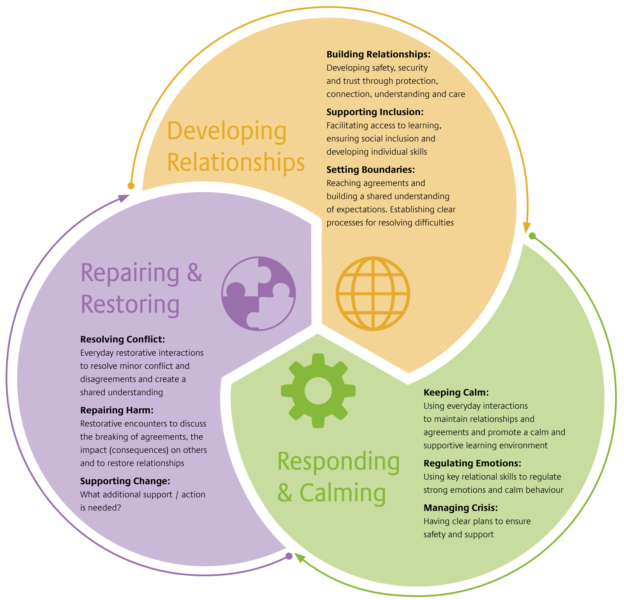
There are three main components to the relational model, developing relationships, responding and calming and repairing and restoring as well as guidance on working in relationship in the classroom and through a graduated response.
The approaches should be used universally as good quality first teaching and in a planned and timely fashion to target early intervention for children and young people who may be at risk of exclusion.
The guidance document includes models and frameworks to support schools in exploring relational practice work as well as templates and tools, including a relational practice audit tool which is helpful when considering how best to implement this work.
Read the guidance for developing relational practice and policy.
Alternatively, a quick guide to developing relational practice and policy is also available.
- Guidance for developing relational support plans
A targeted approach for supporting those children most in need of secure relationships.
This guidance document was developed to support adults in schools to understand different aspects of relationships and to support them in meeting the core relational needs of the children they are working with.
As well as providing a framework for understanding it is also designed to support conversation and reflection in terms of ‘how to be’ in relationships in school. This differs from more typical educational models which tend to tell people what to do. In relational work we are asking people to be reflective about themselves within relationships, how this manifests itself through behaviour and interactions, and how they impact and are impacted by other people.
Whilst the framework draws on theory and research from the fields of neuroscience, attachment, trauma, intersubjectivity, mentalisation and restorative approaches, it is designed to be an accessible and practical tool.
The guidance document includes templates for relational support plans, responsive co-regulation plans and a guide to best practice when establishing plans.
- Relational practice model infographic

- Document downloads
Main documents
- Guidance for developing relational practice and policy
- Guidance for developing relational support plans
Supporting documents
Getting involved
The Educational Psychology Service (EPS) is keen to work with Devon schools in becoming relational practice communities, where all children and young people are fully included, engaged with learning and participating in school life.
The EPS has created several support pathways to help schools develop and embed relational practice effectively. These pathways offer support in four key areas:
- Practical materials and resources – supporting staff to understand relational practice and apply it within their setting.
- Relational practice networks – where schools can share good practice, access training, and build supportive professional connections.
- Relational practice leads – training and ongoing development for relational practice school leads in embedding this work in school.
- Pathfinder schools – opportunities for schools who wish to take a leading role and model best practice as part of a developing community of expertise.
If you are interested in becoming involved as a school in networks of practice, becoming a relational practice lead or applying to be a pathfinder relational practice school please speak to your school educational psychologist, inclusion partner or support worker or email us at educate.relationalpractice-mailbox@devon.gov.uk
Implementation
Over the past three years, the EPS has had the privilege of working with St Peter’s School in Exeter as our relational practice beacon school. We are deeply grateful for their commitment, courage, and care, and for the expertise they have shown in bringing this work to life within their setting.
All members of the school community have been integral in supporting us to understand how best to implement relational practice, including the implications for staff development, system and process change, ongoing support mechanisms, classroom practice, communication, leadership and vision.
Below is a brief summary of some of the implementation findings:
The vision. A clear vision, which is underpinned by strong beliefs and values, co-constructed and well understood by the school community is crucial. Children, parents, and governors as well as school staff need to be involved in co-constructing the vision and there needs to be a joint understanding of exactly what the school is working towards.
Values and beliefs. Strong values and beliefs are what will enable schools to remain consistent to their vision over time and enable them to problem solve in line with their values. Values are key but not to the exclusion of other drivers such as outcomes and data. It is vital that the school establishes value-based outcomes and knows what to measure to evaluate whether things are successful. Thinking around the data, outcomes and measurements should be done with values in mind.
Leadership and strategy. The relational approach needs to be totally embedded in the actions of senior leaders – more a way of being than a new strategy. Leadership needs to be considered beyond an individual person and should adopt a shared approach. For example, a strategy group made up of senior leaders responsible for wellbeing, inclusion, teaching and learning, curriculum, as well as other stakeholders, such as parent governors and pupil representatives. The strategy will need to be long term (at least three years) with shorter term incremental outcomes. However, there will not be a finished product as such but a continual need to evaluate and respond to changing circumstances. Whilst the strategy group will be responsible for key decision making the group will facilitate distributed leadership.
Distributed leadership. The implementation of relational practice should not be seen as a top down process. All members of the school community need to have a voice, contribute and co-construct how the approach will work. Webbed networks (sometimes described as a practice group) that include representatives from all areas and hierarchy in school, are instrumental in collecting views, identifying barriers, recognising areas of strength, identifying areas to develop, and problem solving. This network is vital in ensuring good communication between the strategy group and all other areas of the school.
Staff development. Adopting a relational approach requires both professional and personal development for staff. There will be a need for training, in terms of the underlying theories and research and the underpinning relational models. Whilst training will be a feature of implementation, staff will need ongoing development in order to translate what this means to them, in their unique situation. Ongoing support needs to be provided to enable them to reflect not only on situations but how they feel, and how this may be impacting on their responses.
Establishing authority. It is vital to have a joint understanding of what authority looks like in a relational school. When this isn’t clear there is a risk that staff can become at times too permissive with the children and then at other times veer into behaviourism and authoritarianism. Ensuring that staff are supported to understand how to have high levels of both limit setting and nurture, is vital for children to develop trust and for adults to have authority.
Staff wellbeing. Working relationally can be demanding for staff requiring a high level of emotional labour. It is therefore important to consider staff wellbeing as part of any implementation strategy. This should include opportunities for connection, joint problem solving and collaborative working. When necessary, support to strengthen and at times repair relationships will be beneficial.
Systems, processes and policies. Relational practice needs to be supported by systems, processes and policies that enable staff to use a relational approach, including being able to meet children’s needs through regulatory and restorative approaches. Systems and processes should provide time and space, guidance, structure and support for staff to work relationally. Whereas in a school using predominately behaviourist approaches the system may actively work against staff having agency and professional judgment, in a relational school teachers are supported by processes and systems which they are able to use flexibly in order to respond to the child’s needs. In a relational school the systems and processes support staff to have authority in the classroom through reliable and predictable limit setting, which is empathic and caring.
Clear communication and shared language. It is important to establish clear communication within the school and wider school community. This will involve thinking about lines of communication between; children and staff, staff and staff, staff and parents, different hierarchies within the school, school governors and in some cases the local authority or schools within the trust. Being explicit about the development of a shared language will enable people to express themselves with clarity, be understood and may be instrumental in changing the way people talk, think and feel about individuals and situations.
Working with the children. As well as staff development schools also need to provide opportunities for children to develop their relational skills. This will involve direct teaching as well as modelling. Children need to have opportunities through, for example, circle times to learn how to express their needs in a way which does provoke a defence response from others and to listen to others with empathy. Identifying needs in others and conflict resolution should also be a feature of this. Children can be taught how to use restorative approaches and can be a useful resource for school in resolving problems with their peers.