Overview
This report provides evidence of Devon schools, Further Education Colleges and settings’ compliance with statutory guidance under S.157/175 supported by the work of the Devon Education Services Safeguarding Team.
The purpose of the S.157/175 audit is to enable the Local Authority and the Devon Children Family Partnership (DCFP) to assure themselves that all education providers across Devon are discharging (compliant with) their statutory responsibilities, as a minimum. The audit also poses questions relating to good practice and specific safeguarding themes as set out in Keeping Children Safe in Education (KCSiE). This facilitates a baseline gauging of levels of both knowledge and confidence and will, in turn, be used to inform future training and support them.[LS1] [BM2]
As in previous years, we have asked schools to grade themselves 1-4 (where 1 equates to embedded compliance and high confidence) on how embedded compliance with KCSiE and Working Together Safeguard Children is across all settings as well as asking them to reflect on the open and positive culture of safeguarding provision and the key facets of “everyone’s responsibility” and “it can happen here”. Settings have been asked to consider how well they can demonstrate impact.
This report is made up of six parts, with ‘actions’ reviewed and identified for parts 1-5.
- Part 1: Keeping Children Safe in Education
- Part 2: The Management of Safeguarding
- Part 3: Safer Recruitment
- Part 4: Opportunities to Teach Safeguarding
- Part 5: Devon Specific questions
- Part 6: Devon Safeguarding Children’s Partnership Sub-Group
Finally it is important to recognise the time spent by DSLs across Devon in completing the Section 174 audit and for the honest, detailed and reflective information provided. A heartfelt thanks to all, every return goes towards the development of safeguarding practice for children in Devon and every effort has been made to ensure comments and observations provided are accurately reflected in this report.
Executive summary
The key findings from this report, informed by the analysis of safeguarding practice across PARTS 1-5 indicate that education settings across Devon continue to demonstrate strong commitment to safeguarding principles, with well‑embedded systems, high levels of staff awareness, and a clear culture that safeguarding is everyone’s responsibility.
As with previous years, the focus for development is not on awareness or compliance, but on ensuring consistency, depth, and impact of safeguarding practice across all settings.
The identified priorities within this report highlight the need for DES Safeguarding Team and Safeguarding Partners to support all settings to, in summary:
- Strengthen the consistency and quality of safeguarding records, ensuring that all actions, decision-making, rationale and outcomes are clearly evidenced and regularly reviewed to demonstrate impact for children.
- Embed robust monitoring and evaluation processes, particularly for vulnerable groups, so that interventions (including attendance support, SEND provision and safeguarding plans) are not only implemented but clearly demonstrate measurable improvement over time.
- Improve the timeliness, clarity and documentation of information sharing, including:
- The secure and evidenced transfer of safeguarding files between settings
- Early sharing of key safeguarding information prior to transition
- Strengthened internal recording of communication with external agencies
- Ensure consistent follow‑up and challenge within multi-agency systems, particularly where outcomes from referrals are unclear, to support effective accountability and improved outcomes for children.
- Further develop confidence and clarity in the application of thresholds and safeguarding pathways, including:
- Front Door processes
- Early Help access and escalation routes
- Appropriate use of professional curiosity and challenge
- Enhance workforce development beyond awareness, ensuring that training and CPD:
- Builds practical application and professional judgement
- Targets areas of identified need (e.g. mental health, thresholds, recording,
- escalation)
- Is systematically planned, monitored and evaluated for impact
- Strengthen practice for children with additional vulnerabilities, including:
- Ensuring all SEND, medical and mental health needs are supported by clear, regularly reviewed and parent‑agreed plans
- Improving consistency in review cycles and impact assessment
- Ensuring multi-agency partners are effectively engaged
- Ensure that all part-time timetables and alternative provision arrangements are consistently risk assessed, monitored and reviewed, with safeguarding considerations clearly documented and central to decision-making.
- Develop more consistent and systematic approaches to reflective safeguarding practice, including:
- Case review processes
- Use of local and national learning
- Whole-school dissemination of key learning points
- Continue to strengthen safeguarding responses to attendance concerns, ensuring that all settings can clearly demonstrate the actions taken, challenges encountered, and the impact on improving attendance for vulnerable pupils.
Across all areas, there is a clear need to move from strong, policy-driven compliance to fully embedded, evidence-led practice, where settings can confidently demonstrate how their safeguarding systems make a measurable difference to outcomes for children.
Headlines
Part 1:
- 99%+ of staff demonstrate strong understanding of core safeguarding principles, including “everyone’s responsibility” and contextual safeguarding – consistently high and sustained over time.
- 91.2% (↑ from 85.9%) of staff understand Early Help, indicating a clear improvement in early intervention awareness.
- 88.6% (↓ from 92.1%) of staff know how to report concerns to the Front Door, reflecting a small decline in confidence linked to system pressures.
- Safeguarding file quality is strong overall (72.4% robust and audited), though 23% highlight inconsistent auditing, indicating a developing area.
- 59.3% transfer safeguarding files within 5 days with receipt evidence; timeliness improving but recording remains inconsistent.
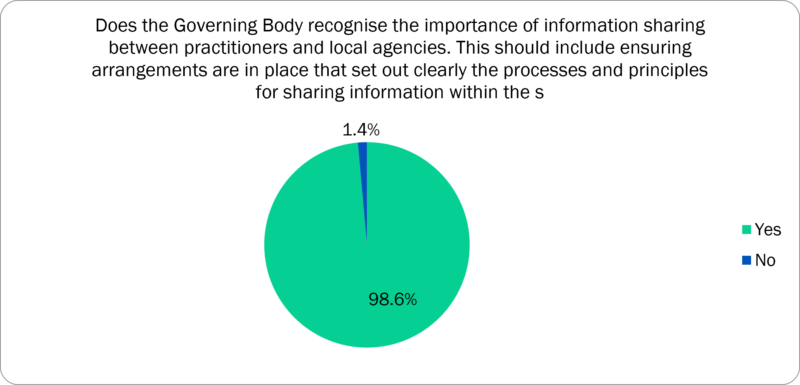
- 98.6% of governing bodies recognise effective information sharing, with 99.7% staff aware GDPR does not prevent safeguarding actions – consistently strong compliance.
- 70% of settings consistently follow up referrals, with a slight increase in difficulty obtaining outcomes, reflecting system‑wide pressures.
Part 2:
- 100% of staff have read KCSiE 2024, with near‑universal understanding of safeguarding roles – maintaining consistently exceptional compliance.
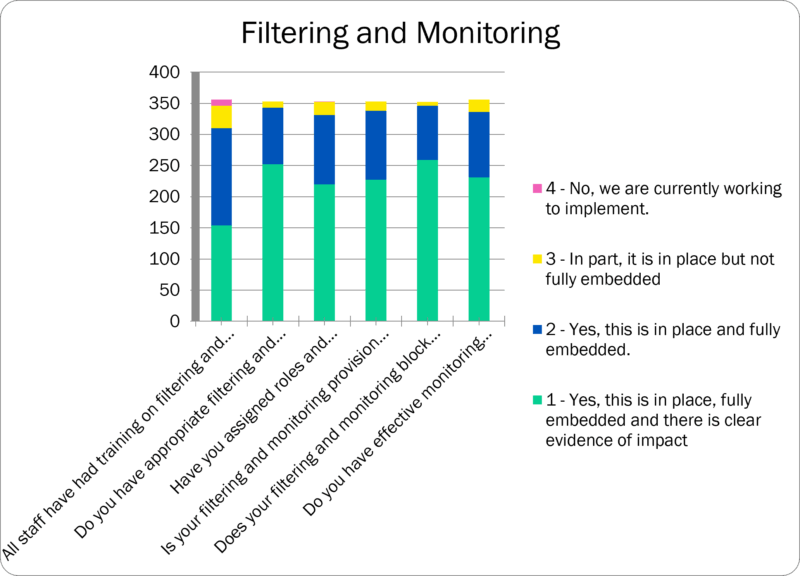
- 98.9% (↑ from 61%) of staff have received Filtering & Monitoring training, showing a significant improvement following updated statutory expectations.
- Safeguarding training coverage remains high across core areas (typically 95–98%), demonstrating a well‑embedded CPD culture.
- Slightly lower confidence remains in:
- Mental health identification
- Whistleblowing and low‑level concerns, indicating ongoing targeted training needs
Part 3:
- 98.3% of staff recognise absence as a safeguarding risk, remaining consistently high and embedded practice.
- Safeguarding teams report strong monitoring systems (weekly/monthly reviews, CPOMS, meetings), though evidence of impact is less consistently demonstrated.
- Increasing focus on persistent and severe absence as a safeguarding priority reflects growing system-wide concern.
- Practice is strong in principle, but recording of actions, challenges and outcomes is variable, indicating a need for improved evidencing.
Part 4:
- 79.5% of settings have robust individual plans for SEND, mental health and medical needs, demonstrating generally strong provision.
- 17.7% report inconsistencies in review cycles, highlighting a key area for development around monitoring and impact evaluation.
- Mental health plans are less consistently embedded, often supported through external services rather than internal planning.
- Strong emphasis on multi‑agency working and parental involvement, though access to specialist services remains a challenge.
Part 5:
- 99.1% of settings report effective multi‑agency working, remaining a key strength across Devon.
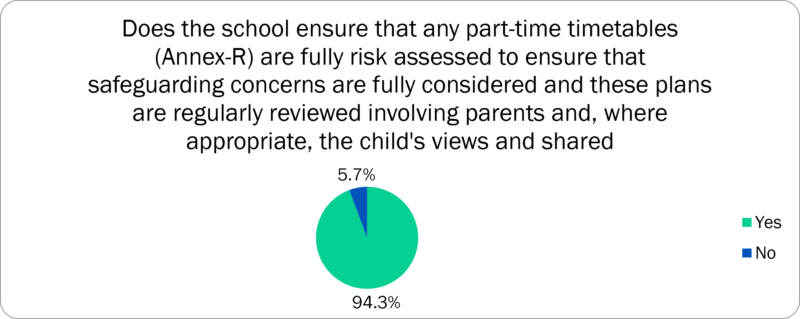
- 94.3% ensure part‑time timetables (Annex R) are risk assessed and reviewed, demonstrating a strong safeguarding approach.
- 90% of settings complete safeguarding checks for alternative provision, though a slight increase in gaps highlights need for continued vigilance.
- 99.1% of DSLs engage with wider professional learning (DES, NSPCC, SCP), reflecting a well‑embedded and evolving CPD culture.
- Key system pressures identified include:
- High referral thresholds
- Inconsistent communication from external agencies
- Delays in accessing support
→ indicating that strong school practice is being challenged by wider system capacity.
Respondents
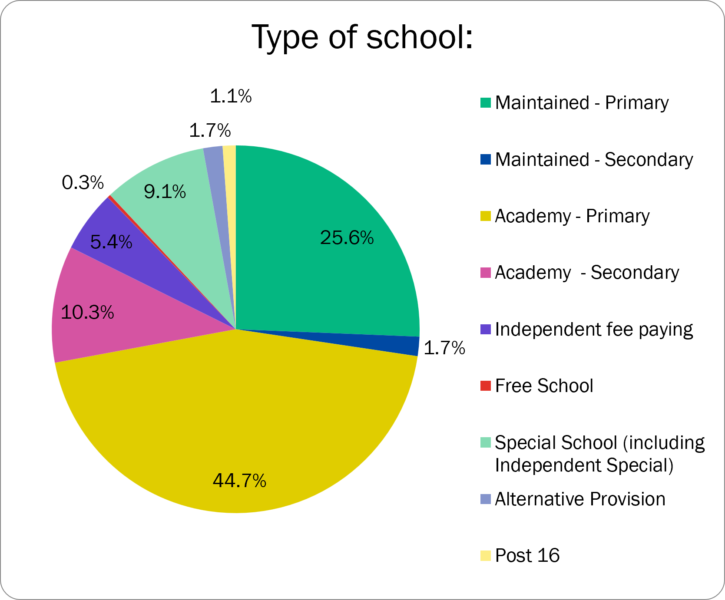
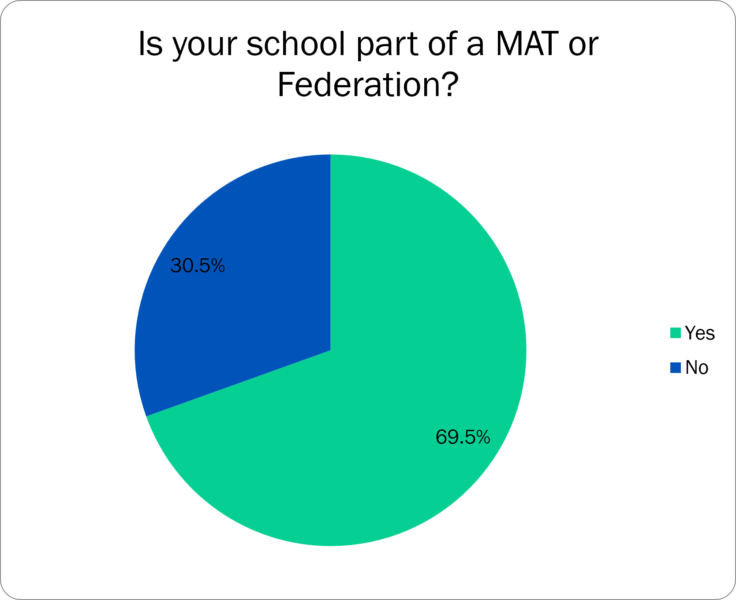
The majority of settings across Devon are part of a Multi Academy Trust (MAT) or Federation.
Summary of key roles
- 100% of settings have a Designated Safeguarding Lead (DSL)
- 100% of settings have a Designated Teacher for CiC.
- 100% of settings have Designated Teacher for Young Carers
- 100% of settings have a named SPOC for Channel / Prevent
- 100% of settings have a Senior Lead for Early Help
- 100% of settings have a Senior Lead for Relationships, Sex & Health Education (RSHE)
- 100% of settings have a Key Adult for Operation Encompass
- 100% of settings have a Designated Mental Health Lead
Q/Is your DSL a senior member of staff
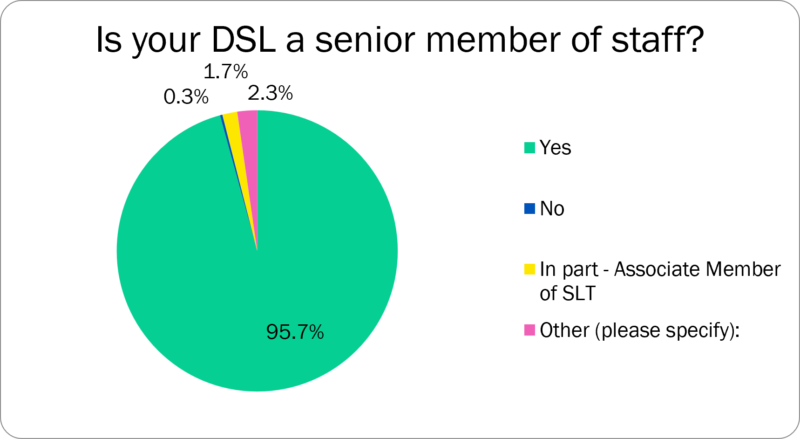
- Of the 4.3% responses that were ‘in part’ or ‘other’ DSL responsibilities was spread between a Strategic Designated Safeguarding Lead who is a member of the Senior Leadership Team (SLT) and an Operational Designated Safeguarding Lead who does not have senior leadership responsibilities.
- 95.2% of settings have a DSL that is always available to discuss concerns during school hours.
- For the 4.8% where DSL is not always available settings have other systems in place, e.g. other L3 trained staff, DDSL’s, or ‘overarching’ MAT DSL’s can be contacted.
| 2024/25 | 2023/24 | 2022/23 | 2021/22 | 2020/21 | 2019/20 | 2018/19 |
| 95.2% | 95.9% | 100% | 100% | – | – | – |
Table showing percentage of settings who have a DSL always available to discuss concerns during school hours.
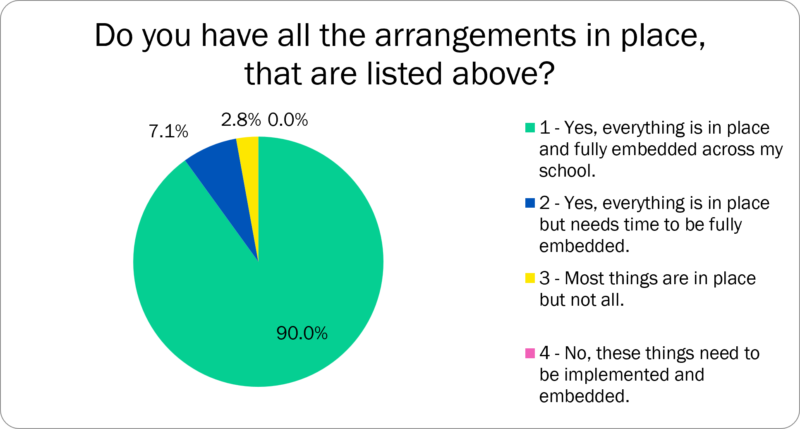
Q/Do you have all the arrangements in place, that are listed (below)?
- An effective Child Protection Policy – reviewed annually (at a minimum) and agreed by the Governing Body.
- A behaviour policy which includes measures to prevent bullying.
- A staff behaviour policy (staff code of conduct), which should include low-level concerns, allegations again staff and whistleblowing, plus acceptable use of technologies.
- Appropriate safeguarding arrangements in place to respond to children who are absent from education.
- A Designated Safeguarding Lead (DSL) who is a member of SLT and takes lead responsibility for safeguarding and child protection.
- A standing agenda item for Safeguarding as part of every governing body meeting.
- A nominated Safeguarding governor (preferably not the chair) to champion Safeguarding and child protection.
- Other safeguarding procedures, including dealing with allegations against members of staff and safer working practice.
- Up to date training at the appropriate level for all staff, volunteers and governors.
- Robust safer recruitment procedures which safeguard children and are in line with the Department for Education (DfE) procedures and other key government guidance.
- All settings should have an accredited person / people who are trained in Safer recruitment.
- A Single Central Record (SCR) for identity, qualification and vetting checks for all staff and volunteers.
Q/How many referrals did the DSL/DDSL make to the following multi agency teams during the period September 2024-July 2025?
| Front Door | Prevent | DBS | Police | MACE | MARAC | Case Resolution | LADO | |
| 2024/25 | 1,944 | 52 | 246* | 1,008 | 25 | 90 | 67 | 293 |
| 2023/24 | 2,190 | 53 | 28 | 1,301 | 22 | 70 | 47 | 295 |
| 2022/23 | 2,041 | 86 | 27 | 1,753 | 10 | 0 | 53 | 282 |
Q/Is the DSL confident that all children’s Safeguarding files are up to date and robust, and that these files provide a full picture of life for the child, including actions, decision making, the rationale and outcomes for all safeguarding concerns, child’s voice, reference to thresholds/toolkits and includes all communication?
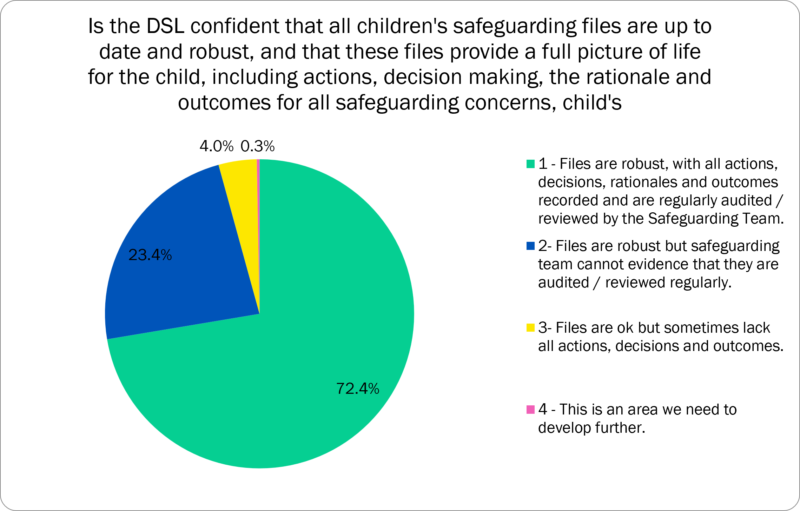
Of the 23.1% of settings that rated their files 2 or below
- Consistency or the embedding of entries to include the evidencing of actions, rationale, decision making and outcomes is required.
- Newly introduced systems for safeguarding file monitoring and auditing needs time to establish consistent approach and an evidence base.
Q/Is the DSL confident that all child protection files are transferred to a new school setting within 5 working days of joining their new setting, and is transferred separately from the main pupil file? Can the DSL show evidence of a received receipt?
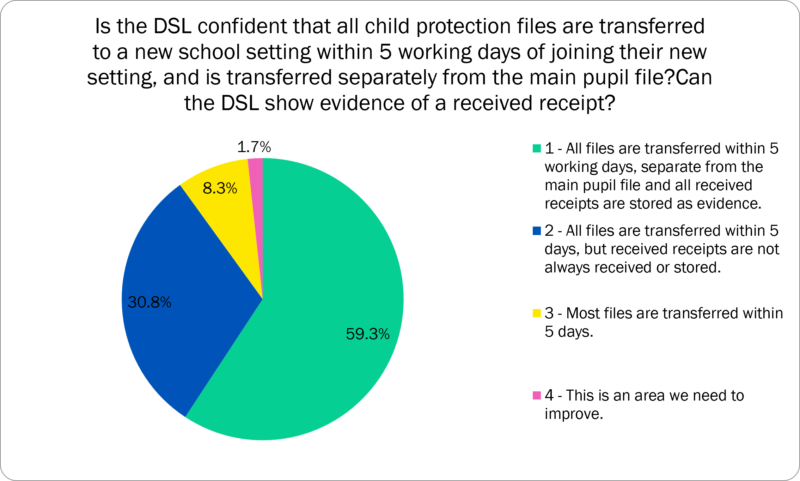
Of those settings (10%) responding 3 or below
- Settings have had difficulty transferring files to schools outside of LA.
- Settings do not always have evidence of files being transferred – need to introduce a received receipt, or they have not received the receipt from accepting schools.
- Settings are not clear about pupil destinations and thus time limits breach whilst investigations are ongoing.
Q/Does the DSL ensure any relevant Safeguarding / Welfare information such as where a child has a current or recent CP or CiN plan which is shared prior to a child starting a new school (and Safeguarding files being sent) to ensure that the receiving school has a full picture of the child and can put the right support in place prior to the 1st day?
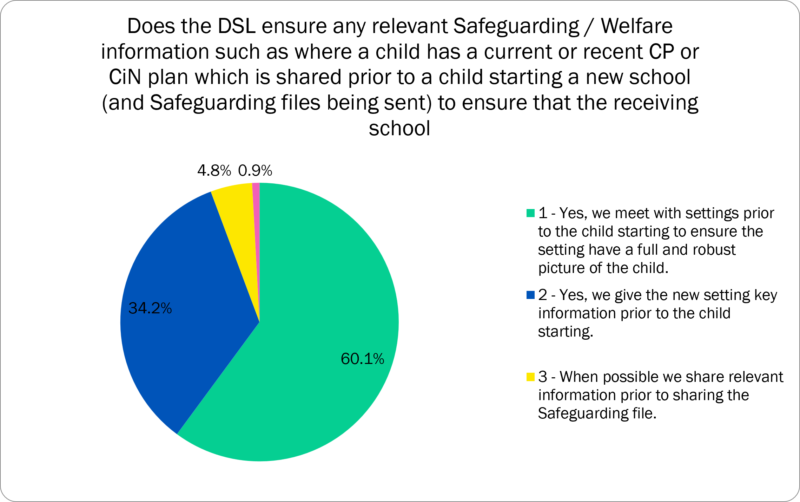
For those settings rating 3 or 4 the explanations are that:
- The receiving school is not known prior a pupil starting
- Poor communication between admissions/new and existing school
- Concerns that pupils may not attended the names school and therefore result in unnecessary/inappropriate sharing of information
- Information is shared verbally through phone calls rather than face to face with new settings
Q/Does the DSL ensure that all Front Door enquiries are followed up if there are no notifications of outcome?
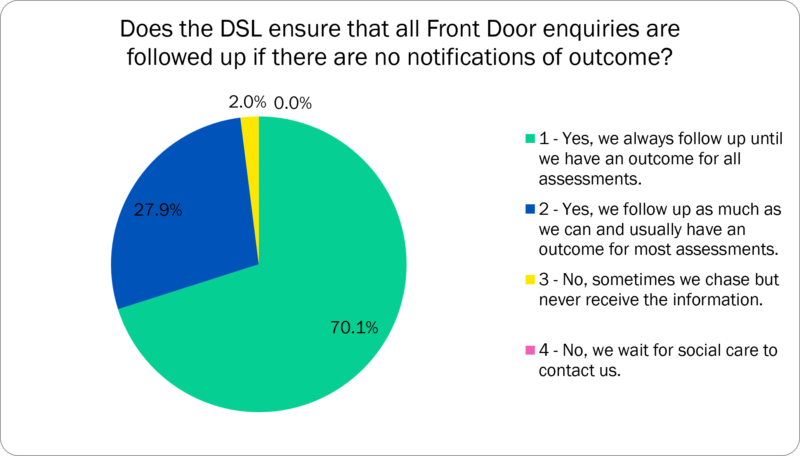
There has been a increase in those settings rating at a ‘3’.
| 2024/2025 | 2023/2024 | 2022/2023 |
| 2.0% | 1.4% | 1.0% |
Reasons provided were
- Changes to Front Door has made chasing up outcomes difficult
- Poor communication with (from) Children’s Social Care
- Settings are not the referring agency, are aware of Front Door enquiries made but not updated by the referrer of the outcome
Q/Is the Safeguarding Team proactive in sharing information as early as possible to help identify, assess and respond to risks or concerns about the safety and welfare of children?
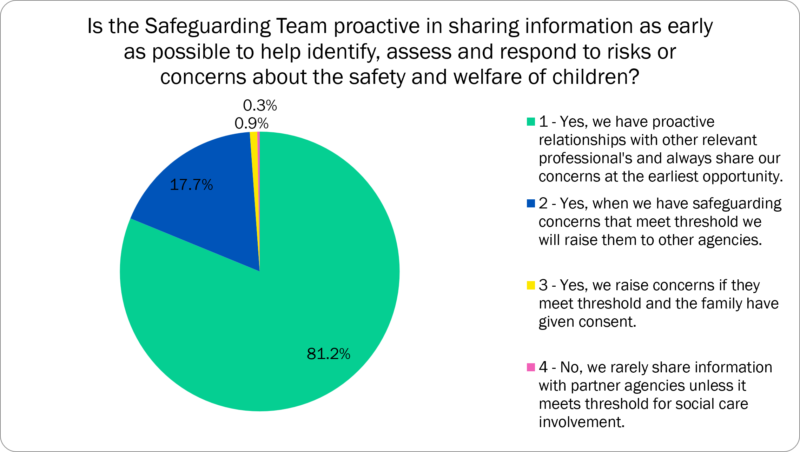
2023/24 there were no settings rating as ‘3 or 4’. This report has seen a 1.2% increase of settings rating as ‘3 or 4’, reasons provided where
- Further clarification would be welcome on what information can be shared if consent has not been provided and/or concerns do not meet ‘statutory threshold’
- Actions e.g. partner agencies sharing information, are not ‘immediate’ which causes a delay
Review of identified actions 2023/24:
All settings to ensure that Safeguarding information is shared to a new school prior to the child starting to ensure a smooth transition and settings to ensure safeguarding files are transferred to the new setting within 5 days.
- DES to liaise with admissions, Careers South-West and other agencies to support schools to explore means of identifying destinations for pupils. NOT YET ACHIEVED
Identified actions 2025/26
In light of changes to Working Together to Safeguarding Children 2026 e.g. the greater emphasis on sharing information and Section 175 responses (2024/25) DES Safeguarding Team to work with partner agencies to continue to develop settings understanding, processes, practice and challenge with regard to:
- Ensuring the voice of the child is heard
- All in settings are accountable and know of their role in protecting children
- How, when and who to share information to safeguard children
- Use learning: LA, national and setting specific to support effective early safeguarding intervention
- Equality, Diversity and Inclusion: all children experience risk, harm and protection differently.
- Understanding the difference safeguarding actions have for the child – the impact
- How Families First
Part one KCSIE: Safeguarding information for all staff
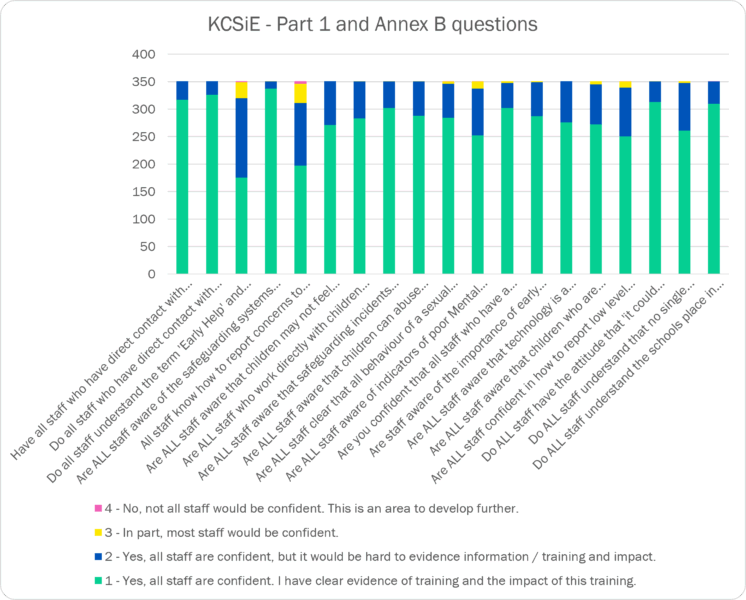
Subjects areas where settings have rated as ‘3 or 4’ include
- Do all staff understand the term ‘Early Help’ and are able to identify children and families who may benefit from Early Help support?
- All staff know how to report concerns to Children’s Social Care (Front Door)?
- Are ALL staff aware of indicators of poor Mental Health and how to identify children in need of extra support?
- Are ALL staff aware that children who are absent from education, particularly on repeat occasions and / or prolonged periods may be an indicator of safeguarding concerns.
- Are ALL staff confident in how to report low level (and Whistleblowing) concerns regarding a colleague.
Q/Do all staff who have direct contact with children understand that Safeguarding is everyone’s responsibility and understand their own role in safeguarding children within your school?
| 2024/25 | 2023/24 | 2022/23 | 2021/22 | 2020/21 | 2019/20 | 2018/19 |
| 100% | 99.7% | 100% | 100% | – | – | – |
Q/Do all staff understand the term ‘Early Help’ and are able to identify children and families who may benefit from Early Help support?
| 2024/25 | 2023/24 | 2022/23 | 2021/22 | 2020/21 | 2019/20 | 2018/19 |
| 91.2% | 85.9% | 80% | 97% | 99% | 99% | 66% |
Q/Are ALL staff aware of the safeguarding systems within your school; including who the DSL / DDSL is and how to report concerns?
| 2024/25 | 2023/24 | 2022/23 | 2021/22 | 2020/21 | 2019/20 | 2018/19 |
| 99.7% | 99.5% | 100% | 99% | 100% | 100% | 100% |
Q/All staff know how to report concerns to Children’s Social Care (MASH)?
| 2024/25 | 2023/24 | 2022/23 | 2021/22 | 2020/21 | 2019/20 | 2018/19 |
| 88.6% | 92.1% | 91% | 99% | 99% | – | – |
Q/Are ALL staff aware that children may not feel ready or know how to tell someone that they are being abused, exploited or neglected and / or they may not recognise their experiences as harmful.
| 2024/25 | 2023/24 | 2022/23 | 2021/22 | 2020/21 | 2019/20 | 2018/19 |
| 100% | 99.5% | 99% | 99% | – | – | – |
Q/Are ALL staff who work directly with children aware that abuse, neglect and Safeguarding issues are rarely standalone events?
| 2024/25 | 2023/24 | 2022/23 | 2021/22 | 2020/21 | 2019/20 | 2018/19 |
| 99.7% | 99.7% | 99% | 100% | 100% | 100% | 98% |
Q/Are ALL staff aware that Safeguarding incidents can happen outside of the family home – in the community and in school?
| 2024/25 | 2023/24 | 2022/23 | 2021/22 | 2020/21 | 2019/20 | 2018/19 |
| 99.7% | 100% | 99% | 98% | 100% | 98% | 70% |
Q/Are ALL staff aware that children can abuse other children and that it can happen both in school and outside of school?
| 2024/25 | 2023/24 | 2022/23 | 2021/22 | 2020/21 | 2019/20 | 2018/19 |
| 99.7% | 100% | 99% | 100% | – | – | – |
Q/Are ALL staff clear that all behaviour of a sexual nature should be challenged and recorded and should not be dismissed as ‘banter’ or ‘just having a laugh’?
| 2024/25 | 2023/24 | 2022/23 | 2021/22 | 2020/21 | 2019/20 | 2018/19 |
| 98.6% | 99% | 99% | 99% | – | – | – |
Q/Are ALL staff aware of indicators of poor mental health and how to identify children in need of extra support?
| 2024/25 | 2023/24 | 2022/23 | 2021/22 | 2020/21 | 2019/20 | 2018/19 |
| 96% | 96% | 94% | 96% | 97% | – | – |
Q/Are you confident that all staff who have a concern about a child’s welfare, act on these concerns immediately?
| 2024/25 | 2023/24 | 2022/23 | 2021/22 | 2020/21 | 2019/20 | 2018/19 |
| 98.8% | 99.5% | 100% | 99% | – | – | – |
Q/Are staff aware of the importance of early information sharing and how vital this is when trying to effectivity identify, and assess, concerns to ensure appropriate and timely allocation of support?
| 2024/25 | 2023/24 | 2022/23 | 2021/22 | 2020/21 | 2019/20 | 2018/19 |
| 99.4% | 99.7% | 99% | 100% | 100% | 100% | – |
Q/Are ALL staff aware that technology is a significant component in many safeguarding and wellbeing issues?
| 2024/25 | 2023/24 | 2022/23 | 2021/22 | 2020/21 | 2019/20 | 2018/19 |
| 100% | 99% | 99% | 99% | 100% | – | – |
Q/Are ALL staff aware that children who are absent from education, particularly on repeat occasions and / or prolonged periods may be an indicator of safeguarding concerns?
| 2024/25 | 2023/24 | 2022/23 | 2021/22 | 2020/21 | 2019/20 | 2018/19 |
| 98.3% | 98.4% | 99% | – | – | – | – |
Q/Are ALL staff confident in how to report low level (and whistleblowing) concerns regarding a colleague?
| 2024/25 | 2023/24 | 2022/23 | 2021/22 | 2020/21 | 2019/20 | 2018/19 |
| 96.5% | 97.2% | 99% | 97% | 99% | – | – |
Q/Has the DSL used escalation procedures including the Case Resolution Protocol for any cases?
| 2024/25 | 2023/24 | 2022/23 | 2021/22 | 2020/21 | 2019/20 | 2018/19 |
| – | 97% | 37% | 69% | – | – | – |
Q/Do ALL staff have the attitude that ‘it could happen here’?
| 2024/25 | 2023/24 | 2022/23 | 2021/22 | 2020/21 | 2019/20 | 2018/19 |
| 99.7% | 99.5% | 100% | – | – | – | – |
Q/Do ALL staff understand that no single practitioner can have a full picture of a child’s needs and circumstances?
| 2024/25 | 2023/24 | 2022/23 | 2021/22 | 2020/21 | 2019/20 | 2018/19 |
| 98.8% | 99.5% | 99% | – | – | – | – |
Q/Do ALL staff understand the schools place in keeping children safe and understand their role in providing a safe environment for children to learn?
| 2024/25 | 2023/24 | 2022/23 | 2021/22 | 2020/21 | 2019/20 | 2018/19 |
| 99.7% | 100% | 99% | – | – | – | – |
Q/Have all staff had training (formal or drip feed) on the following topics during the year 2024/2025?
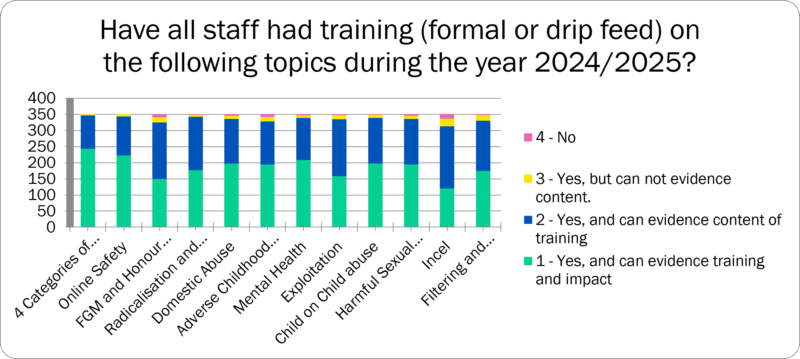
| 2024/25 | 2023/24 | 2022/23 | 2021/22 | 2020/21 | 2019/20 | 2018/19 | |
| 4 Categories of abuse – Physical, Emotional, Sexual, Neglect | 98.6% | 100% | 100% | 96% | 100% | 100% | 100% |
| FGM and Honor Based violence | 92.6% | 96% | 97% | 91% | 99% | – | – |
| Prevent / Radicalisation | 97.4% | 99.7% | 99% | 95% | – | – | – |
| Domestic Abuse | 95.4% | 98% | 98% | 96% | – | – | – |
| Mental Health | 96.6% | 98% | 98% | 95% | 100% | – | – |
| Adverse Childhood Experiences / Trauma | 93.4% | 97% | 95% | 93% | – | – | – |
| Exploitation – CSE, CCE, Gangs | 95.1% | 99% | 99% | 94% | 99% | 98% | – |
| Child on Child abuse | 96.6% | 99% | 99% | 96% | 99% | 99% | 94% |
| Harmful Sexual Behaviour | 95.7% | 99% | 99% | 96% | – | – | – |
| Online Safety | 97.7% | 100% | 100% | 96% | – | – | – |
| Incel | 89.2% | 57% | 75% | – | – | – | – |
| Filtering & Monitoring | 94% | 98% | 84% | – | – | – | – |
Review of actions 2022/23 Identified actions
- DES MASH team to work with DSCP to produce guidance and podcast on case resolution protocol – education specific. IN PRODUCTION.
- Share SWGfL podcasts in Newsletter, forum and FB group. ACHIEVED.
- Settings to ensure they are providing all staff with Mental Health training throughout the year. PARTLY ACHIEVED
Review of actions 2024/25 Identified actions:
- Ensure that requests for help are followed up when no communications are received by settings
- Liaise with Front Door and social care to explore optimum time scales. ACHIEVED
- Include methodologies for pursuit in training, forums, newsletters etc. ACHIEVED
Ensure that all safeguarding personnel know how to enact the case resolution protocol
- Revisit podcast/video
- Create a One Minute Guide
- Liaise with social care and attempt to retrieve data of volume of cases, outcomes and learning. ABOVE ON HOLD WHILST CASE RESOLUTION PROTOCOL WAS UNDER REVIEW
Ensure that training and Continuing Professional Development & Learning pathways are identified and shared with safeguarding teams.
- Revisit and review the training calendar NOT YET ACHIEVED
- Share via newsletters and face to face events/forums/conferencing ACHIEVED
Ensure that settings re-focus on “everyone’s responsibility” and “it can happen here” including designated personnel, systems, processes, whistleblowing and the need for immediate action in settings
- Provide/ redistribute poster material ACHIEVED
- Focus on training, newsletters, reviews, and forums. ACHIEVED
Ensure that all settings are delivering robust messages about the impact of absence on pupil safeguarding and wellbeing.
- Liaise with inclusion and attendance teams to share common messages. ACHIEVED
- Focus on newsletters and forums. Sharing good practice via forums etc. ACHIEVED
From the Section 175 responses and in light of the proposed changed to KCSiE September 2026:
IDENTIFIED ACTIONS 2025/26:
- Develop additional materials, OMG, resources to support all staff in settings to identify mental health concerns.
- Update annual CPD template/suggestions for settings and add to DES safeguarding website.
- Raise setting staff knowledge on
- FGM and Honour Based Abuse
- DV&A
- ACEs
- Exploitation
- HSB
- How to report a concern to the Front Door
Through OMGs, training, newsletters, podcasts, signposting, Facebook and Safeguarding Conference.
Part two: The management of Safeguarding
Q/Does your Governing/Trust Body have strategic leadership of safeguarding across your school and do they understand their legal requirements set out in KCSiE 2024?
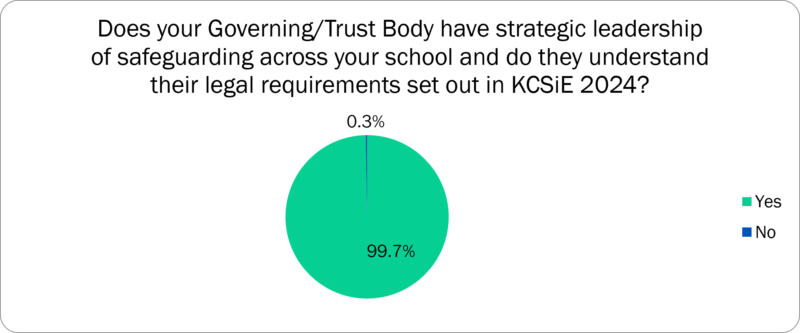
| 2024/25 | 2023/24 | 2022/23 | 2021/22 | 2020/21 | 2019/20 | 2018/19 |
| 99.7% | 99.5% | 99% | 99% | – | – | – |
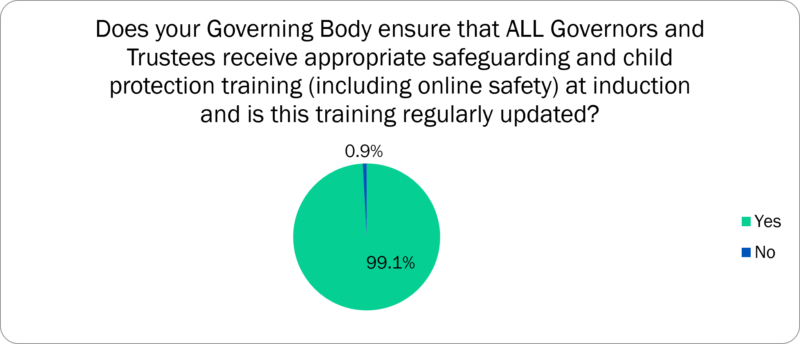
Q/Does your Governing Body ensure that ALL Governors and Trustees receive appropriate safeguarding and child protection training (including online safety) at induction and is this training regularly updated?
| 2024/25 | 2023/24 | 2022/23 | 2021/22 | 2020/21 | 2019/20 | 2018/19 |
| 99.1% | 99.6% | 99% | 98% | – | – | – |
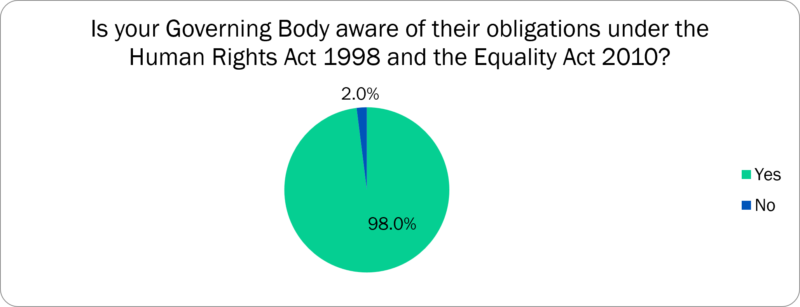
Q/Is your Governing Body aware of their obligations under the Human Rights Act 1998 and the Equality Act 2010?
| 2024/25 | 2023/24 | 2022/23 | 2021/22 | 2020/21 | 2019/20 | 2018/19 |
| 98% | 98.1% | 96% | 95% | – | – | – |
Q/Does the Governing Body recognise the importance of information sharing between practitioners and local agencies. This should include ensuring arrangements are in place that set out clearly the processes and principles for sharing information within the school or college and with local authority children’s social care, the safeguarding partners and other organisations, agencies, and practitioners as required?
| 2024/25 | 2023/24 | 2022/23 | 2021/22 | 2020/21 | 2019/20 | 2018/19 |
| 98.6% | 99.7% | – | – | – | – | – |
Q/Are all staff aware that the Data Protection Act 2018 and UK GDPR do not prevent the sharing of information for the purposes of keeping children safe?
| 2024/25 | 2023/24 | 2022/23 | 2021/22 | 2020/21 | 2019/20 | 2018/19 |
| 99.7% | 100% | 100% | 99% | 99% | 99% | 95% |
Q/Do you hire or rent out your school facilities to organisations or individuals?
| 2024/25 | 2023/24 | 2022/23 | 2021/22 | 2020/21 | 2019/20 | 2018/19 |
| 53.8% | 50.8% | – | – | – | – | – |
Identified Actions 2025/26
In light of changes to Working Together to Safeguarding Children 2026 e.g. the greater emphasis on sharing information and Section 175 responses (2024/25) DES Safeguarding Team to work with partner agencies to continue to develop settings understanding, processes, practice and challenge with regard to:
- All in settings are accountable and know of their role in protecting children
- How, when and who to share information to safeguard children
- Equality, Diversity and Inclusion: all children experience risk, harm and protection differently.
Filtering and Monitoring
Review of Identified actions 2024/25
All settings to ensure they have implemented the requirements from KCSiE 2024 regarding Filtering and monitoring. This must include:
- Staff training for all staff CONTINUING
- DES to produce and roll out bespoke training NOT YET ACHIEVED – however settings signposted to organisations such as the SWGfL
- Identify and share existing good practice via forums CONTINUING
ALTERNATIVE PROVISION AND ANNEX-R
Q/Does the school ensure that suitable checks are undertaken to ensure children who are accessing alternative provision, including any on-line provision is deemed safe and that evidence of these checks are held by the school?
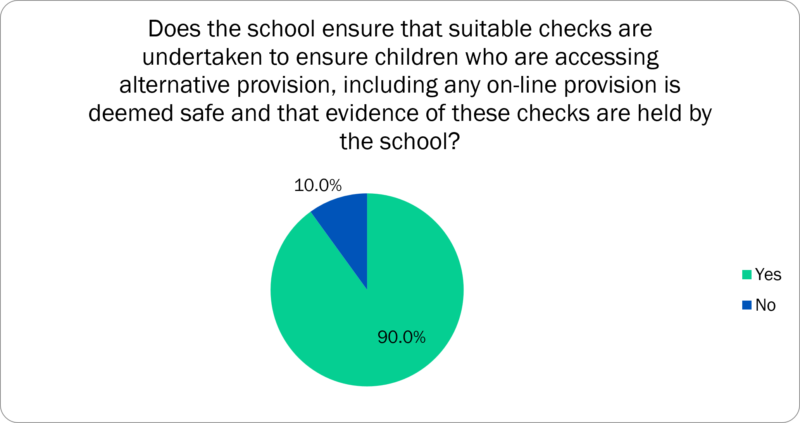
Those settings rating ‘No’ has increased from 6% (2023/24) to 10% (2024/25)
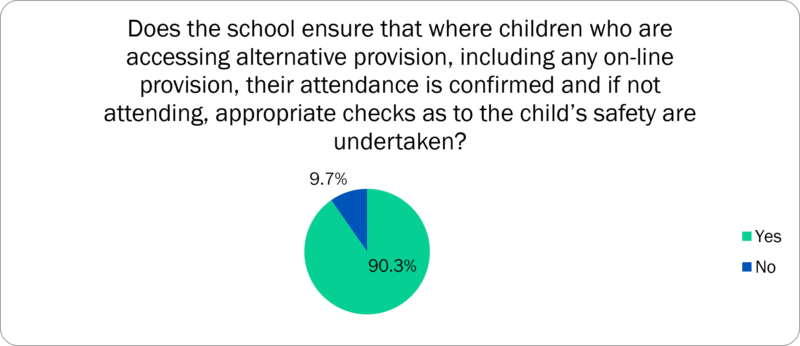
Q/Does the school ensure that where children who are accessing alternative provision, including any on-line provision, their attendance is confirmed and if not attending, appropriate checks as to the child’s safety are undertaken?
Q/Does the school ensure that any part-time timetables (Annex-R) are fully risk assessed to ensure that safeguarding concerns are fully considered and these plans are regularly reviewed involving parents and, where appropriate, the child’s views and shared with the local authority?
Identified Actions 2025/26
Support settings to ensure that suitable checks are undertaken for alternative provision, including any on-line provision
- Create a template checklist for schools to adapt/personalise
- Provide additional information at forums, in newsletters and other communications.
Part three: Safer recruitment
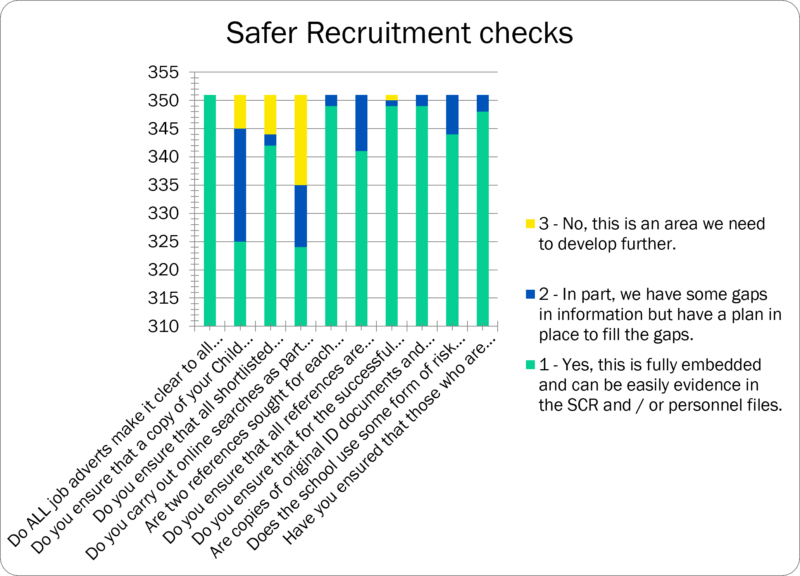
Q/Do ALL job adverts make it clear to all candidates that safeguarding checks will be undertaken?
| 2024/25 | 2023/24 | 2022/23 | 2021/22 | 2020/21 | 2019/20 | 2018/19 |
| 100% | 100% | 99% | 99% | – | – | – |
Q/Do you ensure that a copy of your child protection policy is referred to within the application pack – link to website or attached version?
| 2024/25 | 2023/24 | 2022/23 | 2021/22 | 2020/21 | 2019/20 | 2018/19 |
| 98.2% | 96% | 84% | 35% | – | – | – |
Q/Do you ensure that all shortlisted candidates complete a self-declaration of their criminal record information that may make them unsuitable to work with children?
| 2024/25 | 2023/24 | 2022/23 | 2021/22 | 2020/21 | 2019/20 | 2018/19 |
| 98% | 99% | 95% | 96% | – | – | – |
Q/Do you carry out online searches as part of due diligence for shortlisted candidates?
| 2024/25 | 2023/24 | 2022/23 | 2021/22 | 2020/21 | 2019/20 | 2018/19 |
| 95.4% | 95% | 83% | 72% | – | – | – |
Q/Are two references sought for each employee including their most recent employer and can this be evidenced? Or, if the employee doesn’t have two references, do they have a risk assessment in place?
| 2024/25 | 2023/24 | 2022/23 | 2021/22 | 2020/21 | 2019/20 | 2018/19 |
| 100% | 100% | 99% | 100% | 100% | 99% | 95% |
Q/Do you ensure that all references are verified?
| 2024/25 | 2023/24 | 2022/23 | 2021/22 | 2020/21 | 2019/20 | 2018/19 |
| 100% | 99.7% | 99% | – | – | – | – |
Q/Do you ensure that for the successful candidate, the original DBS certificate is seen but that the certificate is not copied? (Slight change in wording to question 2024/25)
| 2024/25 | 2023/24 | 2022/23 | 2021/22 | 2020/21 | 2019/20 | 2018/19 |
| 99.7% | 100% | 100% | 100% | 99% | 100% | 99% |
Q/Are copies of original ID documents and qualifications, where required, held on file?
| 2024/25 | 2023/24 | 2022/23 | 2021/22 | 2020/21 | 2019/20 | 2018/19 |
| 100% | 100% | 99% | 99% | 99% | 99% | 97% |
Q/Does the school use some form of risk assessment for long standing employees where there are missing documents on files such as references and medical checks?
| 2024/25 | 2023/24 | 2022/23 | 2021/22 | 2020/21 | 2019/20 | 2018/19 |
| 100% | 100% | 96% | 98% | 96% | 97% | 81% |
Q/Have you ensured that those who are qualified teachers (including those not working as teachers such as TAs), or those deemed to be in teaching work have been checked to ensure they are not prohibited?
| 2024/25 | 2023/24 | 2022/23 | 2021/22 | 2020/21 | 2019/20 | 2018/19 |
| 100% | – | – | – | – | – | – |
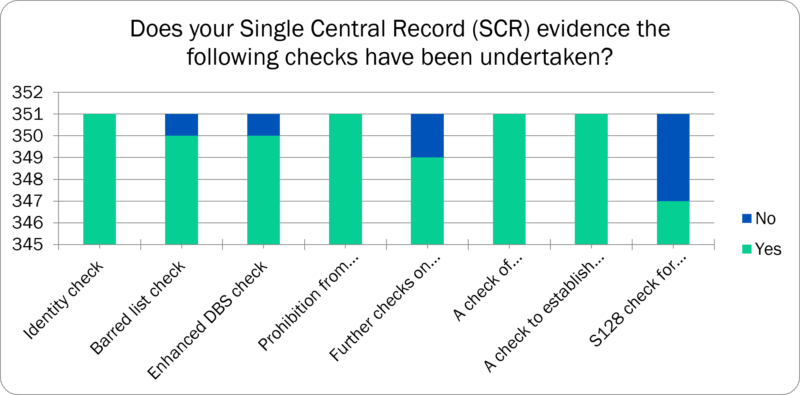
Q/Does your Single Central Record (SCR) evidence the following checks have been undertaken?
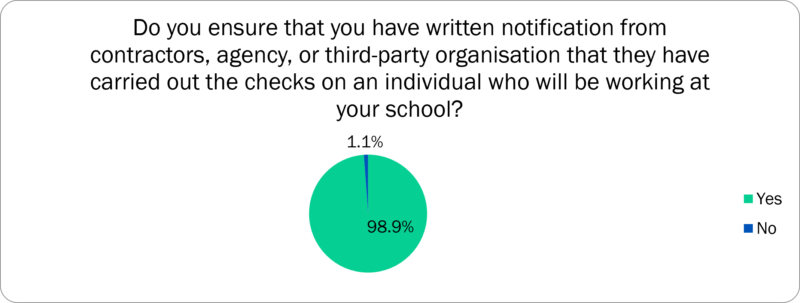
Q/Do you ensure that you have written notification from contractors, agency, or third-party organisation that they have carried out the checks on an individual who will be working at your school?
Q/Do you record fee funded trainee teachers on the SCR?
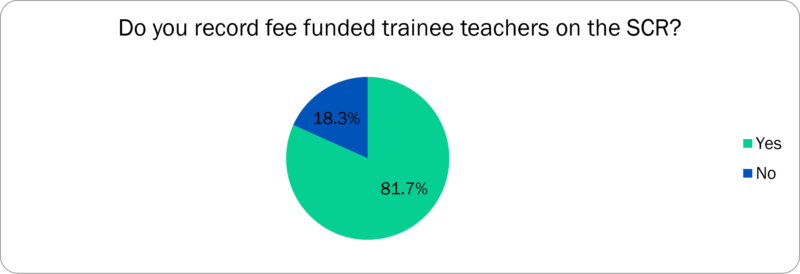
Most settings who responded ‘no’ did not employ fee funded trainee teachers within their setting. Conversations also revealed that there were misconceptions about the nature of “fee funding” which refers to trainee teaching staff who are fully employed by the setting and receive a training salary.
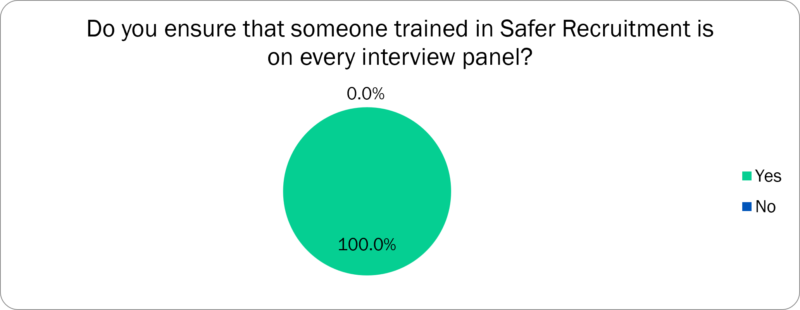
Q/Do you ensure that someone trained in Safer Recruitment is on every interview panel?
Identified Actions 2025/26
There has been a noticeable decline in the ‘Yes’ responses to Q/Does your Single Central Record (SCR) evidence the following checks have been undertaken?
- Review the Devon SCR suggested template, amend and circulate as necessary
- Create a checklist of SCR ‘must haves’ for settings to use when supported by online Recruitment packages
Part four: Opportunities to teach safeguarding
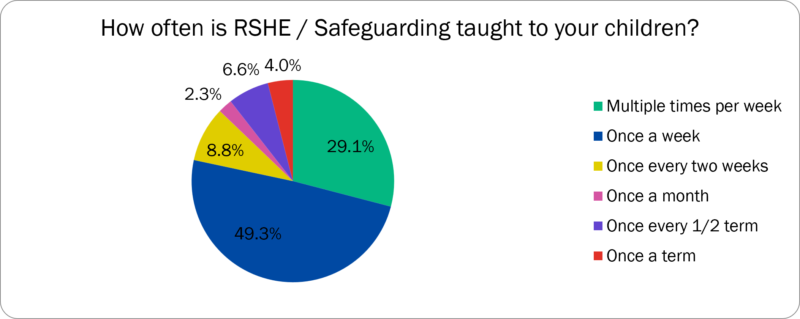
Q/ How often is RSHE / Safeguarding taught to your children?
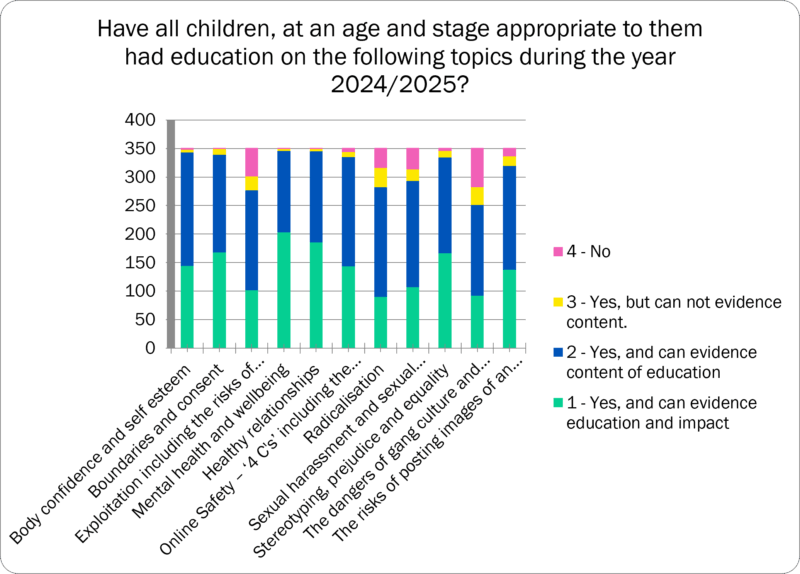
Q/ Have all children, at an age and stage appropriate to them had education on the following topics during the year 2024/2025?
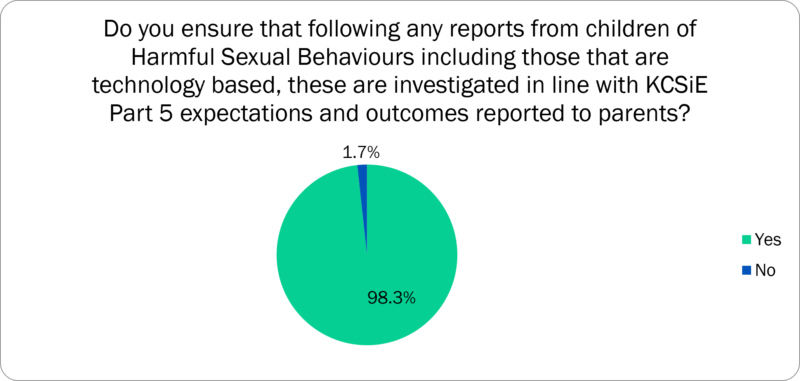
Q/ Do you ensure that following any reports from children of Harmful Sexual Behaviours including those that are technology based, these are investigated in line with KCSiE Part 5 expectations and outcomes reported to parents?
Q/ What documents do you use to support you to assess healthy, concerning or harmful sexual behaviour should incidents be reported including those for learners with SEND?
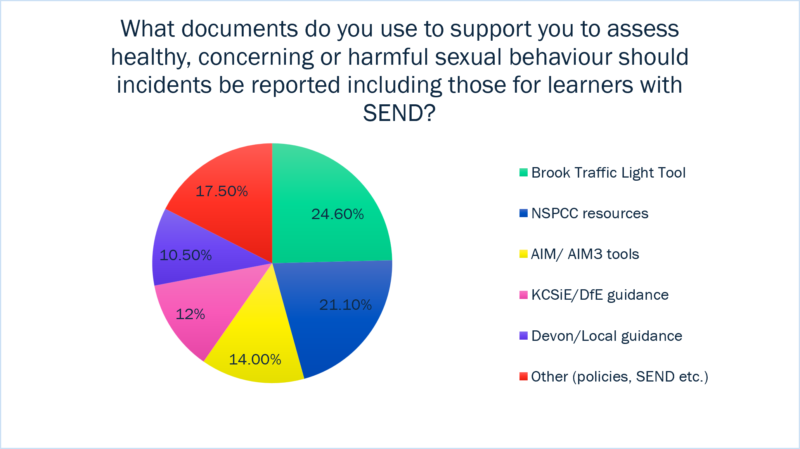
There is a clear reliance on a small number of core tools, with the Brook Traffic Light Tool (24.6%, n=70) emerging as the most consistently used resource across settings. NSPCC resources (21.1%, n=60) also form a significant component, with the AIM/AIM3 tools (14.0%, n=40) used less frequently. Statutory guidance, including KCSIE and DfE documentation (12.3%, n=35), whilst notably, local Devon guidance (10.5%, n=30) is referenced less consistently.
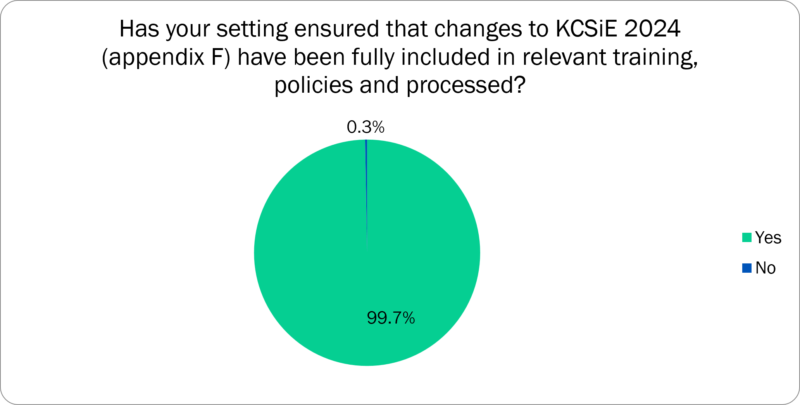
Q/ Has your setting ensured that changes to KCSiE 2024 (appendix F) have been fully included in relevant training, policies and processed?
- DES to await, evaluate and take action when the 2024 DfE curriculum review is published, and recommendations are received. Guidance, signposting and further information provided in newsletters and forums ACHIEVED
- Via e.g. forums and task and finish groups DES to work with best practitioners to share examples of effective resources and teaching materials ACHIEVED
- Via e.g. forums and task and finish groups DES to work with best practitioners to develop and share impact evaluation tools for schools. ACHIEVED
- Reinstate FGM question in 2025/26 review. NOT YET ACHIEVED
Part five (B): Devon specific questions
Q/ Have you undertaken a Prevent Self-Assessment since September 2024? Understanding and identifying radicalisation risk in your education setting – GOV.UK
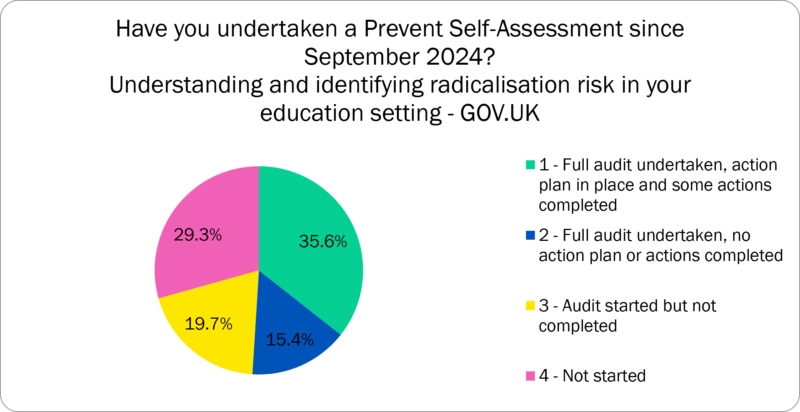
| 2024/25 | 2023/24 | 2022/23 | 2021/22 | 2020/21 | 2019/20 | 2018/19 |
| 51% | 42.6% | – | – | – | – | – |
Q/Do you have a up to date ‘Ready for Anything’ or Lockdown Policy which has been practiced since September 2024?
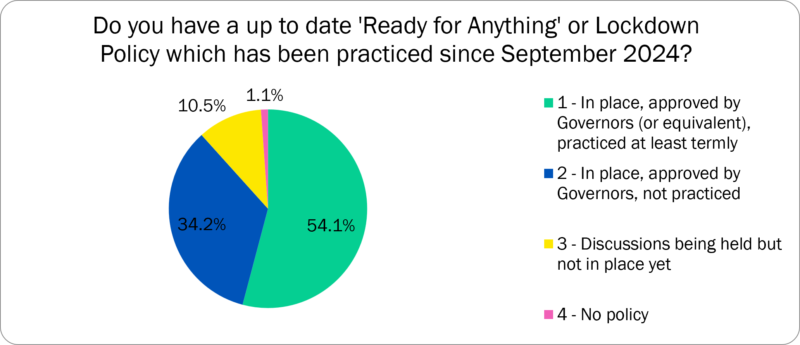
| 2024/25 | 2023/24 | 2022/23 | 2021/22 | 2020/21 | 2019/20 | 2018/19 |
| 88.3% | 83.6% | – | – | – | – | – |
Q/Can leaders demonstrate how, for all the groups below, every effort possible has been taken to ensure children remain at school and attend well?
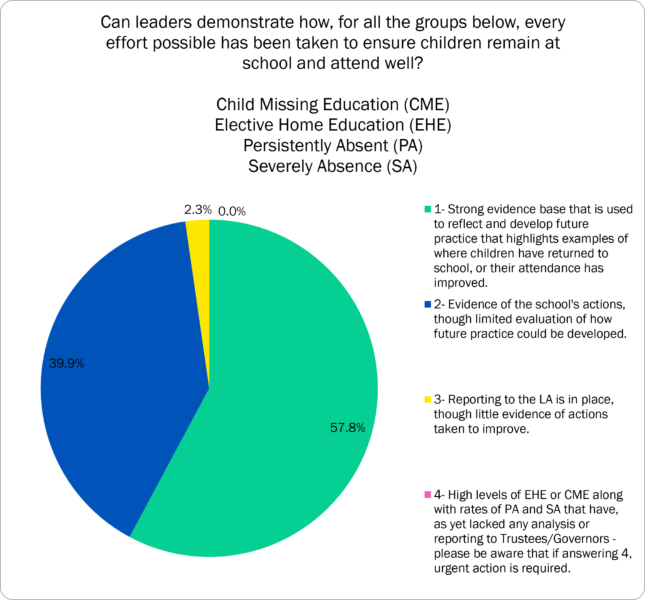
Most schools demonstrate clear systems and strong effort to support attendance, including monitoring, family engagement, and multi‑agency working (often supported by Trust attendance leads). However, evidence of impact is less consistently demonstrated, with many identifying the need to strengthen recording, case studies, and evaluation of actions, particularly for persistently and severely absent pupils.
Q/Do you ensure that all children with SEND, mental health needs or medical conditions have individual plans which have been agreed by parents / carers?
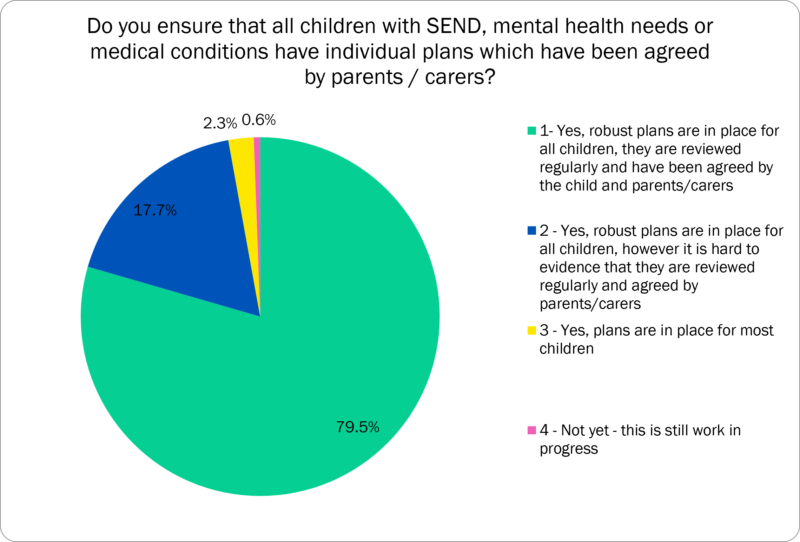
For those settings rating as ‘3/4’ the most common responses suggest:
- Consistency varies, particularly around:
- Regular review cycles
- Ensuring all relevant groups are covered
- Mental health plans are less consistently in place, often supported through external services instead
- Some settings note that not all children require formal plans, in line with graduated approaches
Q/ For children with part-time timetables, what measures do you have to ensure that this decision also considers any safeguarding concerns and any measures, ‘safety plans’, or similar are in place?
Most schools demonstrate that safeguarding is central to decisions about part-time timetables, with strong emphasis on risk assessment, multi-agency involvement, and regular review. Typically, part‑time timetables are only used in exceptional, short-term circumstances, are agreed with parents and often external professionals, and include written plans such as Annex R, risk assessments and safety plans. Schools ensure ongoing monitoring through regular meetings, welfare checks, and “eyes‑on” contact, often daily or weekly, and aim to quickly reintegrate pupils to full-time education. Many settings also highlight that part-time timetables are avoided where safeguarding concerns cannot be mitigated, reinforcing a cautious, safety-led approach.
Q/ Does the DSL team ensure that they use wider professional learning from sources such as the Devon SCP, DES safeguarding team newsletters or NSPCC to continually update and inform their practice?
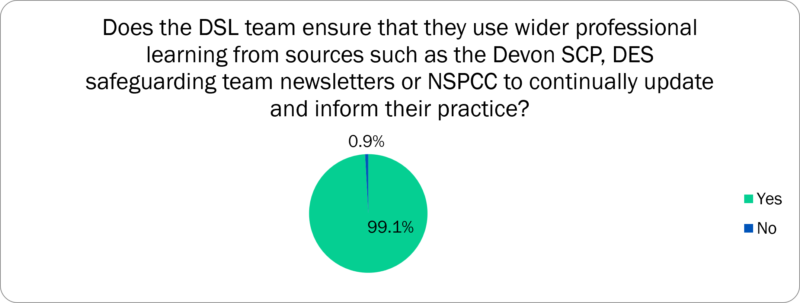
The majority of responses indicate that DSL teams actively engage with a wide range of professional learning sources, including Devon SCP, DES safeguarding newsletters, and NSPCC resources, to keep safeguarding practice current. This learning is typically embedded through regular dissemination mechanisms such as weekly or fortnightly safeguarding briefings, staff bulletins, CPD sessions, and Trust safeguarding networks. DSLs frequently attend forums, conferences, and training, ensuring that emerging themes and guidance inform both leadership decisions and whole‑staff practice. Overall, there is a strong culture of ongoing professional development and “drip‑feeding” key messages, although a small number of responses suggest scope to further strengthen consistency and reach across all staff.
Q/ Do you have a vulnerable children list?
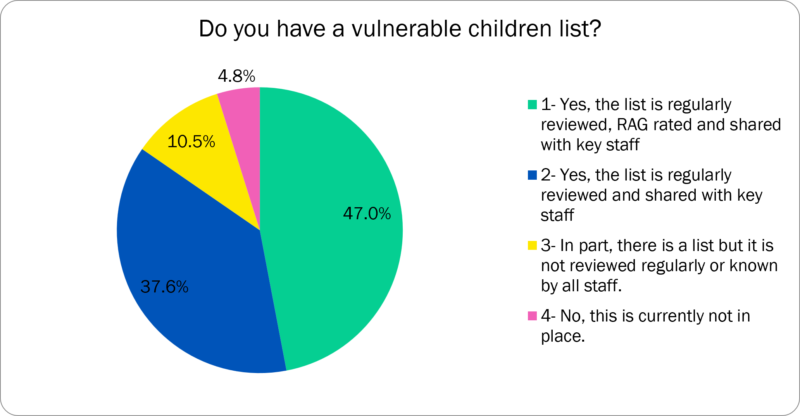
| 2024/25 | 2023/24 | 2022/23 | 2021/22 | 2020/21 | 2019/20 | 2018/19 |
| 84% | 90.8% | – | – | – | – | – |
Q/Do you include previously looked after children on your vulnerable children list?
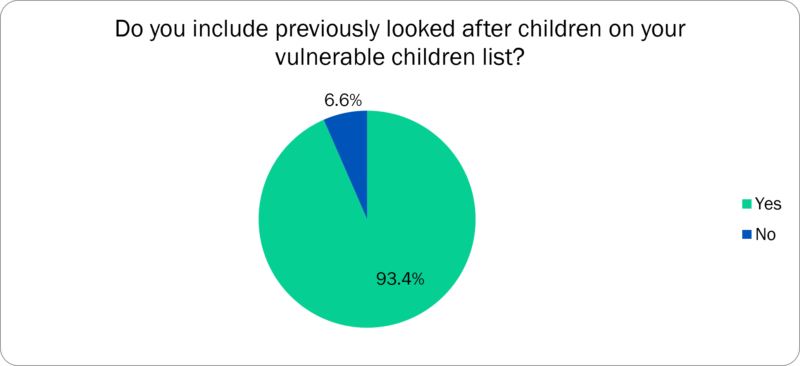
| 2024/25 | 2023/24 | 2022/23 | 2021/22 | 2020/21 | 2019/20 | 2018/19 |
| 93.4% | 92.7% | – | – | – | – | – |
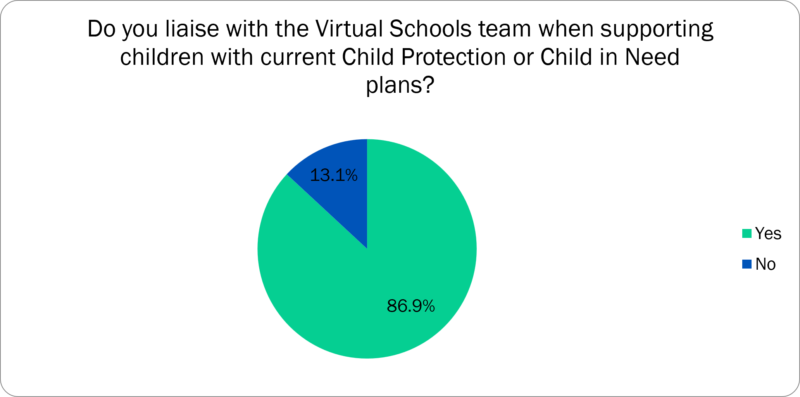
Q/Do you liaise with the Virtual Schools team when supporting children with current Child Protection or Child in Need plans?
| 2024/25 | 2023/24 | 2022/23 | 2021/22 | 2020/21 | 2019/20 | 2018/19 |
| 86.9% | 84.8% | – | – | – | – | – |
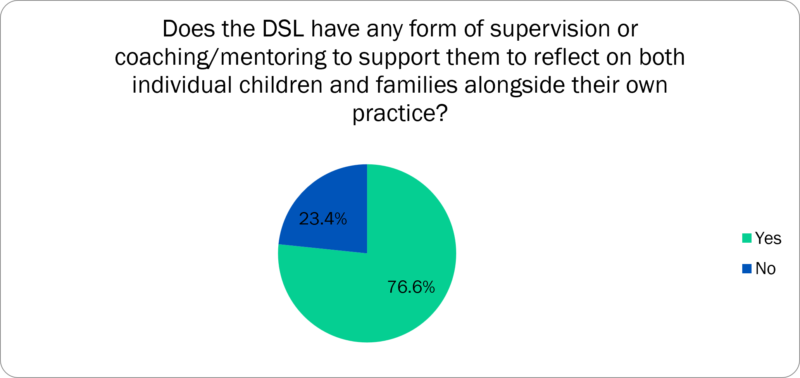
Q/Does the DSL have any form of supervision or coaching/mentoring to support them to reflect on both individual children and families alongside their own practice?
| 2024/25 | 2023/24 | 2022/23 | 2021/22 | 2020/21 | 2019/20 | 2018/19 |
| 76.6% | 76.1% | – | – | – | – | – |
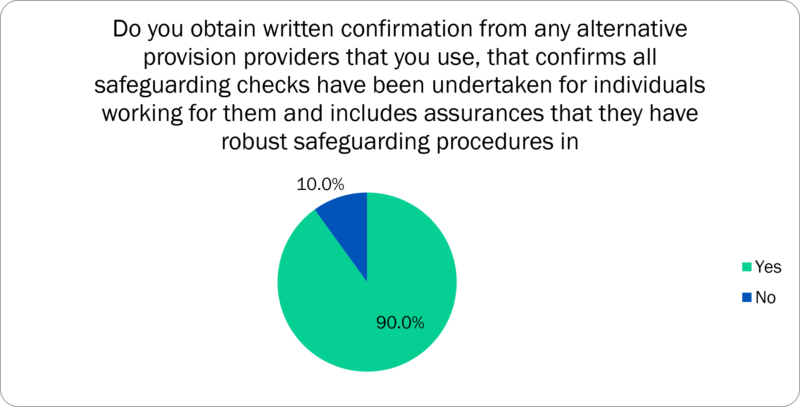
Q/Do you obtain written confirmation from any alternative provision providers that you use, that confirms all safeguarding checks have been undertaken for individuals working for them and includes assurances that they have robust safeguarding procedures in place?
| 2024/25 | 2023/24 | 2022/23 | 2021/22 | 2020/21 | 2019/20 | 2018/19 |
| 90% | 92.9% | – | – | – | – | – |
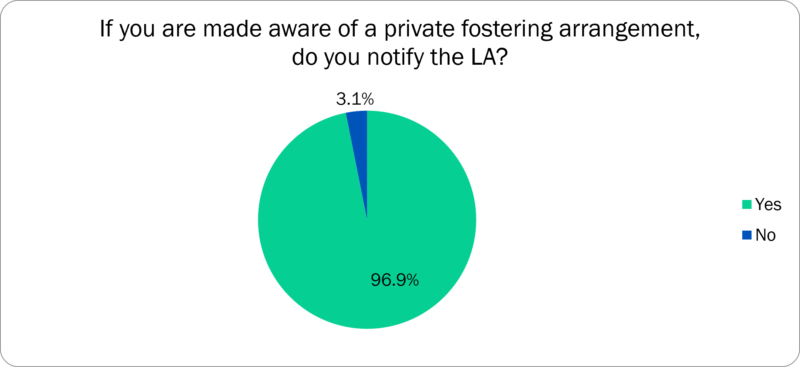
Q/If you are made aware of a private fostering arrangement, do you notify the LA?
| 2024/25 | 2023/24 | 2022/23 | 2021/22 | 2020/21 | 2019/20 | 2018/19 |
| 96.9% | 95.1% | – | – | – | – | – |
Review of Identified actions 2024/25;
- DES to continue to exemplify methods for online safety auditing. ACHIEVED
- All training to flag up and exemplify Martyn’s Law with an allied One Minute Guide. ACHIEVED
- DES to promote the Prevent self-assessment tool. Support with e.g. workshops. PARTLY ACHIEVED (workshop at 2025 Conference)
- Ensure that all settings know who to contact and how to contact Virtual School personnel responsible for outcomes for children on plans. PARTLY ACHIEVED
- DES to explore a DSL supervision offer and create an exploratory pilot scheme with a view to traded opportunities, PARTLY ACHIEVED
- DES to support quality assurance of all Alternative Providers with a checklist and guidance. NOT YET ACHIEVED
- Ensure that all settings inform the local authority of private fostering arrangements. PARTLY ACHIEVED
Identified actions 2025/26
- Ensure that all settings know who to contact and how to contact Virtual School personnel responsible for outcomes for children on plans.
- DES to support quality assurance of all Alternative Providers with a checklist and guidance
- Provide OMG information and possible templates for vulnerable pupil lists.
- Support schools completing the Prevent Self-Assessment, (Safeguarding Conference workshop 2025)
- Continue to advise on and promote the expectations for Martyn’s Law, ‘ready for anything, lockdown and invacuations’
Celebrations and frustrations
Q/What is your biggest safeguarding celebration within your setting during last academic year (2024-25)?
The top 5 ‘Headline’ Statements:
- “Safeguarding is fully embedded as a whole-school responsibility, driven by a proactive, vigilant culture.”
- “Earlier identification and stronger staff confidence are leading to faster, more effective support for children.”
- “Improved attendance for vulnerable pupils has had a direct and measurable impact on safeguarding outcomes.”
- “Strong relationships with families and partners enable early help and prevent escalation.”
- “External validation confirms safeguarding as a key strength, with consistent, high-quality practice across the school.”
Using strategic themes the following celebrations were identified within the Section 175 returns:
1. Overarching Culture of Safeguarding
Key pattern: Safeguarding is embedded, proactive, and owned by all.
What stands out:
- “Everyone’s responsibility” is deeply embedded
- Strong professional curiosity
- Increased confidence and consistency across staff
- Early identification is happening more reliably
Key statements:
- “Safeguarding is no longer a reactive process but a proactive, whole-school responsibility embedded in daily practice.”
- “Staff act quickly, confidently and consistently to protect pupils, with a shared culture of vigilance.”
- “A relentless, child-centred culture ensures no concern is too small to be acted upon.”
- “Professional curiosity has become a defining strength across all staff groups.”
2. Staff Confidence, Training & Systems (CPOMS, CPD, Leadership)
Key pattern: Systems and training are driving consistency and quality.
What stands out:
- Improved CPOMS use (quality, actions, ownership)
- Regular CPD, briefings, safeguarding bulletins
- Expansion of DSL/DDSL capacity
- Strong distributed leadership
Key statements:
- “Improved training and systems have transformed safeguarding into a consistent, high-quality practice across the school.”
- “Staff confidence in recognising and reporting concerns has significantly increased, leading to earlier intervention.”
- “Robust recording systems ensure nothing is missed and accountability is clear.”
- “Distributed safeguarding leadership has strengthened capacity, responsiveness and oversight.”
3. Early Help & Preventative Work
Key pattern: Shift from reactive to preventative safeguarding.
What stands out:
- Growth and impact of Early Help
- Reduced escalation to CP/CIN in some cases
- Families accessing support earlier
- Stronger pastoral and family support roles
Key statements:
- “A strengthened Early Help offer has enabled earlier intervention, reducing the need for escalation.”
- “Preventative safeguarding approaches ensure the right support is in place at the right time.”
- “Our relational approach with families is key to early identification and sustained change.”
- “We are preventing rather than reacting to safeguarding concerns.”
4. Impact on Attendance & Engagement
Key pattern: Attendance work is a major safeguarding success.
What stands out:
- Significant improvements for vulnerable and EBSA pupils
- Reduction in persistent absence and part-time timetables
- Strong link between attendance and safeguarding
Key statements:
- “Improved attendance has significantly strengthened our ability to safeguard vulnerable pupils.”
- “Targeted interventions have enabled some of our most vulnerable learners to re-engage with education.”
- “Attendance is recognised as a key safeguarding priority, with clear impact on pupil wellbeing.”
- “Persistent absence has reduced through strong relational and multi-agency approaches.”
5. Multi-Agency Working & Professional Challenge
Key pattern: Strong partnerships and confident challenge.
What stands out:
- Effective work with social care, CAMHS, MHST, FIT
- Increased escalation and challenge where needed
- Better outcomes through persistence
Key statements:
- “Robust multi-agency working has led to improved outcomes for our most vulnerable children.”
- “We are confident in challenging external professionals to ensure children receive the support they need.”
- “Persistence and professional challenge have been key in securing timely and appropriate interventions.”
- “Strong partnerships ensure coordinated, child-centred support.”
6. Relationships with Pupils & Families
Key pattern: Trusting relationships drive disclosure and support.
What stands out:
- Strong rapport with vulnerable families
- Increased parental engagement
- Pupils confident to speak up and identify trusted adults
Key statements:
- “Strong, trusting relationships enable children and families to seek help early.”
- “Pupils report feeling safe and able to speak to trusted adults.”
- “Open communication with families allows concerns to be addressed before escalation.”
- “Relational safeguarding is at the heart of our practice.”
7. Pupil Voice, Safety & Curriculum
Key pattern: Children understand safeguarding and feel safe.
What stands out:
- Pupil voice strengthened (councils, panels, surveys)
- Safeguarding embedded in curriculum (PSHE, online safety)
- Children can articulate how to stay safe
Key statements:
- “Children are knowledgeable, confident, and able to articulate how to keep themselves safe.”
- “Pupil voice plays a central role in shaping safeguarding practice.”
- “Safeguarding is embedded across the curriculum, not treated as a standalone topic.”
- “Students know who to talk to and feel confident that they will be listened to.”
8. Targeted Impact & Case Outcomes
Key pattern: Clear evidence of life-changing interventions.
What stands out:
- Children moved to safer environments
- Families supported through crisis (DA, neglect, mental health)
- Improved wellbeing, attendance, and outcomes
Key statements:
- “Sustained, persistent safeguarding work has led to life-changing outcomes for vulnerable children.”
- “Children who were previously at risk are now safe, supported and thriving.”
- “Our work has contributed to significant improvements in home stability, wellbeing and educational engagement.”
- “Targeted interventions have enabled young people to successfully transition into further education and beyond.”
9. External Validation & Quality Assurance
Key pattern: Strong external recognition.
What stands out:
- Positive Ofsted, ISI, trust reviews, audits
- Safeguarding highlighted as a strength
- Recognition of culture, systems, and impact
Key statements:
- “Safeguarding has been recognised externally as a significant strength of the school.”
- “Inspection and audit outcomes validate the consistency and impact of our safeguarding practice.”
- “Our safeguarding culture has been described as ‘relentless’ and exemplary.”
10. Site Safety & Contextual Safeguarding
Key pattern: Physical and contextual safety improvements.
What stands out:
- Improved site security, systems, filtering
- Online safety developments (SENSO, curriculum, monitoring)
Key statements:
- “Improvements to site security and contextual safeguarding have enhanced pupils’ sense of safety.”
- “Robust online safety systems ensure pupils are protected in an evolving digital landscape.”
Q/ What is your biggest safeguarding frustration within your setting during last academic year?
The top 6 ‘Headline’ Statements:
- “Thresholds for support remain too high, leaving schools holding significant safeguarding risk.”
- “Communication and information-sharing across agencies is inconsistent and often delayed.”
- “Schools are increasingly acting beyond their remit, leading complex Early Help and safeguarding cases.”
- “Delays in accessing external and specialist services are impacting timely support for vulnerable children.”
- “Frequent changes in social workers undermine continuity, relationships and outcomes.”
- “Demand and complexity are rising, while capacity and external support continue to reduce.”
Using strategic themes the following frustrations were identified within the Section 175 returns:
1. Thresholds Too High & Risk Held in School
Key pattern: Significant concerns not meeting statutory thresholds, leaving schools holding risk.
What stands out:
- Cases repeatedly stepped down to Early Help
- Concerns not meeting thresholds despite evidence
- “Good enough care” standard perceived as too low
- Risk held at Level 2/3 for too long
Key statements:
- “Thresholds for statutory intervention are perceived as too high, leaving schools holding significant safeguarding risk for extended periods.”
- “Serious concerns are frequently stepped down to Early Help, even when risk remains evident.”
- “The current system often requires situations to deteriorate before statutory support is secured.”
- “Schools are managing cases that would benefit from statutory intervention, placing pressure on capacity and expertise.”
2. Communication & Information Sharing Failures
Key pattern: Delays, lack of feedback, and poor communication with external agencies.
What stands out:
- No outcomes from referrals unless chased
- Poor communication from social workers
- Lack of meeting invites/minutes
- Inconsistent or conflicting advice
Key statements:
- “Delays and gaps in communication from external agencies significantly impact timely safeguarding responses.”
- “Schools frequently need to chase outcomes, increasing workload and reducing efficiency.”
- “Information sharing across agencies remains inconsistent and at times unreliable.”
- “A lack of timely updates creates uncertainty around risk and next steps for vulnerable children.”
3. Inconsistency & Turnover of Social Workers
Key pattern: High staff turnover undermines continuity and relationships.
What stands out:
- Frequent changes in social workers
- Lack of handover between professionals
- Inconsistent practice and decision-making
Key statements:
- “High turnover of social workers disrupts continuity, delays progress, and impacts trust with families.”
- “Inconsistent decision-making across cases leads to inequitable outcomes for children.”
- “Frequent changes result in repeated retelling of concerns, delaying effective intervention.”
4. Over-Reliance on Schools / Capacity Pressures
Key pattern: Schools are expected to lead beyond their remit.
What stands out:
- Schools leading Early Help without capacity
- Acting as lead professionals across multiple complex cases
- Managing areas outside education (DV, housing, MH)
- Increasing workload with limited staff
Key statements:
- “Schools are increasingly acting as the primary support service for families, beyond their expertise and capacity.”
- “The expectation for schools to lead Early Help in complex cases places significant strain on staffing and resources.”
- “Safeguarding demands are growing while capacity and external support are diminishing.”
- “Schools are often left as the only consistent agency supporting vulnerable families.”
5. Early Help System Pressures & Limitations
Key pattern: Early Help is overused, under-resourced, and difficult to access.
What stands out:
- Early Help used as default response
- Limited external engagement in TAFs
- Families not engaging
- Long waits / limited impact
Key statements:
- “Early Help has become the default response, often without sufficient resource or multi-agency input.”
- “Families can remain in Early Help for extended periods without meaningful change.”
- “Limited capacity within Early Help restricts timely and effective support for families.”
- “Where families do not engage, there is limited escalation despite ongoing risk.”
6. Delays in Accessing Specialist Support (SEND & Mental Health)
Key pattern: Long waits and high thresholds for support services.
What stands out:
- CAMHS and MHST thresholds high
- EHCP delays impacting safety
- Limited access to therapy and specialist provision
Key statements:
- “Delays in accessing specialist services leave vulnerable pupils without timely support.”
- “High thresholds and long waiting lists for mental health and SEND services increase safeguarding risks.”
- “Schools are required to bridge gaps in provision without the necessary resources or expertise.”
7. Multi-Agency Working Not Fully Joined-Up
Key pattern: Lack of shared responsibility and coordination.
What stands out:
- Other agencies not attending meetings
- Schools leading TAFs in non-education cases
- Health and social care disengagement
Key statements:
- “Multi-agency working is not consistently joined-up, with schools often leading without appropriate partner engagement.”
- “There is a lack of shared responsibility across agencies in safeguarding vulnerable families.”
- “Effective collaboration is hindered by inconsistent engagement and unclear ownership of cases.”
8. Attendance & EBSA Challenges
Key pattern: Attendance concerns not treated as safeguarding by all agencies.
What stands out:
- Persistent absence and EBSA increasing
- Limited external support
- Parents difficult to engage
Key statements:
- “Attendance is not consistently recognised as a multi-agency safeguarding concern.”
- “Persistent absence and EBSA require coordinated support, which is often unavailable.”
- “Schools are left to manage complex attendance issues without sufficient external intervention.”
9. Parental Engagement & Family Barriers
Key pattern: Non-engagement and complexity of family need.
What stands out:
- Families refusing support
- Parent voice overriding child voice
- Mental health and complex home situations
Key statements:
- “Parental non-engagement limits the effectiveness of Early Help and delays intervention.”
- “In some cases, parental voice outweighs the lived experience of the child.”
- “Complex family needs, including mental health, require support beyond what schools can offer.”
10. Systems, Processes & Bureaucracy
Key pattern: Inefficient systems add workload and delay action.
What stands out:
- Complex referral processes (Right for Children)
- Poor IT systems
- Time-consuming admin
Key statements:
- “Current systems and processes are time-consuming and reduce the efficiency of safeguarding responses.”
- “Administrative burden limits time available for direct support to children and families.”
- “Improved digital systems would significantly enhance communication and coordination.”
11. Increasing Complexity of Need
Key pattern: Rising demand and more complex cases.
What stands out:
- More high-risk cases
- Mental health, neglect, exploitation
- Cases becoming more entrenched
Key statements:
- “The complexity and volume of safeguarding need is increasing, while available support is reducing.”
- “Schools are managing more complex cases with greater intensity and duration.”
- “Needs are escalating faster than services can respond.”
Q/ Is there anything Devon Education Services – Safeguarding Team can do to support moving forward?
The top 6 ‘Headline’ Statements:
- “Stronger communication and feedback from social care remains a key priority for schools.”
- “Clearer, more consistent thresholds and escalation processes are essential.”
- “Schools need greater multi-agency support—safeguarding cannot sit primarily with education.”
- “Early Help systems must be strengthened to be more accessible, effective and collaborative.”
- “High-quality, accessible training and practical resources remain a key need.”
- “Investment in systems, service capacity and coordination will significantly improve safeguarding outcomes.”
The responses to this question by settings made reference to additional support and developments that DES, CSC and LA could make. Using strategic themes the following frustrations were identified within the Section 175 returns:
1. Communication & Information Sharing with Social Care
Key pattern: Schools want DES to influence and improve communication with Children’s Services.
What stands out:
- Need for timely updates on referrals and outcomes
- Lack of consistent communication from social workers
- Difficulty tracking cases and understanding status
Key statements:
- “Schools need consistent, timely feedback from social care to enable effective safeguarding decision-making.”
- “A transparent system for tracking referrals and case progress would significantly improve safeguarding outcomes.”
- “Reducing the need for schools to chase information would release valuable capacity for direct support to children.”
2. Clarity on Thresholds, Processes & Escalation
Key pattern: Schools want clearer understanding and consistency in thresholds and decision-making.
What stands out:
- Confusion about thresholds and outcomes
- Variation in decisions across teams
- Need for clearer escalation routes
Key statements:
- “Clear, consistent guidance on thresholds is essential to ensure the right support is secured at the right time.”
- “Schools need greater transparency around decision-making to build confidence in the system.”
- “Stronger escalation processes would support professional challenge and protect children more effectively.”
3. Strengthening Multi-Agency Working
Key pattern: A strong desire for DES to act as a bridge between education, social care, and health.
What stands out:
- Need for better joint working and shared responsibility
- Lack of engagement from health and other agencies
- Schools often leading Early Help alone
Key statements:
- “Effective safeguarding requires genuinely shared responsibility across all agencies, not a school-led model.”
- “DES is well placed to strengthen collaboration between education, social care and health.”
- “Improved multi-agency coordination would reduce duplication and improve outcomes for families.”
4. Early Help System Development
Key pattern: Schools want DES to help strengthen and simplify Early Help.
What stands out:
- Early Help difficult to access and navigate
- Lack of external agency involvement
- Too much reliance on schools as lead professionals
Key statements:
- “Early Help processes need to be clearer, more accessible, and supported by wider agencies.”
- “Schools require greater external support when leading Early Help, particularly in complex cases.”
- “A strengthened Early Help system would prevent escalation and reduce pressure on schools.”
5. Training, CPD & Resources
Key pattern: Strong demand for accessible, high-quality training and practical tools.
What stands out:
- Desire for more frequent, free or low-cost training
- Topic areas: online safety, HSB, mental health, thresholds, SEND
- Value of bite-size resources and practical tools
Key statements:
- “Accessible, high-quality CPD is essential to maintain strong safeguarding practice across all schools.”
- “Bite-size, practical resources are highly valued and support consistent whole-staff understanding.”
- “Emerging risks such as online harm and harmful sexual behaviour require ongoing training focus.”
6. Systems & Technology (Right for Children)
Key pattern: Strong frustration with systems and desire for improvement.
What stands out:
- Right for Children system not user-friendly
- Poor interoperability between agencies
- Time-consuming processes
Key statements:
- “Current systems do not support efficient safeguarding practice and require urgent review.”
- “A streamlined, user-friendly platform for multi-agency working would significantly improve communication and oversight.”
- “Digital systems should enable, not hinder, safeguarding processes.”
7. Access to Services & Capacity in the System
Key pattern: Schools want DES to advocate for increased capacity and access to services.
What stands out:
- Limited access to Early Help workers, MH support, SEND services
- Long waiting times
- Schools filling service gaps
Key statements:
- “Increased capacity in external services is critical to meeting the growing complexity of need.”
- “Schools cannot sustainably compensate for gaps in wider system provision.”
- “Earlier access to support would improve outcomes and reduce escalation.”
8. Networking, Collaboration & Shared Learning
Key pattern: Schools value connection and want more opportunities to collaborate.
What stands out:
- Desire for forums, networking, shared case discussions
- Learning from other schools
- Opportunities to work alongside social care
Key statements:
- “Opportunities for collaboration and shared practice strengthen safeguarding across the system.”
- “Greater understanding between schools and social care would improve relationships and outcomes.”
- “Regular networking enables consistency and builds collective expertise.”
9. Practical Tools, Guidance & Signposting
Key pattern: Schools want clearer, usable tools and guidance.
What stands out:
- Need for flowcharts, templates, service directories
- Practical advice on “what to do next”
- Resources for staff and parents
Key statements:
- “Clear, practical tools and guidance would support confident and consistent safeguarding practice.”
- “A central, up-to-date directory of services would save significant time and improve referrals.”
- “Schools need practical support, not just signposting.”
10. Continued Strength of DES Support (What’s Working)
Key pattern: Very strong positive feedback about the DES team.
What stands out:
- Team seen as accessible, knowledgeable, responsive
- Consultation line highly valued
- Training and updates well received
Key statements:
- “The DES safeguarding team is highly valued, providing responsive, knowledgeable and trusted support.”
- “Access to prompt advice and guidance is a critical strength of the current offer.”
- “Maintaining this level of support and accessibility is essential.”
Part six (B): Devon Safeguarding Children’s Partnership
Prevent Partnership: Thinking about your response to Prevent Duty in your education setting, please help us to understand the following
Q/ Devon County Council S175/157 Safeguarding Audit 2026 (Academic Year 2024-2025)
The top ‘Headline’ messages:
- “Staff are well trained and confident in recognising and responding to Prevent concerns.”
- “Prevent is fully embedded within wider safeguarding practice, not treated in isolation.”
- “Strong relationships with pupils enable early identification of risk.”
- “A vigilant, open culture ensures concerns are recognised and acted upon promptly.”
- “Curriculum and safeguarding systems work together to reduce vulnerability to radicalisation.”
Using strategic themes the following frustrations were identified within the Section 175 returns:
1. Strong Staff Training & Awareness
- The dominant strength is well-established training across staff.
- Regular (often annual) Prevent training is embedded
- Staff understand signs of radicalisation and vulnerability
- Clear awareness of reporting procedures and escalation routes
Summary statement:
“High-quality, regular training ensures staff are confident in recognising and responding to Prevent concerns.”
2. Clear Safeguarding Systems & Reporting
- Prevent is not treated as a standalone duty but fully integrated into safeguarding practice.
- Clear processes for recording and escalating concerns (e.g. CPOMS)
- DSL oversight and defined referral pathways
- Confidence in using Channel and consultation processes
Summary statement:
“Clear, embedded safeguarding systems enable consistent identification, reporting and escalation of Prevent concerns.”
3. Strong Relationships & Knowing Pupils Well
- A major protective factor is deep knowledge of pupils, families and communities.
- Staff quickly notice changes in behaviour or presentation
- Strong relationships enable early questioning and intervention
- Particularly evident in small and rural settings
Summary statement:
“Strong relationships and knowledge of pupils enable early identification of risk.”
4. Vigilant, Open Safeguarding Culture
- Settings demonstrate a culture of curiosity and vigilance.
- “It could happen here” mindset
- Staff confident to question, discuss and challenge concerns
- Open environments where pupils feel safe to speak
Summary statement:
“A vigilant, open culture ensures concerns are identified early and acted upon.”
5. Curriculum & Prevention Through Education
- Schools are confident in their proactive, preventative approach.
- Promotion of British values, inclusion and respect
- Teaching critical thinking and resilience
- PSHE, assemblies and discussion of real-world issues
Summary statement:
“The curriculum actively reduces vulnerability through promoting critical thinking, respect and resilience.”
6. Risk Management & Online Safety
- Settings are confident in managing contextual risks.
- Robust Prevent risk assessments
- Strong filtering and monitoring systems
- Awareness of online radicalisation risks
Summary statement:
“Robust risk assessment and online safety systems strengthen preventative safeguarding.”
7. Confidence in Processes & Partnerships
- There is confidence in what to do when concerns arise.
- Staff know how and when to refer
- Positive experiences with external partners (e.g. police, Prevent teams)
- Access to advice and consultation when needed
Summary statement:
“Staff are confident in referral processes and working with partners to respond effectively.”
Q/ What are you least confident about and would welcome further support/information with?
The top 6 ‘Headline’ messages:
- “Confidence is largely theoretical, with limited real-world experience of Prevent referrals.”
- “Greater clarity is needed around thresholds and when to escalate concerns.”
- “Rapidly evolving online risks, including AI and emerging ideologies, present a key challenge.”
- “More local intelligence and real-life case studies would strengthen contextual understanding.”
- “Staff would benefit from more practical, scenario-based training.”
- “Identifying subtle or low-level indicators—particularly in complex SEND or mental health cases—remains a key development area.”
1. Limited Practical Experience (Referrals & Channel Process)
Key pattern: Many staff have never had to make a Prevent referral, so confidence is theoretical rather than practical.
What stands out:
- Uncertainty about how to make a referral in practice
- Lack of experience with Channel process and post-referral stages
- Desire for step-by-step understanding of what happens next
Summary statement:
“Confidence is high in theory, but limited real-life experience leaves staff less confident in applying Prevent processes in practice.”
2. Thresholds & Decision-Making
Key pattern: Ongoing uncertainty about when to escalate concerns.
What stands out:
- Difficulty distinguishing low-level concerns vs threshold for referral
- Lack of clarity around Prevent vs Channel vs MASH processes
- Hesitation due to fear of over- or under-referring
Summary statement:
“Greater clarity is needed around thresholds to support confident, proportionate decision-making.”
3. Emerging Risks – Online Safety, AI & New Ideologies
Key pattern: Rapidly evolving risks are a major concern.
What stands out:
- Online radicalisation (gaming, social media, algorithms)
- AI, fake news and misinformation
- Emerging ideologies (incel culture, misogyny, far-right narratives, “mixed/unclear” ideologies)
Summary statement:
“Staff feel less confident keeping pace with rapidly evolving online risks and emerging forms of radicalisation.”
4. Need for Local Context & Intelligence
Key pattern: Schools want more localised insight rather than national overviews.
What stands out:
- Lack of information about local risks, trends and hotspots
- Interest in rural/Devon-specific patterns, especially far-right influence
- Wanting real case studies from similar settings
Summary statement:
“More localised intelligence and case studies would strengthen contextual awareness and staff vigilance.”
5. Training & CPD Needs (Deeper / More Applied)
Key pattern: Training is strong but needs to be more practical, current and scenario-based.
What stands out:
- Requests for real-life scenarios and case studies
- Need for ongoing (‘drip-fed’) updates rather than one-off training
- Gaps in specialist areas (SEND, primary context, early indicators)
Summary statement:
“Staff would benefit from more applied, scenario-based training that reflects real-life contexts and evolving risks.”
6. Understanding Subtle / Complex Indicators
Key pattern: Difficulty identifying early or less obvious signs.
What stands out:
- Overlap with SEND, mental health, trauma and normal behaviour
- Concern about missing early indicators
- Challenges in interpreting low-level or ambiguous behaviours
Summary statement:
“Staff would welcome support in identifying subtle or early indicators of vulnerability, particularly in complex cases.”
7. Working with Parents & Community
Key pattern: Managing conversations beyond school is challenging.
What stands out:
- Supporting parents with online safety and radicalisation awareness
- Addressing extreme or intolerant views within families
- Communicating risks without causing alarm or damaging relationships
Summary statement:
“Additional guidance is needed to support effective, sensitive engagement with parents around Prevent-related risks.”
8. Systems, Audits & Risk Assessments
Key pattern: Some uncertainty around compliance and documentation.
What stands out:
- Completing Prevent self-assessment and risk assessments
- Lack of clear templates or guidance
- Linking Prevent into wider safeguarding evaluation
Summary statement:
“Support with audits, risk assessment and evidencing practice would strengthen compliance and consistency.”
9. Keeping Prevent “Live” in Low-Incidence Contexts
Key pattern: Infrequent cases create risk of complacency or reduced awareness.
What stands out:
- Rural settings feel lower exposure but higher risk of missing concerns
- Challenge of keeping staff alert when issues are rare
- Need for regular reminders and refreshers
Summary statement:
“Where cases are rare, maintaining vigilance and staff awareness remains an ongoing challenge.”
10. Access to Support & Follow-Up
Key pattern: Some concerns about external responsiveness and continuity.
What stands out:
- Difficulty contacting Prevent leads or police
- Delays or lack of feedback after referrals
- Uncertainty about available support services
Summary statement:
“Improved access to timely advice and clearer follow-up processes would strengthen confidence in the system.”
Q/Devon has Prevent Leads and forums that meet to support partners, including education. Please suggest any areas that it would be helpful for us to focus on.
The top 6 ‘Headline’ messages:
- “Schools need regular updates on emerging online risks, including AI, misinformation and evolving ideologies.”
- “Greater local intelligence is required to understand risks specific to Devon communities.”
- “Clearer guidance on thresholds and referral pathways remains a key priority.”
- “Practical case studies and real-life scenarios are essential to build staff confidence.”
- “Primary-specific and SEND-focused support is critical to effective Prevent practice.”
- “Improved communication and access to Prevent forums would strengthen sector engagement.”
1. Emerging Risks – Online Radicalisation, AI & Misogyny (Strongest theme)
What schools want:
- Updates on online radicalisation pathways (gaming, social media, influencers)
- Guidance on AI, fake news, deepfakes and misinformation
- Focus on incel culture, misogyny and far-right narratives
Summary statement:
“There is a strong need for ongoing updates and guidance on rapidly evolving online risks, including AI, misinformation and emerging extremist ideologies.”
2. Local Context & Intelligence (Devon/South West) (Very strong theme)
What schools want:
- Regular updates on local trends, groups and “hotspots”
- Information on far-right activity in Devon and rural areas
- Local case studies and patterns (not just national data)
Summary statement:
“Schools want more localised intelligence to understand the specific risks within their communities.”
3. Thresholds, Referrals & “Grey Area” Cases (Key recurring issue)
What schools want:
- Clear guidance on when to refer vs monitor
- Understanding of Channel process and post-referral support
- Support for low-level or borderline concerns
Summary statement:
“Greater clarity around thresholds and referral pathways is essential to support confident decision-making.”
4. Case Studies, Scenarios & Practical Examples (High demand)
What schools want:
- Real-life examples (especially primary-aged children)
- Scenarios relevant to rural settings
- Practical illustrations of what to look for and what to do
Summary statement:
“Practical case studies and real-life scenarios are key to building staff confidence.”
5. Primary-Specific & SEND-Focused Guidance (Very strong theme)
What schools want:
- Guidance tailored to primary and Early Years
- Support with SEND vulnerability and differentiation
- Age-appropriate curriculum and teaching resources
Summary statement:
“Schools need Prevent guidance that reflects primary contexts and the complexities of SEND.”
6. Parental Engagement & Community Awareness (Strong theme)
What schools want:
- Resources and workshops for parents
- Support with challenging conversations
- Helping families understand online risks and radicalisation
Summary statement:
“Greater support is needed to engage and educate parents and the wider community.”
7. Training, Resources & Curriculum Support (Consistent theme)
What schools want:
- More training opportunities and CPD
- Ready-made resources, lesson materials, videos
- Curriculum guidance linking Prevent to PSHE, RSE and online safety
Summary statement:
“Accessible training and practical classroom resources are essential to embed Prevent effectively.”
8. Communication, Access & Visibility of Forums (Clear gap)
What schools want:
- Better advertising of forums and invitations
- Easier access (including independent schools)
- Clear points of contact
Summary statement:
“Many schools are unaware of existing forums—improved communication and access is needed.”
9. Multi-Agency Understanding & Support Pathways (Underlying theme)
What schools want:
- Clarity on what happens after referral
- Understanding of multi-agency roles
- Support for cases that don’t meet threshold
Summary statement:
“Greater transparency around multi-agency processes would improve confidence and consistency.”
10. Practical Tools & Ongoing Updates (Supporting theme)
What schools want:
- Simple tools (posters, checklists, “1-minute guides”)
- Regular updates (“drip-fed”)
- Quick-reference guidance for staff
Summary statement:
“Schools value simple, practical tools and regular updates to keep Prevent ‘live’.”
Q/If your education setting made any referrals to Prevent in the last 12 months, did you contact Counter Terrorism Policing beforehand on the number provided?
The top 5 ‘Headline’ messages:
- “Most schools did not make any Prevent referrals in the last 12 months.”
- “Practice is inconsistent in contacting Counter Terrorism Policing before referrals.”
- “Schools often use alternative routes such as Prevent teams, police, or consultation lines.”
- “Where used, consultation with CTP or Prevent teams is highly valued.”
- “Low case frequency means confidence is often theoretical rather than based on experience.”
1. Very Low Number of Prevent Referrals (Dominant finding)
Most responses were “N/A”, “No referrals made” or “Not applicable”
Many schools have not encountered Prevent concerns recently
Summary statement:
“The majority of settings have not made any Prevent referrals in the last 12 months.”
2. Mixed Practice in Contacting Counter Terrorism Policing (Among those who did engage)
There is no single consistent approach:
Some did contact CTP:
- Direct phone consultation before referral
- Used as a threshold-checking and advice service
- Positive feedback when used
Others did not contact CTP:
- Followed Devon & Cornwall flowcharts or Prevent processes instead
- Referred directly via Prevent or Front Door
- Worked through social workers or Prevent teams
Summary statement:
“There is variability in practice, with some schools consulting CTP and others relying on existing referral pathways.”
3. Use of Alternative Advice Routes (Common approach)
Schools often:
- Contacted Prevent teams directly
- Used local police or consultation lines
- Sought advice without progressing to referral
In several cases:
- Advice was given that threshold was not met
- Schools continued to monitor or take local action
Summary statement:
“Many schools use informal consultation routes or Prevent teams rather than contacting CTP directly.”
4. Positive Value of Consultation Where Used (Important insight)
Where CTP or Prevent teams were contacted:
- Feedback was described as helpful and responsive
- Support helped determine whether referrals were appropriate
Summary statement:
“Early consultation with specialists is valued and supports confident decision-making.”
5. Awareness vs Practice Gap (Underlying theme)
Many schools understand the expectation to contact CTP
However, due to:
- Low incidence of cases
- Limited experience
…this is not consistently applied in practice
Summary statement:
“Awareness of procedures is generally strong, but practical application is limited due to low case frequency.”
Part six: Devon Safeguarding Children’s Partnership
The Front Door Strategic Group
Q/ Escalation Policies – are you aware and confident in how to escalate a professional concern or disagreement regarding a decision made by another agency (Children’s Social Care, Police or Health)
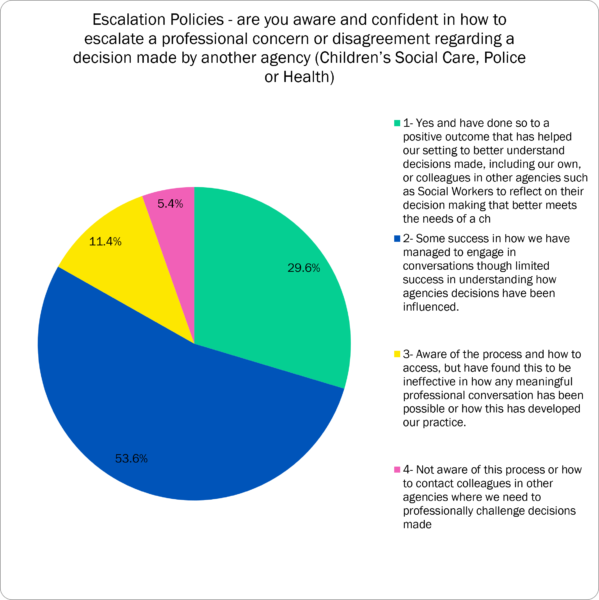
Most schools are aware of escalation policies and feel generally confident in principle, but have rarely needed to use them in practice. As a result, confidence is often theoretical rather than experience-based.
- Where escalation has been used, experiences are mixed:
- Some report positive resolution and feeling heard
- Others describe frustration, delays, limited impact, or lack of responsiveness from agencies
A smaller number of responses highlight:
- Need for clearer guidance and training
- Greater accessibility and visibility of the escalation process
- Challenges in being listened to or influencing decisions
Key takeaway:
“Most settings understand how to escalate concerns, but limited practical use and mixed outcomes mean confidence is variable, with a need for clearer guidance and stronger multi-agency responsiveness.”
Q/ Understanding Devon Children’s Front Door Levels of Need – we routinely use the current Level’s of Need document to support our decision making, including to seek Targeted Early Help or to make a request for support through the Front Door
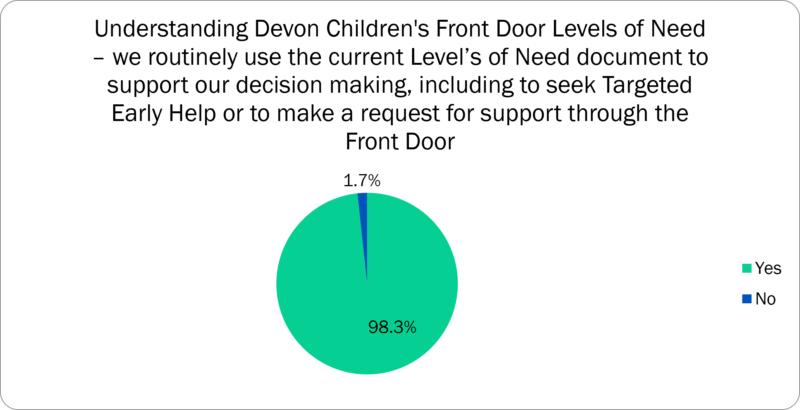
Q/ Use of Professional’s consultation lines for the Front Door – please share any positives and areas for development
Key ‘Headline’ message:
“The consultation line is a highly valued and effective support for schools, but improvements are needed in consistency, accessibility, alignment with thresholds, and communication of outcomes.”
Key Strengths
1. Accessible, supportive advice
- Staff describe the line as helpful, reassuring and professional
- Enables discussion of complex cases and uncertainty
- Provides confidence in decision-making and next steps
“A valued source of advice that supports professional judgement and safeguarding decisions.”
2. Supports threshold decisions
Particularly useful for:
- Sense-checking concerns
- Deciding whether to refer or manage in school
- Helps ensure appropriate and proportionate referrals
“An effective tool for clarifying thresholds and guiding appropriate action.”
3. Strengthens safeguarding practice
- Encourages reflection and professional curiosity
- Supports new or less experienced DSLs
- Acts as a reliable second opinion
“An invaluable sounding board that strengthens confidence and consistency.”
Key Areas for Development
1. Inconsistency in advice
- Different responses depending on who answers the call
- Advice sometimes does not match later referral outcomes
“Variation in advice and outcomes can reduce confidence in the system.”
2. Threshold mismatch
Frequent frustration where:
- Advice suggests referral
- But referral is later rejected or downgraded to Early Help
“A lack of alignment between consultation advice and Front Door decisions is a key concern.”
3. Access & availability issues
- Long waiting times (sometimes 20–60 minutes)
- Line unavailable:
- Lunchtimes
- After school / Fridays
“Opening hours do not align well with school day pressures.”
4. Communication & follow-up
Lack of:
- Feedback on outcomes
- Updates after referrals
- Schools often have to chase information
“Clearer follow-up and feedback loops are needed.”
5. System & process clarity
Confusion around:
- Front Door vs MASH processes
- Referral expectations
- Some calls feel too generic or not sufficiently contextualised
“Greater clarity and more tailored guidance would improve effectiveness.”
6. Capacity & resourcing pressures
- Delays and variability attributed to service pressure
- Perception that thresholds remain high and support limited
“System pressures impact responsiveness and outcomes.”
Part six: Devon Safeguarding Children’s Partnership
Child Sexual Abuse and Exploitation (CSAE) Sub-Group: set up to examine the reasons for the lack of knowledge and confidence in recognising CSA and harmful sexual behaviour.
Q/ Do all staff receive suitable training to help them identify signs of possible CSAE at an age and stage appropriate level including abuse that is familial?
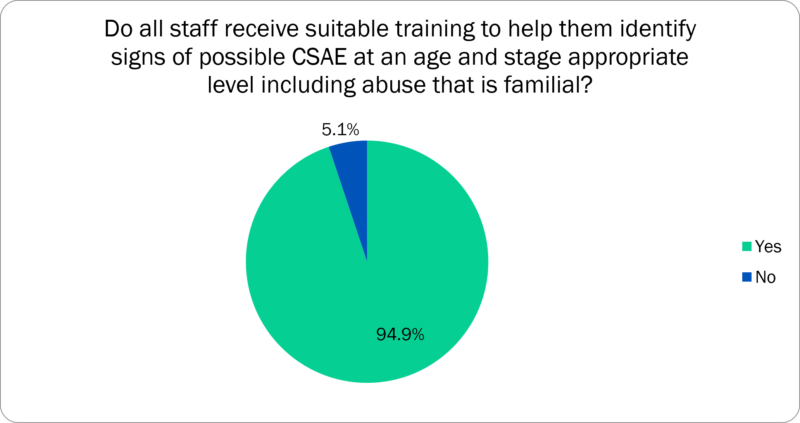
Most settings report that all staff do receive suitable CSAE training, delivered through a structured and layered approach.
Key observations
Annual safeguarding (Level 2) training is universal and forms the foundation
- This is consistently reinforced through regular “drip‑feed” updates (e.g. briefings, bulletins, one-minute guides, quizzes)
- Training is often ongoing and embedded, delivered through:
- Staff meetings
- Weekly/monthly safeguarding updates
- Scenario-based discussions and case studies
- Many schools highlight the use of external resources (e.g. NSPCC, Brook Traffic Light Tool, National College)
Strengths
- Training is frequent, varied and continuous, not one-off
- Strong emphasis on practical application (scenarios, discussions, patterns of behaviour)
- Staff are supported to understand age/stage indicators and familial abuse
- A culture of ongoing awareness and professional curiosity is evident
Areas for development (minor but consistent)
Some settings note:
- Need for more specific / dedicated CSAE training modules
- Desire to deepen detail rather than rely on general safeguarding training
- Ongoing need to refresh and revisit knowledge regularly
Q/ Do all staff, when working with secondary and FE age students, have training that enables them to recognise the possible signs of abuse within students own relationships including recognising harmful, non-compliant and disruptive behaviours as a result of their traumatic experiences.
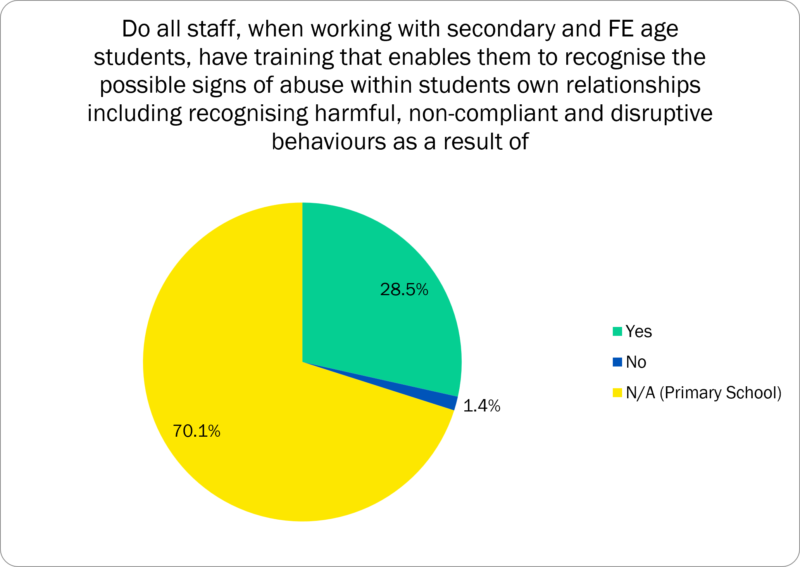
Most settings report that staff working with secondary/FE students do receive appropriate training to recognise abuse within peer relationships and the impact of trauma.
Key observations
Training is typically delivered through:
- Annual safeguarding (Level 2/3) training
- INSET sessions and induction
- Ongoing “drip‑feed” CPD (briefings, bulletins, one‑minute guides, quizzes)
- Many settings include specific training on harmful sexual behaviour (HSB), trauma-informed practice, and peer-on-peer abuse
- Training is often supported by:
- External resources (NSPCC, National College, Brook Traffic Light Tool, CAMHS)
- Scenario-based learning and case studies
Strengths
- Strong emphasis on trauma-informed practice and understanding behaviour as communication
- Good coverage of peer relationships, consent, coercion and exploitation
- Training is continuous and reinforced through multiple formats
- In some settings, this is embedded further through:
- Student profiles, relational support plans, or daily safeguarding discussions
Areas for development
- Some responses note:
- Need for more explicit or consistent focus across all staff
- Gaps in coverage of specific themes (e.g. misogyny / MNSs)
- Continued need for ongoing, targeted training rather than generic safeguarding content
Q/ At an age and stage appropriate level, does your setting ensure that children understand what healthy relationships are, and understand who and how to seek support if they are experiencing abuse?
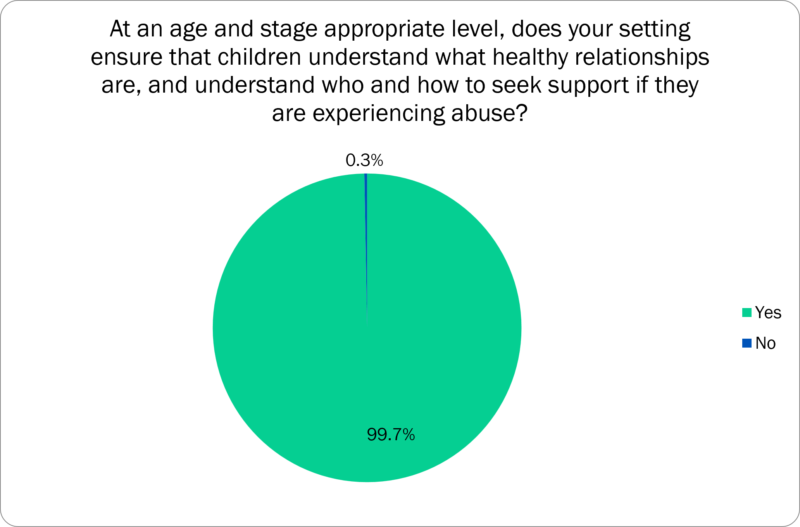
Most settings report that children are systematically taught about healthy relationships through a strong, curriculum-led approach, primarily via PSHE/RSHE.
Key observations
- PSHE/RSHE curriculum is the main delivery mechanism across all settings
- Reinforced through:
- Assemblies and collective worship
- Pastoral support, 1:1 discussions and interventions
- External programmes (e.g. NSPCC Speak Out Stay Safe, PANTS)
- Many schools use structured schemes (e.g. Jigsaw, SCARF, One Decision, Kapow)
Strengths
- Learning is age and stage appropriate and sequenced
- Strong emphasis on:
- Consent, boundaries, respect, and recognising abuse
- Knowing trusted adults and how to seek help
- Supported by a relational culture, where children feel safe to speak up
Part six: Devon Safeguarding Children’s Partnership
Child Exploitation Strategic Group: Devon’s multi agency response to child exploitation and is responsible for developing and reviewing Deon’s multi-agency Child Exploitation Strategy and Tools. The Group is also the Devon SCP’s link into local exploitation services.
Q/ Does your school identify children at risk of sexual or criminal exploitation and ensure timely action, including risk assessments and referrals to appropriate agencies?
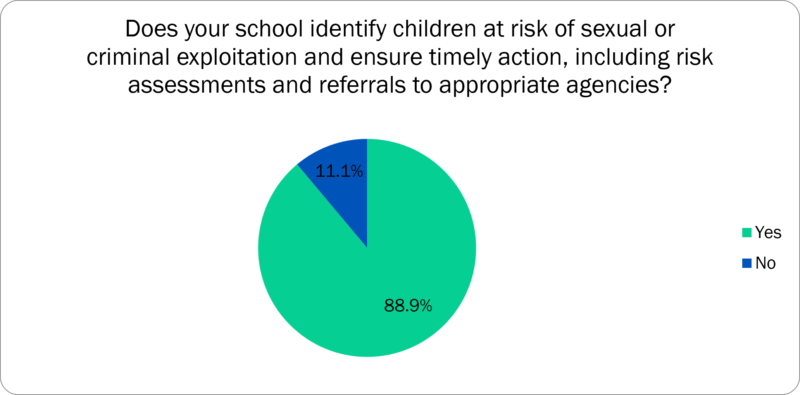
Most settings demonstrate that they do identify children at risk and take action, supported by strong safeguarding systems and processes, although experience varies depending on whether cases have arisen.
Key observations
Identification is primarily driven by:
- Strong staff knowledge of pupils and families
- Vigilance and professional curiosity
- Recording systems (predominantly CPOMS)
- Regular safeguarding meetings and vulnerable pupil lists are widely used to monitor risk and identify patterns
Action typically includes:
- Early Help support and parental engagement
- Risk assessments (where required)
- Referrals to Front Door, police, MASH, or other agencies
- Multi-agency working (e.g. LINKS, MACE, police teams)
Strengths
- Strong culture of early identification and ongoing monitoring
- Clear processes for recording, reviewing and escalating concerns
- Good emphasis on multi-agency collaboration and information sharing
- Many schools highlight a proactive “it could happen here” safeguarding culture
Variability / areas for development
- Many settings report:
- Low incidence of cases, meaning processes are understood but not always tested
- Inconsistent use of formal risk assessments in some schools
- Reliance on knowledge of children rather than formalised tools in all cases
Q/ Are there measures are in place to build awareness and capability among staff and pupils on exploitation risks (particularly those children most at risk of exploitation who might have poor attendance) , including how the school review cases to learn and improve practice?
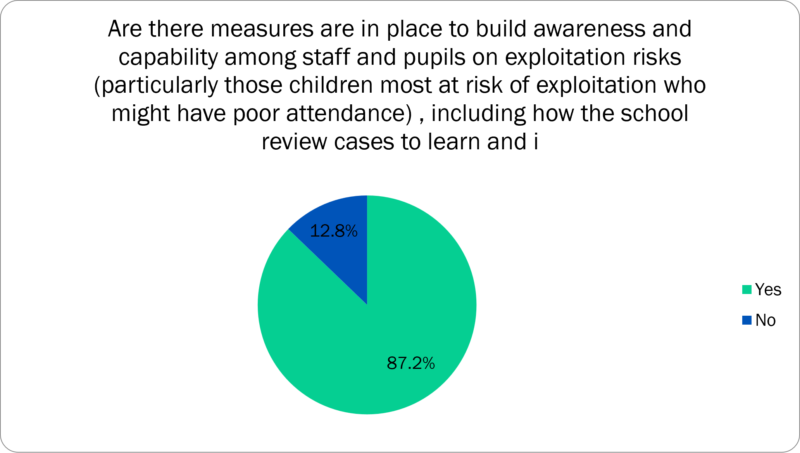
Most settings report that there are strong measures in place to build awareness of exploitation risks among staff and pupils, particularly linked to poor attendance and vulnerability, though practice varies in depth.
Key observations
- Awareness is built through:
- Regular safeguarding training and CPD (including updates, bulletins, and scenarios)
- PSHE/RSHE curriculum and assemblies for pupils
- Ongoing professional dialogue and briefings
- A strong focus on:
- Attendance monitoring (e.g. attendance trawls, meetings, follow-up)
- Use of vulnerable pupil lists and safeguarding systems (CPOMS)
- Many schools hold:
- Regular safeguarding or pastoral meetings (weekly/fortnightly)
- Multi-agency discussions where needed
Strengths
- Clear emphasis on linking attendance with safeguarding risk
- Strong culture of professional curiosity and vigilance
- Evidence of case discussions and reflective practice to inform improvements
- Good use of scenario-based learning and shared case reviews
Areas for development
- Some schools report:
- Limited direct experience of exploitation cases
- Case review processes are inconsistent or not fully embedded
- Need to strengthen how learning is shared systematically across staff
- Ongoing desire to expand pupil awareness further
Q/ Does your school collaborate with multi-agency partners (i.e.. police, health, and social care) to safeguard children and provide support to affected families?
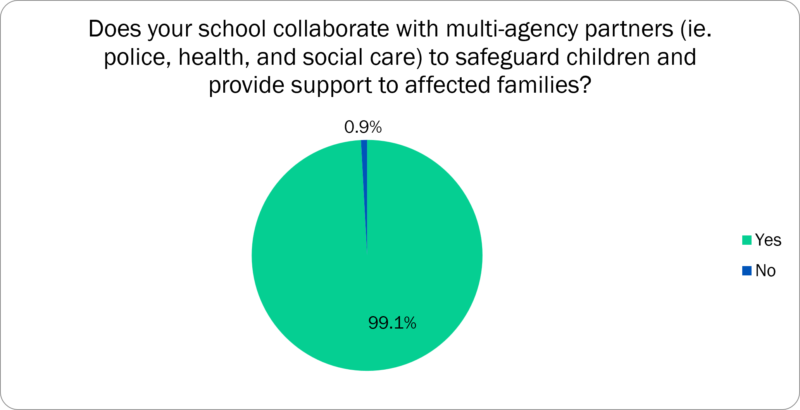
Most schools report strong and established multi-agency collaboration, with regular engagement with social care, police, health, and Early Help services to support children and families.
Key observations
- Collaboration typically happens through:
- Multi-agency meetings (TAF, CIN, CP, Core Groups, Strategy meetings)
- Early Help processes and referrals via Front Door/MASH
- Regular communication (calls, emails, information sharing, PPN/Operation Encompass)
- Common partners include:
- Police (including PCSOs and Youth Intervention Teams)
- Social care and Early Help/FIT teams
- Health services (school nurses, CAMHS, GPs)
- Additional services (e.g. MHST, LINKS, YSMART, Virtual School)
Strengths
- Strong relationships and clear communication channels with partners
- Good practice in attending and contributing to multi-agency meetings
- Evidence of proactive information sharing and coordinated support plans
- Increasing use of local networks and named contacts
Challenges noted
- Inconsistent engagement or responsiveness from some agencies
- Schools often feel they are leading or coordinating multi-agency work
- Greater difficulty engaging with health services in some cases
Part six: Devon Safeguarding Children’s Partnership
The Quality Assurance Workforce Delivery Group: Undertakes multi-agency audits, thematic reviews and appreciative inquiries to identify learning, has oversight of the Devon SCP audit activity and actions, converting learning review recommendations into actions. The recommendations from the audits feed into Workforce Development remit of the group which supports the implementation of learning within the partnership, and is responsible for multi-agency training, events and learning opportunities.
Q/ How consistently is the Devon SCP Neglect Toolkit and GCP2 training used across your school to identify and respond to signs of child neglect?
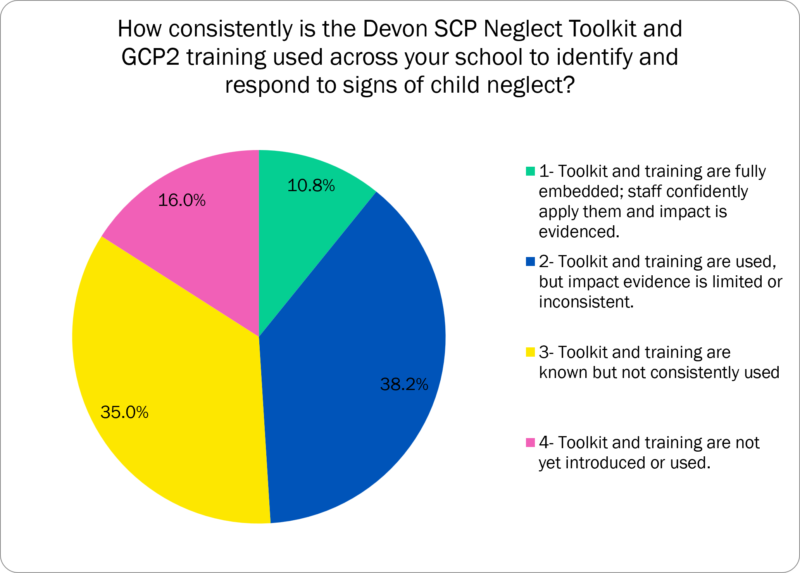
Most settings report that use of the Devon SCP Neglect Toolkit and GCP2 is inconsistent and still developing across schools.
Key observations
- In many settings:
- The DSL/safeguarding team are aware of and sometimes use the toolkit
- Whole-staff awareness and confidence is limited
- GCP2 training is far less embedded, with many schools:
- Not yet trained
- Struggling to access training
- Including it in future plans
Common themes
- Frequent intention to:
- Introduce or embed the toolkit more systematically
- Provide staff training and CPD
- Add to school safeguarding action plans
- Tools are often:
- Used informally to support decision-making
- Not always consistently recorded or applied
Strengths
- DSLs often have good awareness and initial confidence
- Some schools already use the toolkit in:
- Safeguarding discussions and referrals
- Multi-agency work
Areas for development
- Need to:
- Roll out training to all staff
- Embed tools into daily safeguarding practice
- Improve consistency, recording, and evidence of impact
- Increase access to GCP2 training opportunities
Q/ How effective are your school’s systems for multi-agency information sharing and coordination in child neglect cases?
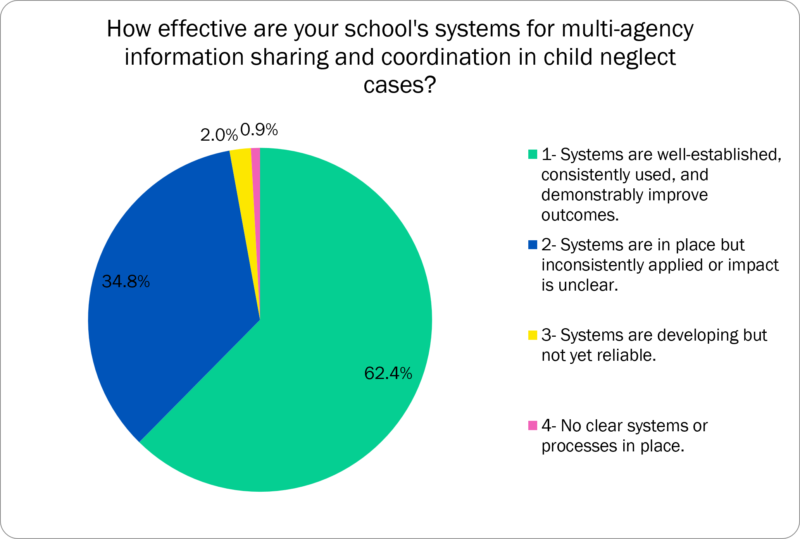
Responses suggest that systems for multi-agency information sharing are generally established and function well in principle, but effectiveness is difficult to evidence in many settings due to low incidence of neglect cases.
Key observations
- Many schools report:
- Very few or no recent neglect cases, limiting ability to evaluate impact
- Confidence that systems and processes are in place if needed
- Where used, systems rely on:
- CPOMS or equivalent systems for recording and building chronologies
- Regular safeguarding meetings and DSL oversight
- Information sharing with social care, Early Help and other partners
Strengths
- Strong internal systems for:
- Recording and monitoring concerns
- Coordinating within school (DSL-led processes)
- When engaged, multi-agency working is often described as:
- Timely and well-coordinated by schools
- Supported by clear communication and established relationships
Challenges
- Common issues relate to:
- Limited experience due to low case numbers
- Inconsistent responsiveness or follow-through from external agencies
- Cases often stepped down to Early Help with unclear impact
- Parental engagement barriers affecting information sharing
Q/ How well does your school promote and support professional curiosity and trauma-informed practice when working with children and families experiencing neglect?
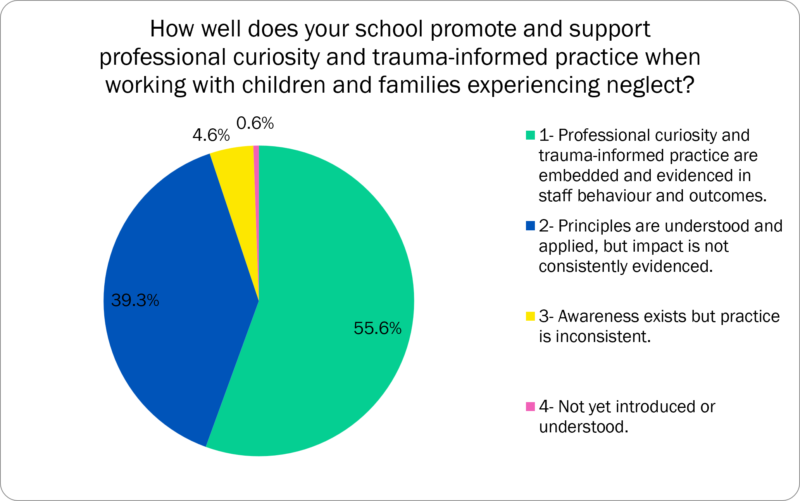
Schools generally demonstrate a growing commitment to professional curiosity and trauma-informed practice, but consistency and depth vary across staff and settings.
Key observations
- Professional curiosity is widely described as:
- Well embedded in culture
- Encouraged through open communication, questioning, and DSL support
- Trauma-informed practice:
- Often present through training and relational approaches
- More consistently embedded in some settings (especially SEMH or trauma-informed schools)
Strengths
- Strong emphasis on:
- Relational practice and understanding behaviour as communication
- Encouraging staff to look beyond presenting behaviours
- Use of ACEs, Thrive, and trauma-informed training
- Some settings report:
- Whole-staff training or accreditation (e.g. TIS)
- Integration into policies, practice and safeguarding culture
Areas for development
- Common themes include:
- Inconsistent application across all staff (stronger with DSLs/teaching staff)
- Need for more widespread and ongoing training
- Difficulty evidencing impact, especially where cases are limited
- Trauma-informed practice sometimes understood but not explicitly named or embedded
Part six: Devon Safeguarding Children’s Partnership
Child Safeguarding Practice Review Group: Responsible for commissioning/undertaking Rapid Reviews to identify learning, Child Safeguarding Practice Reviews (CSPRs) and/or other reviews as required under WT 2023; liaising with the Independent Child Safeguarding Practice Review Panel, as required; contributing to the development of practice culture characterised by high support/high challenge; considering all Serious Incident Notifications to make decisions on next steps, commissioning and over-seeing Child Safeguarding Practice Reviews, Local Learning Reviews and/or other case reviews in eligible cases; submitting all reviews for implementation of learning recommendations into actions and then sharing those with Devon SCP Business Group to ensure local multi-agency practice improves in line with that agreed in review reports.
Q/ Does your school use any published learning from reviews including those recently shared regarding significant cases of Child Neglect in Devon to inform and develop your practice?
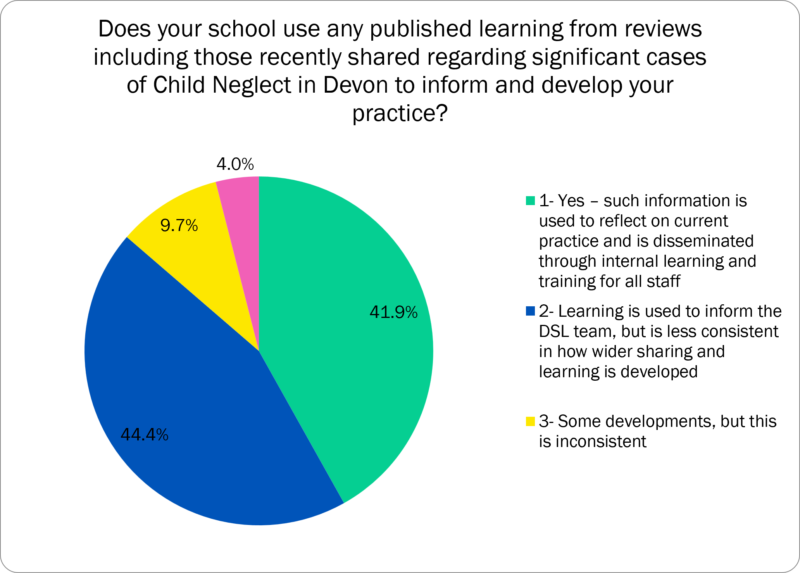
Schools show emerging but inconsistent use of published learning from neglect reviews, with most awareness sitting at DSL/safeguarding leadership level, and wider staff dissemination still developing.
Key observations
- Many settings:
- Are aware of published learning and briefings (e.g. Devon neglect briefing, NSPCC, SCRs)
- Have shared learning in staff meetings, INSET or bulletins at least once
- However:
- Use is often not systematic or embedded across the whole staff team
- Some schools are unsure how to access or regularly receive updates
Strengths
- Good use of:
- Safeguarding bulletins and newsletters
- INSET / staff meetings to share key learning
- National case reviews and NSPCC materials
- Many schools demonstrate intent to:
- Use learning to inform training, reflection and “could it happen here” discussions
Areas for development
- Common themes include:
- Need to share learning more consistently with all staff (not just DSLs)
- Lack of a formalised system for reviewing and embedding learning
- Limited evidence of impact on practice
- Greater focus on national cases than local Devon learning
Q/ Does your school have periodic internal reviews or case reflection opportunities to identify where practice is strong, in that it has had a positive outcome for children and families?
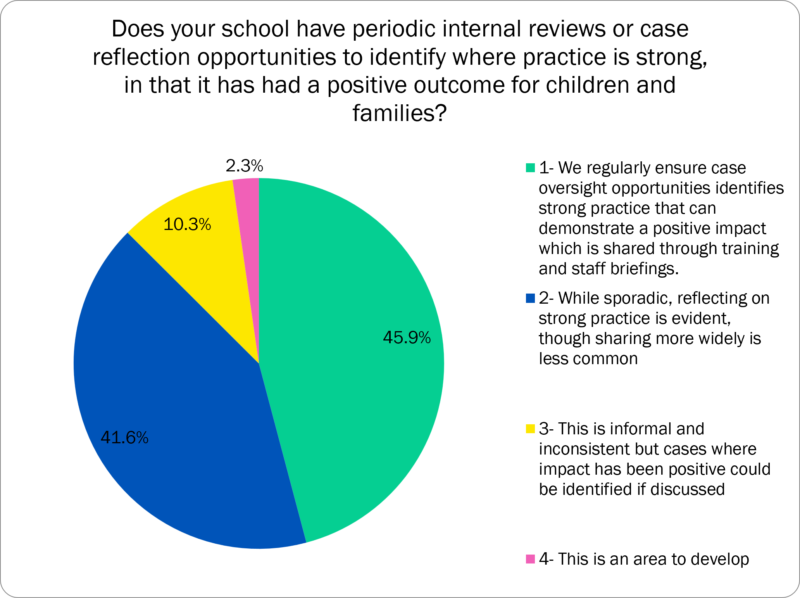
Most schools do have some form of internal review or case reflection in place, but this is often informal, inconsistent, or limited to safeguarding teams rather than whole-school practice.
Key observations
- Reviews typically happen through:
- Safeguarding / DSL team meetings (weekly, fortnightly, or termly)
- Vulnerable pupil list reviews and CPOMS audits
Trust-level reviews, forums, or audits
- Some schools also:
- Include safeguarding as a standing agenda item in SLT or staff meetings
- Use external or trust safeguarding audits
Strengths
- Strong culture of:
- Regular case discussion within safeguarding teams
- Ongoing monitoring and reflection on individual children
- Good examples of:
- Trust-wide sharing and oversight
- Use of audits to identify strengths and improvements
Areas for development
- Common themes include:
- Need to formalise and schedule reflection opportunities more consistently
- Limited whole-staff involvement (often DSL-led only)
- Focus tends to be on issues/concerns rather than celebrating strong practice
- Time constraints impacting regular review
- Need to evidence impact more clearly
Q/ Is your Governing/Trust Board informed as to the impact of case reviews including local (Devon) or National Learning and how this has an impact on your settings practice?
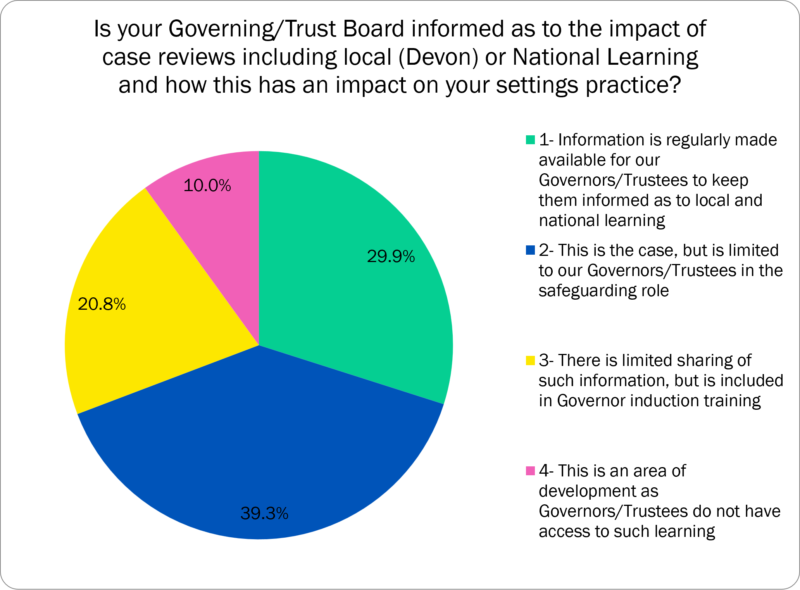
Most schools do provide safeguarding updates to Governors/Trust Boards, but the specific focus on the impact of case reviews (local and national) is not yet consistent or well embedded.
Key observations
- Information is typically shared through:
- Termly DSL or Headteacher safeguarding reports
- Safeguarding governor meetings and training
- Trust-level updates and briefings
- However, in many settings:
- Case review learning is not systematically included
- Discussion of impact on school practice is limited or unclear
Strengths
- Many schools have:
- Established reporting structures to governors
- Dedicated safeguarding governors or leads
- Inclusion of safeguarding as a standing agenda item
Areas for development
- Common themes include:
- Need to share local and national case review learning more explicitly
- Limited evidence of how learning impacts practice being communicated
- Need for:
- Regular updates (not one-off)
- Inclusion in governor training and induction
- Wider dissemination beyond safeguarding governor to full board
Conclusion
The 2024/25 S175/157 Audit confirms that safeguarding across Devon’s education settings continues to be positive, where there has been a focus on embedding culture in which safeguarding is understood as everyone’s responsibility which in turn is supported by good levels of staff awareness, training and leadership.
As in previous years settings demonstrate secure compliance with statutory requirements, systems and proactive approaches to early identification and intervention, alongside multi‑agency relationships and positive engagement with children and families. This is reflected in consistently ‘1/ 2’ rated levels of confidence across core safeguarding principles, workforce development, and evidence of increasingly preventative and relational practice that is making a difference to children’s safety, wellbeing and engagement in education.
However, the findings also highlight that the next phase of development is on improving the consistency, quality and demonstrable impact of safeguarding practice across all settings. Variability remains in the depth of recording, the robustness of monitoring and evaluation, and the ability to evidence clearly how actions taken lead to improved outcomes for children, particularly for those with additional vulnerabilities. There is also a need to strengthen the timeliness and clarity of information sharing, ensure consistent follow‑up and professional challenge within multi‑agency processes, and build greater confidence in the application of thresholds and pathways. While training provision is strong, there is a clear requirement to continue shifting from knowledge acquisition to confident, skilled application in practice.
The report further recognises the significant influence of wider system and partner agency pressures, including thresholds for statutory services, accessing support and communication across agencies, which increasingly challenge school and partner agency practice. In this context, the role of the Devon Education Services Safeguarding Team, LA, DevonSCP, and safeguarding partners remains critical in providing clear guidance, practical tools, and coordinated support to ensure that settings are not only maintaining standards, but are able to evidence impact and sustain improvement.
Building on setting leadership, skilled practitioners and an open and positive safeguarding culture the priority moving forward is to embed more consistent, evidence‑informed practice, strengthen multi‑agency effectiveness, and ensure that all safeguarding activity can clearly demonstrate the difference it makes to the lives of children and young people across Devon.
This report finds that settings have a strong safeguarding foundation upon which to navigate the updated and emerging statutory guidance, including KCSIE 2026, the Children’s Wellbeing and Schools Act, and the Schools White Paper. Collectively, these strengthen expectations around early intervention, multi-agency working, online safety and contextual safeguarding, with a clear shift towards a whole-school, whole-system approach to safeguarding practice.