Stover’s autumnal golds and reds are finally fading and falling now that winter has descended. The woodland birds will now have fewer daylight hours in which to feed.
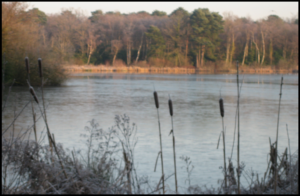 Most insects have now gone into hibernation and are hidden away by the beginning of December. Woods rustle as blackbirds and thrushes sift through the leaf-litter in search of food. Male robins are singing at the moment to mark out their territories and most will have paired up by Christmas. In early winter, both males and females are highly territorial. Song thrushes should start to sing in December, joining the wrens and the dunnocks. Keep an ear out for the mistle thrush’s song – normally they start singing after Christmas. Crossbills will now be nest building – the hatching of the chicks coincides with the opening of conifer and alder cones which peaks in February. These will attract other seed-eating birds such as siskin and redpoll. If the scales on the conifer cones have been split longitudinally, then crossbills have been feeding on them. They are easily approachable at this time of year when they are concentrating on feeding. There are plenty of other birds to see in the Park in the winter which include great spotted and green woodpecker, bullfinch, siskin and redpoll. Chaffinch can be seen coming into Stover at dusk to roost in some of the rhododendron bushes. The best time to view these birds during December is from 3.30pm onwards; different birds arrive in groups of 30 to 50 and then assemble together. Starlings gather noisily on the pylons during this time of the day also. Keep an ear open for redwing. They can be heard as they migrate at night making a ‘tseep’ call – the first arrived on 7th November. It’s often not until after Christmas that fieldfares are seen inland in significant numbers. If you are really lucky you may spot a woodcock resting on the ground – however its camouflage makes it tricky to see. They usually arrive at Stover after the ‘Woodcock Moon’, more commonly known as the ‘Beaver Moon’ which is the first full moon in November. Tawny owls are at present pairing up and establishing territories so are at their most vocal. Wood pigeon flocks have been seen flying over the Stover area – some will consist of migrating European birds.
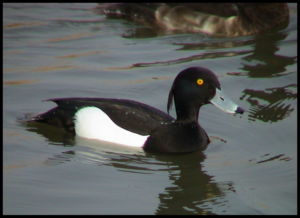 On the lake, pochard numbers are still very low as they have been for several years now. The first pochard of the winter arrived on 7th November, with a maximum of 4 since. Tufted ducks however have beaten records this year with 56 recorded on the 10th, arriving just before the first cold snap of the winter. Previous to this, the highest numbers were 49 recorded on 29th November 2022. Up to 6 mandarin ducks were present on the lake last month, which for the past few years has been down on the 23 sighted at Stover in 2022. Up to 3 Canada geese have been recorded on the lake during last month. Keep an eye out for wigeon, gadwall and teal during December. A male wigeon was spotted on 9th November with a female on the 19th. Wigeon are unusual as they are grazing ducks, eating grass like geese, but will also ‘upend’ whilst feeding on the water. Male wigeon have a striking yellow forehead whereas female wigeon are more uniformly brown than other female ducks, with a small bill. Teal are Britain’s smallest duck and their population is increased by a large migrant population from northern Europe in winter. A male and female shoveler have been present throughout November. Goosander usually start to arrive on the lake in November, with the first seen on the 20th. Keep an eye out for them in December. Goosander are a type of sawbill duck having a serrated cutting edge to their beak that enable them to feed on fish, and are frequently seen on reservoirs and lakes during winter. Cormorant numbers are building at this time of year and can be seen perched in the trees on the island; 4 were recorded on the 25th. The peak count for black-headed gulls during November was over 100. Herring gulls were seen throughout last month.
 Water rail are present in the marsh along with snipe. The snipe are easiest to see when they are standing on the edge of the marsh. Many more rest up in the middle making them impossible to spot. At dusk they can be heard leaving the marsh for their feeding sites on nearby pasture. The highest coot count was 24 on 9th November along with 29 moorhens. The equivalent counts this month in 2023 were 104 and 25 respectively. Kingfishers and herons have been recorded throughout November. All 8 cygnets are regularly flying over the lake practising for their eventual departure. The great-crested grebe was not recorded during November.
Mammals are easier to spot now that the ground cover has died back and they spend more time foraging. Foxes appear particularly striking as their breeding season gets under way, peaking early in January. Foxes become increasingly active at this time of year and can often be seen in daylight hours. Even if you don’t see them, you will most certainly hear their barks and screams at night. Their distinctive musky smell is obvious all over the Park.
Some insects can be seen over the winter months such as a small brown moth known as the winter moth. Oak and sitka spruce are favourite hosts, of which Stover has plenty ! Any warm sunny days during the winter months may rouse brimstone, red admiral and peacock butterflies from their hibernation so they may be seen briefly on the wing. November’s mild weather enabled a few last sightings of butterflies – a speckled wood on the 8th and a red admiral on the 17th and 30th. The majority of adult dragonflies die with the arrival of the colder weather, however their eggs and nymphs will remain safe under the water until they transform into adults and start emerging again next summer. Again, due to November’s mild weather, incredibly late sightings of common darters were recorded as they were spotted breeding on 30th November.
Next year’s buds are starting to appear on many of Stover’s trees. The scarlet elf-cup fungus is out at the moment and can be found on rotten wood in the damper areas of Stover’s woodlands, along with the barometer earthstar fungus visible on the heath.
Merry Christmas !
Christmas Opening times for the public toilets – open every day apart from Christmas Day.