May is the month when the rhododendron, azalea, and yellow flag start to flower; the trees come into leaf; the last of the summer migrants return, and when the dawn chorus is at its peak.
Nightjars usually start arriving from their winter quarters in Africa in May. The males arrive first usually during the first week of May, with the females following in mid-May. These nocturnal birds roost on the ground in heathland areas during the day and feed on moths at night. When glimpsed at dusk the nightjar resembles a large swift and can be heard ‘churring’. Keep an eye out for the real swifts which also return from Africa this month – make the most of them as they are the first migrants to leave in August.
The first sand martins were first seen over the lake on 7th March, with the first swallow spotted late this year on 28th April. The first blackcap was heard singing on 5th April, with willow warblers yet to be recorded. Other migrants still to appear include garden, wood warbler, sedge warbler, spotted flycatcher, pied flycatcher and hobby. Hobbies are our only full-scale sub-Saharan migrant falcon. They arrive here this month and feed not only on birds, but also on insects, especially dragonflies. Their breeding season begins in early May with their chicks often just fledging in mid-August. This is an excellent time for them to learn to feed as there are plenty of young swallows and martins to chase as well as lots of dragonflies.
Many of the songbirds are now feeding young with the first warblers, blackbirds and robins due to fledge this month. Goldfinch and siskin have been recorded throughout April.
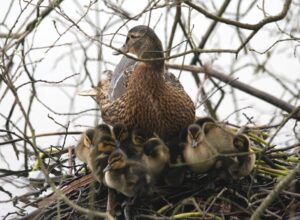 Only a couple of broods of ducklings have hatched out so far. Most other mallards are still sitting on eggs, along with coots and moorhen. The first coot chicks hatched out on 9th April, with the first moorhens breeding early and hatching out mid-March onwards. A second great-crested grebe arrived on 8th April. Great-crested grebe courtship is worth watching – they fluff up their ruffs, shake their heads and present each other with water-weed staying beak to beak. Nine cygnets hatched out on 29th April, however 4 appear to have been predated that first night and the swans immediately stopped returning to the nest site and have de-camped in the marsh which suggests something happened on the island where the nest is located. One of the ringed cygnets from 2025 was spotted on the Teign Estuary with others from its brood, so good to know they’re doing well. There have been a couple of male mandarin duck at Stover – visible on the lake and ponds, with the females presumably sitting on eggs. Up to 19 tufted duck stayed until the end of April with a third then leaving for their breeding grounds in north Europe and Russia. Black-headed gulls have now left the lake, however there have been up to 19 herring gulls and 5 lesser black-backed gulls present throughout last month. Common sandpipers are usually seen at Stover in April, but not for the past few years. However, two were spotted at Stover on 17th April this year. This bird is the most likely wader to be seen inland. It is a summer visitor and is easily told by its typical flickering-wing flight low over the water, and habit of bobbing its head up and down when at rest. Most of the over-wintering snipe have now left Stover.
Following the appearance of their aphid prey many species of ladybird have started emerging from their winter shelters. April has seen an increase in butterfly numbers. Small tortoishells would normally be out by now but haven’t been spotted so far. The first orange-tip was recorded on 23rd March and their appearance is usually synchronised with the flowering of cuckoo flower / ladies smock on which the caterpillars feed. This year the first flower was also spotted on 23rd March and is out in abundance in the marsh. Along with garlic mustard, this plant is the orange-tip butterfly caterpillars’ favourite food plant, so keep an eye out for the single eggs which turn bright orange shortly after being laid. More orange-tips emerged during April. The first speckled wood was seen on the 27th. Keep an eye out for holly blues which are on the wing at the moment – the first was seen on 23rd April. They can be easily mistaken for common blue butterflies, and lay their eggs mainly on holly flowers from whence they get their name. The rare white admiral butterfly should also be on the wing this month. White admirals spend a lot of time in the tree canopy but will also come down to ground level where they feed on bramble blossom. Honeysuckle is important to these butterflies as it is the caterpillar’s food plant. Pearl-bordered fritillaries should also be on the wing this month but are declining nationally; they favour yellow and purple plants to feed from, with bugle being their favourite.
The first damselfly of the year, the large red damselfly, was recorded at Stover on 3rd April, with a male broad-bodied chaser on the 28th. In particular look out for the rare downy emerald dragonfly which should be on the wing this month. The downy emerald is a handsome metallic bronze-green dragonfly with a distinct covering of yellow downy hair, which is particularly noticeable on its thorax. The male, who has a clubbed tail, patrols along the tree-lined margins of the lake and ponds.
Cockchafer beetles (also known as maybugs) are usually flying around in May. They are mainly nocturnal and emerge during the middle of the month after spending the previous three years as a white, root-feeding grub. Stag beetles also start to appear in May after feeding in dead wood as larvae for five years. Once an adult they only live for a few weeks using this time to find mates and lay eggs.
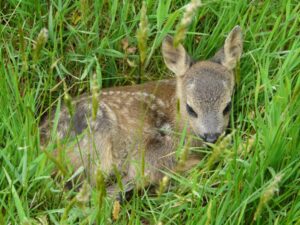 With the increase in numbers of flying insects bats should start to become more conspicuous at dusk as they fly over the lake feeding. During the bat box checks Soprano pipistrelle, Natterer’s and barbastelle bats were recorded. Hedgehogs court, and badger, stoat and fox cubs are active above the ground in May. Roe deer hinds will drop their kids from mid-May onwards. The young stay hidden among the bracken and grass, not moving until their mothers’ return. Many of the freshwater fish in the lake, especially the rudd and roach, can now be seen at the water’s edge as they spawn. The red-eared terrapin was first seen on 19th April after its winter hibernation. It usually appears around 25th March so had a lie-in this year ! Keep an eye out for grass-snakes and adders this month as temperatures rise.
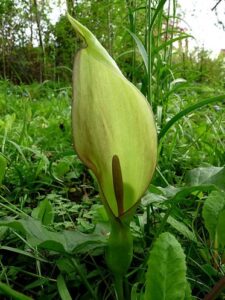 The large Monterey Pines in the car park will soon start to shed huge quantities of pollen, covering the cars in a luminous yellow dust. Other wind pollinated trees, such as oak and beech, flower before their leaves obstruct the drifting pollen. Holly, horse-chestnut, elder and hawthorn also flower this month displaying their more obvious insect-visited flowers. Just before the trees are in full leaf and shade out the woodland floor completely, the spring flowers have their chance to grow, flower and attract pollinating insects. Most are powered by food stored in underground bulbs or stems. These include bluebells, ramsons and violets which are already out in profusion at Stover. Common-spotted orchid leaves are just starting to appear. The ferns are now uncurling and the horsetails are coming up around the lake path and in the marsh. The marsh marigolds and ladies smock are in flower in the marsh. Yellow archangel and celandine are in flower along with sanicle, ground ivy, yellow pimpernel and herb robert. Lords-and-ladies are also in flower and give off a foul stench attracting the flies which pollinate it.