April is the month that the woodland plants have been waiting for all through the winter. Bluebell leaves are emerging along with ramson leaves; and violets, primroses, dog’s mercury, wood anemone and celandine are all in flower. All these plants make use of the lack of light competition at this time of year before the tree leaves start to grow. As the woodland trees start to come into leaf, many spring flowering plants are coming towards the end of their life cycle for this season.
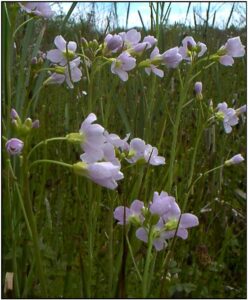 Marsh marigold is flowering in the marsh. Keep an eye out also for ladies smock (also known as cuckoo flower) which flowers in the damp grassy areas and in the marsh. Coltsfoot started flowering in February this year, with laurel around the lake and blackthorn in the car park joining in the latter half of March. Hawthorn is the first common tree species to come into full leaf; look at the roadside plantings as these usually are the first. Apart from hawthorn, the elder leaves are just starting to grow and many of the willow and hazel buds have burst.
The first of the summer migrants have finally arrived; sand martins were recorded for the first time on 6th March. Sand martins are usually recorded in mid-March, closely followed by house martins and swallows. The latter two haven’t been spotted as yet but are due in any day. Chiffchaffs were first heard singing on 9th March (11th in 2025) with willow warblers due to follow shortly. Willow warblers and chiffchaffs look very similar; the easiest way of differentiation is song. The chiffchaff has an easily recognisable song – a monotonous chiff-chaff, chiff-chaff. The bulk of the summer migrants arrive in April so keep an eye out for blackcaps, sedge warblers and whitethroats. A resident population of chiffchaffs and blackcaps do overwinter in Britain as the winters have got gradually warmer, therefore the first records of the year do not necessarily mean the migrants have arrived. Stover’s birdsong is now noticeably louder and will reach a crescendo by the end of the month. The songs are used to defend territories and attract mates. The great-spotted woodpeckers are carrying on with their own version – drumming on hollow trees to announce their territories first heard on 14th February – nearly a month in advance of our usual dates. Mistle thrush started singing late this year on 14th March, and song thrush started singing 3rd March. Long-tailed tits are now busily building their nests in the gorse, and the early blackbird and robin nesters will now have eggs.
On the lake our coots, moorhens and mallards are already sitting on eggs; usually they are still nest building. The first moorhen young hatched out on 17th March, with the first ducklings on the 30th. The single great-crested grebe has yet to attract a mate thereby delaying nesting. Once the second one arrives great-crested grebe courtship is worth watching on Stover Lake – they fluff up their ruffs, shake their heads and present each other with water-weed staying beak to beak. The swans built a nest during the end of February with the female starting to sit on the eggs on 9th March. The remaining 8 cygnets from last year finally took the hint and left the lake on 14th March en masse without needing too much encouragement from the parents. Numbers of manadarin ducks have been low last month, but the few remaining will now be nesting. The last sighting of goosanders was on 26th March and all have now left the lake. Water rail were seen throughout last month and will soon be leaving Stover to breed, although one was heard in summer 23 so one pair may have stayed to nest but breeding hasn’t been confirmed. There were two pairs of Canada geese on the lake last month.
The cormorant, black-headed gull and tufted duck numbers have now dropped as summer approaches, leaving the herring gulls, with the heron and kingfisher visiting frequently. The first black-headed gull with its summer plumage (a black head from whence it gets its name, rather than just a black spot behind the ear in the winter) was spotted on 1st March. There have been no pochard sighted at all this winter. They are in decline throughout Europe unfortunately. There were a maximum of 24 tufted duck during March. Keep an eye out for the red-eared and yellow shelled terrapins following their hibernation.
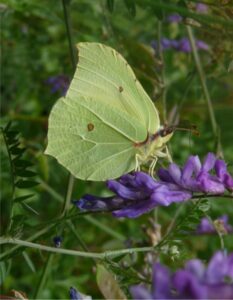 The first butterfly of the year was a red admiral spotted on 14th February, with peacock and brimstone sightings coming a week after. Comma was recorded for the first time on 18th March. Keep an eye out for small tortoishells which are usually on the wing also in March. These March butterflies are the ones which have hibernated during the winter as adults; peacock and small tortoishell over-winter in hollow trees and ivy thickets. Look out for silky drapes over the tips of young stinging nettles once they grow taller – within them are the first batches of small tortoishell and peacock caterpillars. Orange-tips usually emerge in April, the males before the females. They over-winter as a chrysalis and time their annual flight to coincide with the opening of the flowers of the caterpillar’s food plants. These include the pale purple-pink flowers of lady’s smock and garlic mustard. The females lay only one minute orange egg per plant, because the caterpillars become cannibals if they have to compete for food. This year the first orange-tip was recorded early on 23rd March, which was the first day the lady’s smock bloomed.
The wood ants should now be active – they have spent the winter hibernating underground beneath their nests which have slowly rotted down over the winter. Keep an eye out for them starting to rebuild their large nests out of conifer needles. First the ants all congregate on top of the nest remains in a seething mass using the sun’s heat to warm up their bodies. They then go back to the middle of the nest transporting this heat to its core.
 The first of the damselflies will be on the wing in April. Watch out for the large red damselflies around the lake and ditches as they are usually the first to appear. St Mark’s flies emerge around St Mark’s Day on 25th April and generally swarm round the hawthorn trees.
Fox and badger cubs will start to play above ground this month. Roe deer bucks will shortly be shedding the velvet coat from their antlers. They do this by rubbing against bushes and small trees. Usually at this time of year bats, lizards, adders and grass-snakes should shortly be coming out of hibernation. The first frogspawn was seen on 17th February. There should be more frogs and toads spawning this month making easy meals for the grass-snakes once they emerge. Keep an eye out for the snakes swimming across the lake or ponds. The newt breeding season is now underway.
Sustainable charcoal, made from timber felled within the park is available for sale should anyone be planning a Spring BBQ ! The prices are very competitive; all monies will be ploughed back into projects conserving the biodiversity of the Park.
Please ensure dogs stay on the paths in all areas of the Country Park including the heaths and the woods to avoid disturbance to ground nesting birds over the next few months as they start to incubate eggs. Please respect the ‘keep dogs on leads’ around the watercourses and adjoining woodlands as the wildfowl are also now nesting on the ground and are very vulnerable. Thank you.