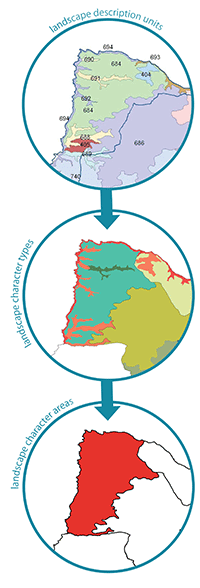
Landscapes constantly change due to nature and human activity. A Landscape Character Assessment (LCA) describes a landscape at a specific time, grouping areas with similar character and sense of place. It explains what makes each area distinctive and valued, how it has evolved, and what future changes may occur. Each area has guidelines to protect and enhance these qualities while supporting benefits for people, nature, and heritage. LCAs help guide planning and land management, aiming to balance necessary change with conserving the landscape’s key features and functions.
The Devon-wide Landscape Character Assessments (DLCA) were completed in 2011 as a County-wide effort led by the Devon Landscape Policy Group. They comprise two layers of information that together provide a shared evidence base for landscape and seascape character that is consistent across administrative boundaries in the geographical county of Devon:
- Landscape Character Types: These are generic types of landscape or seascape that can occur anywhere in Devon, for example ‘Estuaries’. They are selected from a shared Menu and key characteristics of Landscape Character Types in Devon.
- Devon Character Areas: These are geographically unique areas that are recognisable at a County scale and that have a distinct sense of place, for example the ‘Teign Estuary’.
Exmoor National Park uses a slightly different approach to classifying its LCA. The DLCA sits within the wider framework of Natural England’s National Character Areas that cover England.
In addition to the two Devon-wide LCA layers above, England is divided into a number of National Character Areas identified by Natural England. There are 7 National Character Areas covering Devon.
Together these three layers form a nested hierarchy:
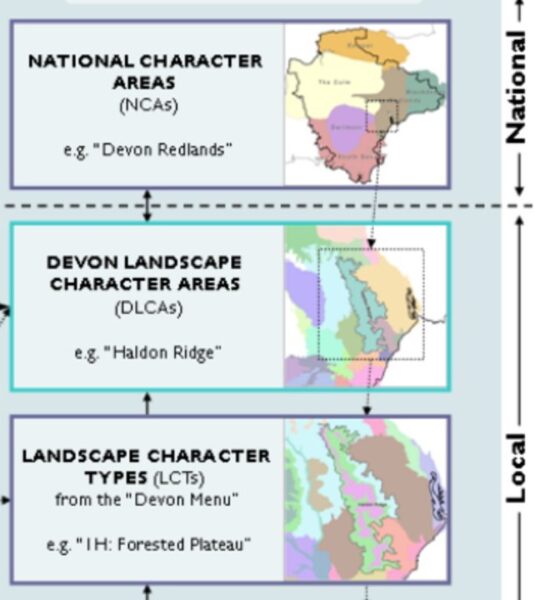
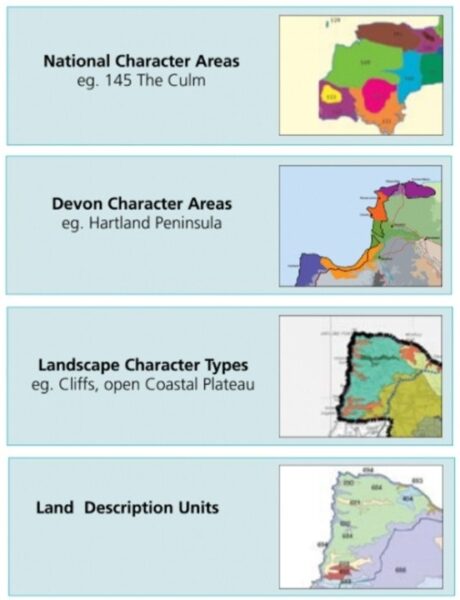
In addition, some areas of Devon have local assessments of smaller landscape units which break down LCTs into more detail, for example in Torbay there are Local Landscape Character Areas that further subdivide LCTs. Locally-specific Landscape Character Assessments may also be prepared to inform Neighbourhood Plans.
Devon’s Historic Landscape Characterisation provides mapping within our Historic Environment Record that informs and understanding of the landscape that we see today with reference to its historical development.
Where can I find the DLCA information
The map below is a screen-shot from the DCC Environment Viewer. The coloured areas are Landscape or Seascape Character Types, and the areas edged red are Devon Character Areas.
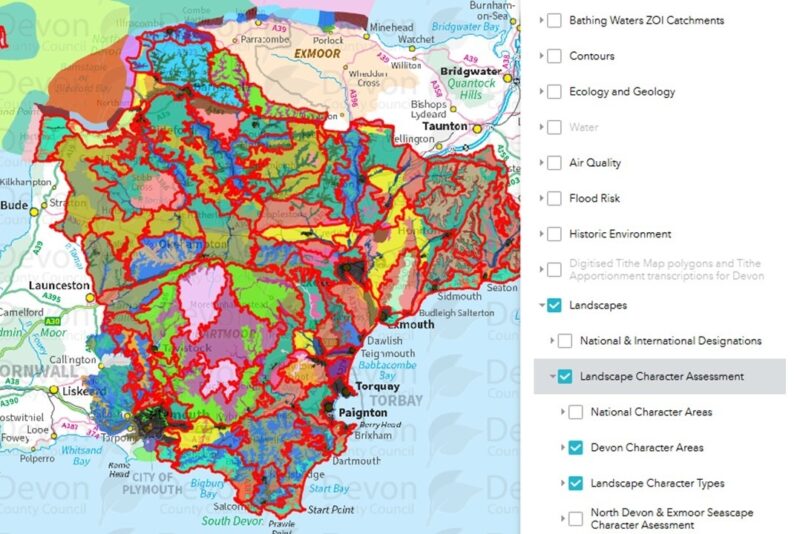
To review the written profile that accompanies each Devon Character Area, open the Devon Character Areas (DCAs) on the DCC Environment Viewer click on the map and follow the link to the profile from the pop-up box.
To review the written profile that accompanies each Landscape Character Type, either:
a) open the link to the Landscape Character Areas (LCTs) on the DCC Environment Viewer, click on the map and follow the link in the pop-up box to where the Landscape Character Types are published locally the websites of Devon’s District, Borough, City and Unitary Councils; or
b) click on one of the links below to jump straight to where the local LCA information is published, along with more detailed local LCA information:
- East Devon District, Landscape Character Assessment, including East Devon National Landscape and Blackdown Hills National Landscape 2019
- North Devon and Torridge Joint Landscape Character Assessment 2023
- South Hams District and West Devon Borough Joint Landscape Character Assessment 2018
- Mid Devon Landscape Character Assessment 2024
- Teignbridge Landscape Character Assessment 2024
- Torbay Landscape Character Assessment 2025]
- Plymouth Landscape Character Assessment 2018 (chapters 1-3 and 4 onwards)
- Dartmoor National Park Landscape Character assessment 2017
- Exmoor National Park Landscape Character Assessment 2018
- Tamar Valley Landscape Character Assessment for the Tamara Landscape Partnership 2020
- How to use DLCA
- How was the DLCA created?
The DLCA follows nationally recognised guidelines, and was undertaken in three stages following the Living Landscape Methodology devised for Devon by Diacono Associates:
Stage 1 was completed as a County-wide study, and involved a desk study to identify ‘Land Description Units’. These are the smallest landscape areas of common character, based on geographical information including geology, landform, vegetation and land use.
Stage 2 was completed by individual District Councils, AONB areas and Dartmoor National Park. It involved field survey work verifying findings from the desk study and resulted in the identification of ‘Landscape Character Types’ occurring in Devon.
Stage 3 was completed as a County-wide study. This identified Devon Character Areas to give an overview of the landscape as a whole, building on an understanding of the constituent Landscape Character Types and Land Description Units. This involved an iterative process of familiarisation, desk study and field survey, followed by classification and description. Stakeholder engagement was carried out with the Devon Landscape Policy Group, workshops were held and the public provided online input. The final Devon Character Areas and profiles were then produced. It drew on the findings of stage 2 to identify ‘Devon Character Areas’. Each area has a written profile.
- How do Devon Character Areas, Landscape Character Types and National Character Areas relate to each other?
 These layers of landscape classification nest together like Russian dolls. The smallest units, ‘Land Description Units’ were defined first, and used to identify Landscape Character Types. Some planning authorities still use Landscape Description Units as part of their LCA evidence while others do not. Once generic Landscape Character Types had been defined and mapped throughout Devon by individual planning authorities, these were grouped into geographically unique Devon Character Areas that have their own particular identity as a whole landscape. Therefore, a distinct Devon landscape such as the Hartland Peninsula comprises a number of different generic Landscape Character Types such as Cliffs, Coastal Open Plateaux, Coastal Slopes and Combes, and Secluded Valleys.
The written profiles for Landscape Character Types highlight key characteristics of the generic landscape type, whereas those of the Devon Character Areas highlight the distinct and unique characteristics of the area. Devon Character Areas give emphasis to local identity e.g. landmarks, and to visual and perceptual influences e.g. scenic and special qualities. As well as the descriptive elements, both of these data ‘layers’ set out strategies and guidelines aimed at protecting and managing what makes the landscape distinctive and special, as well as planning positively for landscape change as part of sustainable development. This is consistent with the National methodology for Landscape Character Assessment published by The Countryside Agency in 2002 (now Natural England). Those guidelines written in the latter stages of Devon’s LCA programme, including the Devon Character Area profiles, are compliant with the European Landscape Convention, having been the subject of public participation and stakeholder workshops across Devon. Together, these datasets provide a finer grain of detail to the National Character Areas used by Natural England as the spatial framework for their work.
We support both Devon Character Areas and Landscape Character Types being referred to when describing Devon’s landscape character. For example, the location of a site can be described using both e.g. ‘The site is in a Secluded Valley (Landscape Character Type) of the Hartland Peninsula (Devon Character Area)’.
- How does the DLCA relate to the National Character Areas?
The DLCA is more detailed than the National Character Areas Assessment. However it has been developed in such a way as to be consistent with that Assessment. Links to the national profiles and integrated objectives are provided. The Devon Character Areas give a more precise indication of where key changes in landscape character occur at a County scale.
- What are Devon Character Areas?
Devon Character Areas are unique, geographically-specific areas of landscape. Each Devon Character Area has an individual identity but most Areas comprise a number of different Landscape Character Types. Devon Character Areas are called by a specific place name e.g. ‘High Dartmoor North’.
- What are the Devon Landscape Character Types?
The Devon Landscape Character Types are generic landscapes that share similar characteristics but may occur in different parts of Devon. Landscape Character Types allow different landscapes to be compared. Landscape Character Types are called by a descriptive name e.g. ‘Wooded ridges and hilltops’.
- What are Land Description Units?
Land Description Units or LDUs are the building blocks of the characterisation process. Through desk study mapping using GIS, they are defined by overlaying published data that describes the landscape according to the following natural and cultural attributes:
- Physiography – the geology and landform;
- Ground Type – the soils;
- Landcover – vegetation and settlement;
- Cultural Pattern – settlement form and pattern and farm type
The Devon-wide Landscape Character Assessment process used a ‘bottom up’ approach, beginning with the desk-based derivation of Land Description Units (LDUs) carried out for the County of Devon in 2006. LDUs form a factual basis for the identification of broader, more descriptive, Landscape Character Types and Character Areas.
- What are National Character Areas?
National Character Areas are broadly similar areas of landscape defined at a national scale. There are 159 National Character Areas in England. Character descriptions for each of the NCAs were produced in the 1990s and published in regional volumes to highlight the influences determining the character of the landscape, for example land cover, buildings and settlements. Natural England is currently working to update the NCA profiles and develop objectives for their future management.
- How does the DLCA relate to Historic Landscape Characterisation?
The Devon Character Areas provide a summary of the historic landscape of each area. It is essential to refer to the Historic Landscape Characterisation for a more detailed understanding of the historic landscape. The Devon Historic Landscape Characterisation was a key reference dataset in the production of the DLCA.