1. Introduction
1.1 Minerals Planning in Devon
1.2 Purpose of the Monitoring Report
1.3 Implementation of the Minerals and Waste Development
Scheme
1.4 Review of the Devon Minerals Plan
2. MINERALS POLICY: ASSESSMENT OF PERFORMANCE AND EFFECTS
2.0.1 The below assessment of performance and effects is based on the indicators contained within the Implementation and Monitoring Chapter in Table 9.2 of the Devon Minerals Plan. It should be borne in mind that the number of planning applications for minerals development received by the County Council in any one year is small, and that a large proportion of the Plan policies may not be used in the determination of planning applications every year. A schedule of 2023 planning applications for mineral development is provided in Appendix 1.
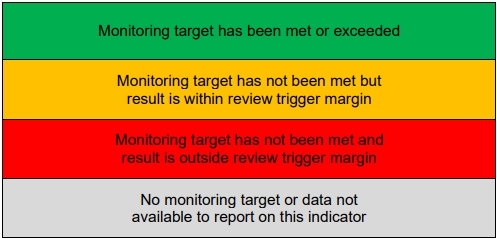
2.0.3 The indicators for each of the Plan’s six key objectives have been grouped into a table for each. Where indicators have scored red as above, a review has been undertaken. This is presented after the results table for each objective.
2.1 Objective 1: Spatial Strategy
2.1.1 Indicators 1.1 – 1.5 seek to ensure minerals development adhere to the Spatial Strategy contained within the Devon Minerals Plan.
| Indicator | Baseline | Target | Monitoring Trigger | 2023 Results |
|---|---|---|---|---|
| 1.1 Number of locations in Devon for working of industrial minerals | Four (2015) (Lee Moor, Drakelands, Bovey Basin, Peters Marland) | No reduction | Closure of one location | Three (Red RAG Rating) |
| 1.2 Proportion of Devon’s land-won and secondary aggregates originating within the M5/A38 Corridor | 90.8% (2015) | 85% | Significant variance (+/- 10%) from target indicating over-concentration of production and/or lack of local supply | 90.6% (Green RAG rating) |
| 1.3 Proportion of Devon’s annual sales of land-won sand and gravel resources originating from the Budleigh Salterton Pebblebeds | 80.7% (2015) | 85% | Significant variance (+/- 10%) from target indicating over-concentration of production and/or lack of local supply | 89% (Green RAG rating) |
| 1.4 Proportion of Devon’s land-won and secondary aggregates sold to destinations within wider Devon | 86.0% (2014) | 85% | Significant variance (+/- 10%) from target indicating increase reliance on imported aggregates or reduced contributions to sub-regional needs | 75% (Amber RAG rating) |
| 1.5 Number of planning permissions for mineral extraction that are contrary to the spatial strategy | N/A | None | One permission | Zero (Green RAG rating) |
2.1.2 In relation to indicator 1.1, there are three sites that are working industrial minerals in Devon. This result is below the baseline, triggering the need to monitor this performance and as such has scored a red RAG rating. The reduction from the baseline is due to the closure of Hemerdon in 2022 (formerly known as Drakelands), which was addressed in the previous monitoring report5 and in the Mineral Plan Review. Whilst the site had remained closed in 2023, the operator had expressed their intention to restart working at the site. As stated in the Mineral Plan Review, the production of tungsten at Hemerdon is influenced by factors beyond the control and scope of the Minerals Plan, however the policies within the Devon Minerals Plan, especially policy M9, support the completion of the approved development.
2.1.3 Indicator 1.2 relates to the proportion of Devon’s land-won and secondary aggregates originating within the M5/A38 corridor. This indicator has remained the same as the previous year at 90.6% land won and secondary aggregate sales originating within the M5/A38 corridor. This remains within 10% of the target for this indicator and demonstrates compliance with the Spatial Strategy (Policy M1 of the Devon Minerals Plan).
2.1.4 In relation to indicator 1.3, although the proportion of the annual sales of landwon sand and gravel resources originating from the Budleigh Salterton
Pebblebeds (BSPB) has decreased slightly ( from 91.7% in 2022 to 89% in
2023), the result for 2023 remains above the indicator target and within the 10% variance and therefore a green RAG rating has been applied. This demonstrates compliance with the Spatial Strategy (Policy M1 of the Devon Minerals Plan) which acknowledges the importance of the BSPB in producing a large proportion of the County’s sand and gravel resources.
2.1.5 In relation to indicator 1.4, 75% of Devon’s land-won and secondary aggregates were sold to destinations within wider Devon. This has remained below the target for the fourth consecutive year but it has increased year on year since 2020, and is within the 10% variance set by the monitoring trigger. The result for this AMR indicator is reliant on the commercial market which may be impacted by a range of factors including high interest rates, the cost of transporting aggregates and procurement decisions of developers. Devon County Council as Mineral Planning Authority produces an annual Local Aggregate Assessment (LAA), which considers sale trends in more detail. This indicator will continue to be monitored in future years, but it is not considered necessary to update the Minerals Plan in response to this indicator given the reliance on the commercial market.
2.1.6 Indicator 1.5 relates to the number of permissions for mineral extraction which are contrary to the Spatial Strategy. The Mineral Planning Authority did not determine any planning applications for mineral extraction within the reporting year and as such the result for this indicator is zero.
2.1.7 Overall, it is considered that mineral development within the monitoring year has broadly been carried out in accordance with the Spatial Strategy.
2.2 Objective 2: Safeguarding Mineral Resources and
Infrastructure
2.2.1 Indicators 2.1 – 2.2 seek to ensure policy is effectively safeguarding mineral resources and associated infrastructure from sterilisation by other forms of development.
| Indicator | Baseline | Target | Monitoring Trigger | 2023 Result |
|---|---|---|---|---|
| 2.1 Number of applications approved by local planning authorities in Devon contrary to an objection on minerals safeguarding grounds by the county council | 0 (2014) | 0 | Approval of development sterilising a strategic mineral resource contrary to the criteria of Policy M2 | One (Red RAG rating) |
| 2.2 Number of operational mineral wharves and railheads in Devon | Six (2015) | No reduction | Closure of wharf or railhead without alternative provision being available | Three (Amber RAG rating) |
2.2.2 Within the monitoring year, Devon County Council as Mineral Planning Authority objected to eight planning applications on mineral safeguarding grounds. Three of these applications were withdrawn prior to determination and therefore are not considered further in this monitoring review. The local planning authorities refused four applications and included mineral safeguarding as a reason for refusal. This indicates that the applications were determined in accordance with Policy M2 (Mineral Safeguarding Areas) of the Devon Minerals Plan.
| Year | Applications MPA Objected to and LPA Determined in year | LPA Refused or application withdrawn | LPA Approved | % approved contrary to objection |
|---|---|---|---|---|
| 2023 | 8 | 7 | 1 | 11% |
2.2.3 One application was approved contrary to an objection from the Mineral
Planning Authority on mineral safeguarding grounds. This application related to the demolition of an agricultural building and erection of a dwelling and was determined by Teignbridge District Council (reference 23/01382/FUL). The Local Planning Authority’s decision cited:
“it is considered that on balance the proposed dwellinghouse is located to the edge of the MSA with a previous approval for a dwellinghouse under Class Q with several existing dwellinghouses located in close proximity to the application site. It is therefore considered that the proposal would not adversely impact on mineral extraction given the legitimate fallback position and existing nearby residential properties thus complying with Policy S1”.
2.2.4 Whilst this outcome is disappointing, the Council continues to monitor new planning applications closely to ensure that it is able to make appropriate
responses. The Minerals Plan Review recommended a series of measures for
the Mineral Planning Authority (MPA) to implement going forward. These are to:
monitor planning applications on weekly lists closely to make appropriate
responses and raise safeguarding concerns where necessary;
provide further training on mineral safeguarding issues to LPA planning
officers;
ensure the requirement for a Mineral Resource Assessment is included
on district validation checklists;
provide input at the Local Plan preparation stage to comment on any site
allocations.
2.2.5 An update of the implementation of these measures will be provided as part of the annual monitoring review for 2024.
2.2.6 In 2023, the number of operational mineral wharves and railheads had reduced to three and is therefore below the target for the indicator. This reduction is due to the cessation of two mineral wharves. Despite the overall reduction, the majority of the facilities remain in place and available for use in the future. The only exception to this is the closure of Bidna Wharf, which has subsequently been redeveloped. However, Appledore Wharf and Yelland Quay remain available for use in northern Devon which provides alternative provision in the area, and replacement facilities are not considered necessary for the closure of Bidna Wharf. Therefore, it is not considered necessary to review the Devon Minerals Plan at this time, and this indicator has been scored as an amber RAG rating.
2.3 Objective 3: Industrial Minerals
2.3.1 Indicators 3.1 – 3.6 seek to ensure policy is maintaining Devon’s ability to assist in meeting national and international demand for those industrial minerals found within the County.
| Indicator | Baseline | Target | Monitoring Trigger | 2023 Result |
|---|---|---|---|---|
| 3.1 Number | Three (2015) | No reduction | Closure of a site | Three (Green RAG rating) |
| 3.2 Number of operational ball clay sites | Eight (2015) | No reduction | Closure of a site | Eight (Green RAG rating) |
| 3.3 Number of operational metalliferous mineral sites | one (2015) | No reduction | Closure of a site | Zero (Red RAG rating) |
| 3.4 Annual UK sales of china clay | 1.090 million tonnes (2014) | No reduction | Significant variation (+/- 20% from baseline) | 0.514 million tonnes (53% from baseline) (Red RAG rating) |
| 3.5 Annual UK sales of ball clay | 0.748 million tonnes (2013) | No reduction | Significant variation (+/- 20% from baseline) | 0.729 million tonnes (2.5% from baseline) (Amber RAG rating) |
| 3.6 Annual UK sales of tungsten | Not Commenced | N/A | Cessation of operations prior to completion | 0 (Grey RAG rating) |
2.3.2 The results for indicator 3.1 and 3.2, have remained consistent. The reduction from the baseline for indicator 3.3 relates to Hemerdon mine remaining closed, as such the indicator retains a red RAG rating. It is not considered necessary to review the policy at this time given that the operator has expressed their intention to restart working at the site, as outlined in objective 1.
2.3.3 Indicator 3.4 shows a significant variation (53%) from the baseline, and the 2023 figures have reduced from the 20227 , the threshold trigger has therefore been met.
2.3.4 Indicator 3.5 relates to the annual UK sales of ball clay, the result is within 2.5% of the baseline figure and is therefore not considered to be a significant
variation. The figure has however decreased8 from the previous monitoring year and therefore the indicator has scored an amber RAG rating.
2.3.5 Indicators 3.4 and 3.5 are reliant on the commercial market which may be
impacted by a range of factors including high interest rates, the cost of
transporting aggregates and procurement decisions of developers. The number of operational sites working ball clay and china clay in Devon has remained the same, and it is therefore considered that Devon has the ability to provide materials for any future increases in demand. It is therefore not considered necessary to review the policies at this time.
2.4 Objective 4: Aggregate Minerals
2.4.1 Indicators 4.1 – 4.3 seek to ensure policy maintains a sustainable, steady and adequate supply of aggregates, making maximum use of the County’s
resources of secondary and recycled materials and providing new resources when required.
| Indicator | Baseline | Target | Monitoring Trigger | 2023 Result |
|---|---|---|---|---|
| 4.1 Landbank within wider Devon of: (a) crushed rock (b) sand and gravel | 2015 (end) (a) 48.9 yrs (b) 12.5 yrs | Minimum of: (a) 15 yrs (b) 10 yrs | The crushed rock landbank dropping below 10 years and/or the sand and gravel landbank dropping below 7 years | a) 37.5 years b) 7.5 years (Amber RAG rating) |
| 4.2 Average annual sales within wider Devon of land-won aggregates: (a) crushed rock over 10 years; (b) crushed rock over the past 3 years; (c) sand and gravel over the past 10 years (d) sand and ravel over the past 3 years | (2015) (a) 2.35 mt (b) 2.70 mt (c) 0.56 mt (d) 0.52 mt | No target | The average calculated over the past 3 years exceeding that over the past 10 years | a) 2.656 mt b) 2.642 mt c) 0.505 mt d) 0.477 mt (Grey RAG rating) |
| 4.3 Proportion of total sales of land-won and secondary aggregates within wider Devon accounted for by secondary aggregates | 11.8% (2015) | 20% | Reduction to less than 10% | 17.9% (Amber RAG rating) |
2.4.2 The landbank for land-won crushed rock in 2023 is 37.5 years and remains well above the NPPF’s minimum requirement of 10 years, although this has decreased by 4.4 years from the 2022 landbank. Following the granting of planning permission at Straitgate Farm9 , the landbank for sand and gravel increased from the previous year to 7.5 years which is now above the minimum required by the NPPF. . However, the operator has no intention to implement the permission and the permission is likely to expire in January 2026. The review of the Devon Minerals Plan considers the landbank of crushed rock and sand and gravel landbank in more detail. Given the MPA is currently considering an application for extraction covering part of the preferred area at West of Penslade cross it is considered that a review of the policy is not necessary at this time. This should be kept under review, particularly if this application is refused.
2.4.3 With regard to indicator 4.2 sales of crushed rock have increased, but sand and gravel sales have decreased. The three year sales for crushed rock and sand and gravel remains below the ten years sales average for the fourth consecutive year indicating that recent demand has decreased. This trend is consistent with the overall sales in Great Britain, as reported in the MPA’s 11th Annual Mineral Planning Survey Report10. It is considered that the decrease in sales is a result of the economic uncertainty brought about by market volatility, worldwide events and the pandemic, which the UK economy is still recovering from. The Devon Local Aggregate Assessment for 202311 considers this in more detail.
2.4.4 The proportion of total sales of land-won and secondary aggregates being accounted for by secondary aggregates has increased by 1% from 2023 (from 16.9% in 2022 to 17.9% in 2023) and is the highest it has been since 2017. The sales of secondary aggregates have remained fairly consistent with previous years, however land won aggregate sales have decreased. The increase in indicator 4.3 is therefore positive as it indicates that the use of secondary aggregates are being prioritised over land won aggregates, in accordance with the Aggregates Hierarchy in Objective 4 of the Devon Minerals Plan.
2.5 Objective 5: Building Stone
2.5.1 Indicators 5.1 – 5.2 seek to ensure policy enables local distinctiveness by
securing an appropriate supply of local characteristic building materials.
| Indicator | Baseline | Target | Monitoring Trigger | 2023 Result |
|---|---|---|---|---|
| 5.1 Number of key building stones (Table 6.1) quarried in Devon | Seven (2015) | No reduction in the number of stone types | A reduction in number of stone types | Nine (Green RAG rating) |
| 5.2 Sales of building stone produced in Devon | 7,061 tonnes (2015) | No Reduction in annual production | A reduction in annual production of 15% in comparison with the previous year | 1,007 tonnes (-89% from previous year) (Red RAG rating) |
2.5.2 The result for indicator 5.1 has increased from the previous year and remains above the baseline. This increase is due to the quarrying of an additional building stone type, Exeter Volcanic Series, at a recently permitted site which became operational in 2023.
2.5.3 With regards to indicator 5.2, the large decrease is due to changes in operator’s priorities resulting in some sites no longer selling building stone. This may be a result of economic and commercial market factors which are outside of the control of the mineral planning authority and, as demonstrated by indicator 5.1, is not as result of a reduction in availability of stone types in the plan area. This indicator will continue to be monitored in future years, but it is not considered necessary to update the Minerals Plan given the reliance on the commercial market.
2.6 Objective 6: Managing Mineral Development
2.6.1 Indicators 6.1 – 6.9 monitor policies that seek to manage mineral development in a manner that protects Devon’s communities from adverse impacts, conserves and enhances its environment, delivers positive benefits for its quality of life and green infrastructure, and assists in mitigation of & adaptation to climate change.
| Indicator | Baseline | Target | Monitoring Trigger | 2023 Result |
|---|---|---|---|---|
| 6.1 The number of local quarry liaison groups | Seven | No reduction in the number of liaison groups | A reduction in the number of liaison groups (excluding cessation of a group due to closure of a quarry) | Four (Green RAG rating) |
| 6.2 The number of mineral planning applications incorporating sustainable drainage systems | N/A | 50% of relevant permissions | Less than 25% of permissions for extraction, tipping and/or built development | 100% (Green RAG rating) |
| 6.3 The area of best and most versatile agricultural land that would be lost to mineral development in new permissions | N/A | No loss | One new planning permission without adequate provision for restoration to agricultural land of similar quality | No applications resulted in a loss of the best and most versatile agricultural land (Green RAG rating) |
| 6.4 New planning permissions for mineral development in an Area of Outstanding Natural Beauty or World Heritage Site | N/A | No new permissions that are contrary to Policy M18 | One new planning permission that is contrary to Policy M18 | No applications were within National Landscape (formerly AONB) or World Heritage Site (Green RAG rating) |
| 6.5 New planning permissions for mineral development that result in the loss of, or harm to, assets of heritage value | N/A | No permissions that are contrary to Policy M19 | A planning permission resulting in substantial harm to a significant heritage asset contrary to Policy M19 | No applications resulted in loss of, or harm to, heritage assets (Green RAG rating) |
| 6.6 Change in the area, type and condition of Devon BAP habitats caused by mineral developmen | N/A | No net loss of area or deterioration in condition | Significant net loss or deterioration in condition contrary to Policy M17 | No applications resulted in change in area, type or condition of BAP habitats (Green RAG rating) |
| 6.7 The number of planning permissions for mineral development within, or affecting, a SSSI or County Wildlife Site | N/A | No new permissions that are contrary to Policy M17 | One new planning permission that fails to deliver adequate mitigation of compensation for harm or is otherwise contrary to Policy M17 | No applications were within or affected a SSSI or County Wildlife Sites (Green RAG rating) |
| 6.8 Area of land within mineral sites restored for agricultural use and/or green infrastructure | N/A | All restoration to deliver green infrastructure | Absence of green infrastructure benefits in restoration implemented in the monitoring year | 100% (Green RAG rating) |
| 6.9 The number of mineral planning applications that include provision for the use or generation of renewable or low-carbon energy | N/A | 50% of relevant applications | Less than 25% of permissions for extraction, processing plant and/or built development | 50% (One of two relevant applications) (Green RAG rating) |
2.6.2 The results for the Managing Mineral Development indicators (6.1-6.9) are positive for 2023, with the targets for all the indicators being met.
2.6.3 With regards to indicator 6.1, four liaison groups met during 2023, which has remained the same as the previous monitoring year. As reported in previous years, the reduction from the baseline figure is due to quarry closures, which is excluded from the review trigger and therefore does not indicate a need to review the policy. As such, the RAG rating for this indicator has remained as green.
2.6.4 For indicators 6.2 to 6.9, the MPA reviewed the applications that had been determined within the monitoring year. The MPA considered that some of the applications determined were not relevant to review for some indicators. The applications that were considered relevant for each indicator are outlined in the following paragraphs.
2.6.5 In total, six applications were determined during the monitoring period, three of which related to variations of conditions on existing mineral permission. There were no applications for the extraction of material during this monitoring year.
2.6.6 In relation to indicator 6.2, two of the six applications were considered relevant::
DCC/4339/2023 – Importation of waste to fill void as part of restoration
scheme; and
DCC/4328/2022 – Construction of high-density hydro pumped energy
storage.
2.6.7 The result for this indicator showed a significant improvement from the last monitoring report, with 100% of relevant applications incorporating sustainable drainage systems as part of their proposals such as SuDS ponds, ditches and swales. The indicator has exceeded the monitoring target and as such, has been scored as a green RAG rating. The remining four applications related to variations of conditions or prior approvals and were not considered relevant for this indicator given the scope of these applications.
2.6.8 In relation to indicator 6.3, the following three applications were considered relevant to this indicator:
DCC/4360/2023 – Prior approval under Part 17 Class B for the
installation of a proposed ready-mix concrete batching plant;
DCC/4339/2023 – Importation of inert waste to fill void as part of
restoration scheme;
DCC/4328/2022 – Construction of temporary demonstration plant for
high-density hydro pumped energy;
2.6.9 None of these applications were located on land for agricultural use due to their siting within existing operational mineral sites. Therefore, this indicator can be scored as a green RAG rating.
2.6.10 The RAG rating for indicators 6.4, 6.5, 6.6 and 6.7 have been recorded as a green RAG rating. This is due to none of the applications determined within the monitoring year being located within any of the following designations:
a National Landscape (formerly AONB);
World Heritage site;
within or affecting a SSSI ,
Biodiversity Action Plan (BAP) Habitat, and
did not result in the loss of, or harm to, assets of heritage value.
2.6.11 In relation to indicator 6.8, the following four of the six applications were considered relevant to the indicator:
DCC/4339/2023 – Importation of inert waste to fill void as part of restoration scheme;
DCC/4328/2022 – Construction of temporary demonstration plant for
high-density hydro pumped energy;
DCC/4326/2022 – Variation of condition for the extension of time to allow
for mineral extraction and restoration;
DCC/4322/2022 – Variation of condition for restoration and aftercare
scheme.
2.6.12 All of these applications included proposals to restore the land for agricultural use, or green infrastructure.
2.6.13 Indicator 6.9 relates to applications that include the provision for the use or generation of renewable or low-carbon energy. The applications considered relevant to this indicator are:
DCC/4339/2023 – Importation of inert waste for the purpose of filling void
as part of the restoration scheme following the future cessation of
quarrying activities
DCC/4328/2022 – Construction of temporary demonstration plant for
High-Density Hydro Pumped Energy Storage
2.6.14 The result for this indicator showed that 50% of the relevant applications included the provision of low-carbon energy. Application reference DCC/4328/2022 included the provision of high-density hydro pumped energy storage, which is considered to demonstrate the use or generation of renewable or low carbon energy.
3. DUTY TO COOPERATE
3.0.1 The importance of working with our neighbours has been strengthened through the Localism Act and the introduction of the Duty to Cooperate. This Duty places a requirement for local authorities to work together on planning issues, including the development of planning policy documents. This ensures the effectiveness and deliverability of plans regarding strategic cross boundary matters.
3.0.2 Activities undertaken by Devon County Council in line with the Duty to
Cooperate during the period of this Monitoring Report are summarised within
this section.
3.1 Other Mineral Planning Authorities
3.1.1 In developing the Devon Minerals Plan, close liaison with other Minerals
Planning Authorities meant that there were no objections raised in relation to the Duty to Cooperate.
3.1.2 Devon County Council has continued to coordinate data for aggregate minerals on behalf of the other wider Devon MPAs through 2023, partly due to its greater specialist resourcing and partly because the limited number of mineral sites in the other MPAs prevents them publishing sales and reserves data separately. The County Council undertakes annual aggregate surveys that cover wider Devon and prepares the Devon Local Aggregate Assessment in discussion with the other MPAs.
3.1.3 Devon County Council will continue to engage with the neighbouring MPAs, both directly and through the South West Aggregate Working Party (for which it provided the chairperson from August 2016 to December 2017), and will contribute to development of their future Minerals Plans to ensure that cross-boundary issues are considered. In particular, dialogue will be maintained with Somerset County Council, regarding maintenance of a joint sand and gravel landbank taking account of potential supply from Somerset, and with Cornwall Council as outlined in a joint Memorandum of Understanding.
3.1.4 To ensure planning consistency across Devon’s MPAs, Devon County Council led on preparation of a joint minerals evidence base covering Devon, including Dartmoor, Plymouth and Torbay, to inform development of each MPA’s Minerals/Local Plans. It is intended that this set of Topic Papers is maintained as a ‘live’ resource and updated as necessary to inform the subsequent preparation of minerals policy by the other MPAs.
3.2. District Planning Authorities
3.2.1. Devon County Council participates extensively in the preparation of Local Plans by Devon’s district councils, and in Plans prepared by adjoining unitary and national park authorities, reflecting its roles as minerals and waste planning authority, highway authority and infrastructure provider. This participation includes ensuring that these Local Plans avoid constraining mineral resources and operations.
3.3. Other Relevant Organisations
3.3.1 In producing the Devon Minerals Plan formal engagement was carried out in compliance with the specified organisations that fall within the scope of the Duty to Cooperate. The extent to which wider engagement in the development of the Plan has occurred is dependent on the degree to which individual organisations have an interest in minerals planning. Engagement has been most extensive with the Environment Agency and Natural England. As well as the designated Duty to Cooperate bodies, engagement has taken place with a range of organisations from the public and voluntary sectors.
4. KEY FINDINGS AND ACTIONS REQUIRED
4.1. Minerals and Waste Development Scheme
4.1.1. As outlined in section 1.3, the Fifth Revision of the Minerals and Waste
Development Scheme was published in March 2018 and notes the Minerals
Plan as having been adopted. It indicates that in the event of an update to the
Minerals Plan being required as a result of a review, a further revision of the
Scheme will be prepared.
4.2. Implementation of the Devon Minerals Plan
4.2.1 The Devon Minerals Plan was adopted in February 2017 and this monitoring period represents the sixth full year in which the Plan’s policies have been fully in effect. Whilst this enables a consideration of the policies implementation, the number of planning applications for minerals development in each year remains low.
4.2.2 Chapter 2 shows that a positive approach is being achieved with minerals
permissions granted in 2023, largely conforming to the Plan’s policies.
Monitoring triggers have been breached for the following indicators12:
Indicator 1.1: The number of locations in Devon for working of industrial
minerals remained three and below the baseline.
Indicator 2.1: One application was approved by a local planning authority
contrary to an objection from the County Council as mineral planning
authority on mineral safeguarding grounds;
Indicator 3.3: The number of operational metalliferous mineral sites
remained at one, which is a reduction from the baseline.
Indicator 3.4: The annual UK sales of china clay were below the baseline of
1.090 million and showed a significant variation;
Indicator 5.2: The sales of building stone produced in Devon reduced
significantly on the previous year.
4.2.3 Where breaches have occurred, these have been reviewed and discussed in this report.
APPENDIX 1 – SCHEDULE OF MINERALS PLANNING APPLICATIONS DETERMINED IN 2023
| Application Reference | Development | Site | Decision Date | Decision |
|---|---|---|---|---|
| DCC/4360/2023 | Prior approval under Part 17 Class B for the Installation of a Proposed Ready-Mix Concrete Batching Plant | Hillhead Quarry, Uffculme, Cullompton, EX15 3EP | 04/08/2023 | Approved |
| DCC/4354/2023 | Variation of condition 4 of planning permission DCC/4291/2022 to enable the asphalt plant to operate outside of the approved operating hours (specifically to permit night time working) | Brayford Quarry, Brayford, near Barnstaple, Devon, EX32 7QD | 30/06/2023 | Approved |
| DCC/4339/2023 | Importation of inert waste for the purpose of filling the void as part of the restoration scheme following the future cessation of quarrying activities | Zig Zag Quarry, Aller Brake Road, Newton Abbot, Devon, TQ12 5FN | 04/07/2023 | Approved |
| DCC/4328/2022 | Construction of temporary demonstration plant for High-Density Hydro Pumped Energy Storage | Land at Hemerdon Mine, South Devon, PL7 5BS | 12/05/2023 | Approved |
| DCC/4326/2022 | Variation of condition 2 of permission number DCC/2770/2009 for the extension of time for a period of 10 years to allow for the completion of approved mineral extraction and restoration | Town Farm Quarry, Burlescombe, Devon, EX16 7JU Grid Reference: ST 308150 116709 | 10/03/2023 | Approved |
| DCC/4322/2022 | Variation of Condition 32 (Detailed Restoration and Aftercare Scheme) of planning permission 2001/2914/23/09 to amend the approved restoration scheme for RV10 | RV10, Babcombe and Sands Copse, Fosterville, Newton Abbot, Devon, TQ12 3GP | 3GP 05/05/2023 | Approved |