1. Strategy summary
In 2019, the Council set a target to achieve a net-zero supply chain from 2030 by avoiding carbon-intensive activities where possible and modifying activities to reduce emissions to progressively replace high-carbon practices with low-carbon solutions.
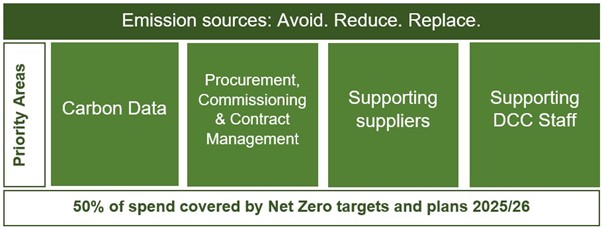
To do this the council will focus on four priority areas:
- Improving the quality of the supply-chain carbon data
- Procurement commissioning and contract management processes
- Supporting suppliers, and
- Supporting and training DCC staff.
As an interim target, the Council aims to have 50% of its spend covered by net-zero targets by the end of 2025/26 (March 2026). This strategy describes how the authority will accelerate activity to achieve the interim target.
2. Background
2.1 Purpose of strategy
In February 2019 Devon County Council (DCC) declared a Climate Emergency and has since set the target to become net-zero carbon by 2030, including its supply chain, in its Carbon Reduction Plan.
The carbon emissions from the council’s supply chain are roughly 19 times larger than the council’s corporate footprint, with the latest figure (2020/21) showing the supply chain carbon emissions to be 386 ktCO2e.
This strategy sets out how DCC intends to accelerate activity over the next 3 years to March 2026 to achieve the interim target of 50% of spend covered by net zero targets and plans by 2025/26. Learning will inform the subsequent phase from 2026/27 – 2030/31.
2.2 Climate change
The Intergovernmental Panel on Climate Change (IPCC) state that climate change is unequivocally happening and is being caused by human impacts on the climate. Increased greenhouse gasses (GHG) released by human activity trap more heat, causing the climate to warm. 2020 was the joint hottest global surface temperature on recordi and the past seven years have been the hottest since records beganii. Temperatures are already between 0.5 – 1 degree higher in Devon than they were in the 1970siii. Projections of warming in Devon show a worst-case scenario increase of over 4 degreesiv.
This warming increases the likelihood of extreme weather events, with extreme storms, heatwaves and droughts already causing damage and destruction, and gives rise to higher sea levels, putting coastal communities at risk. Devon can expect to see increasingly wetter, hotter winters and drier, hotter summers, with floods and heat waves more frequent and severe. Increased frequency of extreme weather events will have significant impacts for the population of Devon and its public services with widespread disruption, strain on public services and economic stress.
The IPCC report highlights the importance of keeping warming below 1.5 degrees from pre-industrial levels by reducing carbon emissions to limit damaging impacts of global warming. Every tonne of emissions avoided is important.
2.3 Policy context
International
The Paris Agreement, adopted in 2015, is an international binding agreement amongst 196 parties including the United Kingdom. The parties have committed to action to keep warming well below 2 degrees, preferably by 1.5 degree, by reducing greenhouse gas emissions and achieving a climate neutral world by 2050v. The agreement commits the parties to taking both mitigating and adaptive actions in response to climate change.
National
The UK Climate Change Act 2008 requires greenhouse gas emissions to be significantly reduced and to adapt to climate change risks. In 2019 it was amended to a legally binding target to be net-zero by 2050.
Local
Devon County Council have signed the Devon Climate Emergency (DCE) declaration and are one of many partner organisations who are committed to collaborating and creating a net-zero Devon. The DCE Devon Carbon Plan sets out to create a net-zero carbon Devon by 2050 at the latest, with an interim 2030 target of 50% reduction compared to 2010 levels. Local Authorities are well placed to influence action to mitigate climate change as procurers, commissioners, and service providers.
Devon County Council context
Devon County Council (DCC) have declared a climate emergency and set a 2030 net-zero target through its Carbon Reduction Plan. Net-zero means significantly reducing the carbon emissions produced and any residual emissions being offset, a term used to describe the removal of carbon emissions from the atmosphere. Carbon in this strategy refers to a group of greenhouse gasses (GHG) including carbon dioxide.
DCC’s strategic priorities include tackling climate change. As a strategic priority, tackling the climate crisis must underpin all council activity and be a priority shared with the council’s partners.
2.4 Scope of strategy
The council commissions and procures for a range of goods and services that serve the people of Devon. Although the council does not have direct control over the companies in the supply chain, there is opportunity to influence and reduce their impacts on the environment while carrying out work commissioned and procured, by the council. The strategy will influence the emissions of this procured and commissioned revenue and capital spend.
3. Vision for 2030
In 2030 the council will have a net-zero carbon supply chain. The authority will have high-quality data about the carbon emissions arising from its receipt of goods and services. Those emissions will be declining rapidly due to the previous years’ efforts.
Staff responsible for leading commissioning and procurement processes and managing contracts will be using new skills to ensure that all requests for quotations and invitations to tender include carbon-related evaluation criteria and/or the specifications for the goods and services incorporate low-carbon and circulareconomy requirements.
All suppliers will be reporting to DCC the carbon emissions or raw activity data related to the delivery of the contract, having been supported to develop their knowledge and skills to do this. Similarly, suppliers will have been supported to understand the low-carbon solutions available to them and will have started implementing these.
4. Target
Setting an absolute emissions reduction target from the supply chain is challenging for a number of reasons. Firstly, the amount of money spent within the supply chain and hence the extent of goods and services purchased changes from year to year – this means the carbon emissions will vary as well. Secondly, the data available for the supply chain’s carbon emissions are currently low-quality (see Section 5.1) but will be improved over the coming years. This means that emissions may appear to increase or decrease simply because the council’s data quality has improved.
Instead of an absolute emissions reduction target, the authority will increase the effort being made within the supply chain to minimise emissions. Currently, 20% of the authority’s spend is covered by a net-zero target – these are either targets set within the organisations of companies delivering the council’s contracts, or are contract specific. The council will aim to increase this to 50% of its spend covered by net-zero targets by the end of 2025/26.
5. Priority areas
The resources required to deliver these priority areas are shown in the table at Section 9.
5.1 Carbon data
Key themes: Accuracy, Monitoring, Transparency, Reduction
To gain an accurate measure of the supply chain emissions and carbon reduction efforts DCC must collect, store and analyse carbon data from the supply chain.
The latest figure for 2020/21 shows the supply chain carbon emissions to be 386 ktCO2e. DCC currently calculate the supply chain carbon footprint using government spend factors. These give an estimation of DCC’s supply chain carbon emissions based on how much is spent in categories. The conversion factors have not been updated since 2009 so the estimation of the supply chain emissions have largely stayed the same since its initial baseline in 2012/13. This means carbon saving measures already utilised in contracts are not currently accounted for in the supply chain carbon footprint.
It is therefore important to start receiving primary data from suppliers to gain a more accurate picture of the council’s supply chain emissions. The council has begun to receive primary carbon data from some contractors and are integrating these figures into the supply chain carbon footprint.
The council will need carbon emissions data about products and services from ‘cradle to grave’. Alternatively known as ‘whole life-cycle carbon’, this approach provides a true picture of a product’s or service’s carbon impact on the environment by considering the carbon emissions arising from materials extraction, processing, construction, use and disposal. Life-cycle assessments ensure that lower carbon emissions from a product when in use, for example, will not be rendered invalid by increased carbon emissions from manufacturing, disposal, or replacement frequency, in comparison to the traditional alternative.
a. Collecting data
DCC will need to collect carbon data from suppliers in a consistent format. This will enable the council to get a more accurate picture of the actual emissions associated with the supply chain.
Options for gathering carbon data:
- Spend data
DCC currently work out supply chain carbon emissions based on spend conversion factors for categories of public spend. This requires spend data for DCC’s supply chain to then be multiplied by the corresponding government conversion factor.
This requires low data demand and all data needed is internal. However, it produces an inaccurate figure of supply chain emissions and does not account for carbon reduction solutions, unless they result in lower expenditure. - Company-wide emissions: percentage revenue
This requires the company to measure their whole company emissions (quoted companies or companies with over 250 employees, £36m annual turnover, or £18m balance sheet total have had to report their carbon emissions in their Directors’ Report since 1st April 2019) and provide this to DCC alongside the percentage of their revenue that comes from DCC contracts. The percentage of the company emissions associated with revenue is then assigned to the DCC contract. This is more accurate than spend conversion factors and less data intensive than collecting raw data. However, the carbon data is not directly for DCC’s contract, so would not account for specific carbon reduction measures in the contract, but would pick up the carbon benefit of low-carbon initiatives delivered across the whole company’s operations e.g. if the company operated a fleet of electric vehicles that are used on all of its clients’ contracts. Emissions calculated by companies will likely cover different scopes of activities, and may not cover their own supply chain (and hence not ‘cradle to grave’, but they will be following UK Environmental Reporting Guidelines that will ensure an acceptable level of consistency. - Contract-specific carbon data
Suppliers provide precalculated carbon data for emissions associated specifically with the DCC contract. This would provide DCC carbon data for the council’s contracts, but the council would need to set out clear guidelines for how this would be calculated. It would require DCC’s contractors to engage with their suppliers right back to the origin of materials to ensure the ‘cradle to grave’ approach, which may be difficult for the council’s suppliers. - Contract-specific raw activity data
Collecting raw activity data from suppliers over the course of the contract, for example tonnes of different materials used and the distance they have been transported, to then calculate the emissions associated with that activity, is a very accurate method for producing carbon data. This also gives the council control over how the activity data is turned into carbon data, and the approach will be able to demonstrate clear carbon reduction when improved practices are introduced. However, it is a very data intensive method.
The council are in the process of developing and testing a system built in-house by DCC’s information technology partner, SCOMIS, for storing and visualising carbon data collected from suppliers as part of a pilot approach in the Highways, Infrastructure, and Development service.
The strategy:
S1. Prioritise collecting ‘raw activity data’ or ‘company-wide: percentage revenue’ emissions data, dependent on which is most relevant to the contract in question. ‘Contract specific carbon data’ may be collected where justified, e.g. rental vehicle contracts where the distance travelled and carbon intensity of each vehicle can be used to calculate emissions.
S2. Focus effort initially on collecting data from the highest value contracts, which are likely to be the carbon hotspots, moving to lower value contracts later in the decade. However, where contractors operating smaller value contracts are keen to engage and supply emissions data, then their enthusiasm should be supported.
The actions:
A1. Approach existing suppliers who are already likely to be calculating their company-wide emissions, to then calculate the associated emissions for the contract using the percentage revenue technique.
A2. Continue developing a tool to collect suppliers’ raw activity data. Test it with willing suppliers.
A3. Roll-out the tool to all contracts for which raw activity data collection is most appropriate.
b. Storing data
To enable the analysis of carbon data, DCC must be able to store the data that will be received from different sources and using the different data calculation methods. This is important to ensure the supply chain carbon footprint can be easily calculated. The council are in the process of developing a system in-house for storing carbon data for the corporate carbon footprint and the supply chain.
The strategy:
S3. Aggregate supply-chain carbon emissions data into one system for easy analysis.
The actions:
A4. Ensure the tool acquired for storing the council’s carbon data can accept supply-chain data and meets users’ needs.
c. Verifying and auditing data
There is a risk that carbon data and activity data provided to DCC by suppliers is inaccurate. This presents particular problems if carbon data is being used as part of a quotation or tender evaluation process.
Precalculated carbon data received from suppliers must reach a minimum standard and be available for random audit. Large businesses are likely to have undertaken a third-party, independent verification of their carbon data which will give the authority confidence that the data is correct and of high quality.
Audits could be undertaken by contract managers, specialist staff (e,g. existing procurement or environmental specialists), Devon Audit Partnership or external consultants. The relative merits and costs of each solution need to be understood before determining the most appropriate solution for DCC.
The strategy:
S4. Randomly audit suppliers’ carbon or activity data to check its integrity, where this has not already been subject to independent verification.
The actions:
A5. Determine the most appropriate solution for undertaking random audits of suppliers’ carbon or activity data.
d. Analysing data
Carbon intensity reporting, for example reporting carbon emissions of care homes as kgCO2e per resident, will aid carbon reduction efforts by pinpointing carbon hotspots in contracts and services.
The strategy:
S5. Analyse data from contracts to monitor carbon reduction performance and to target further efforts.
5.2 Procurement, commissioning, and contract management
Key themes: Proportionality, Monitoring, Reduction, Engagement
The council procure and commission a wide range of goods and services and provide community services which will continue to be provided at high standards whilst working to reduce their associated carbon emissions.
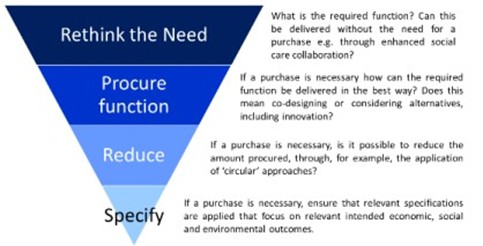
The climate emergency agenda needs to be embedded in procurement and commissioning daily activity. To do this, the council will implement the carbon management hierarchy (Figure 3) when procuring and commissioning goods and services. vi As part of this, DCC will encourage circularity – to transition to a sustainable supply chain, we must move away from a linear economy. A circular economy reduces waste and carbon emissions by refurbishment, repairing, reusing and recycling resources.
The council are beginning to introduce carbon reporting and reduction requirements into their evaluation and contract documents, but also into the specifications for goods and services, for example specifying the use of warm asphalt for highways maintenance rather than hot-mix that uses more energy. Devon County Council will continue to introduce these measures in a proportionate and relevant manner.
The strategy:
S6. Consider carbon reduction opportunities as early as possible in the procurement and commissioning process, following the sustainable procurement carbon hierarchy.
S7. Include carbon reduction criteria in quotation and tender evaluations that are proportionate and relevant to the contract. Innovation for low carbon solutions will be encouraged.
S8. Incorporate low-carbon and circular economy principles into the specification of goods and services.
S9. Conduct premarket engagement to discover the maturity of the market around carbon for specific contracts. This will inform what carbon measures can be included in specific contracts.
S10. Employ effective contract management. This will include establishing carbon baselines for all contracts, initially prioritising high value contracts, against which to assess performance by setting specific, measurable, achievable, realistic and time-bound carbon reduction Key Performance Indicators (KPIs).
S11. Incorporate an escalation process into contracts for suppliers who do not achieve carbon targets.
The actions:
A6. Update procurement and commissioning procedures and practices to reflect this strategy and embed the climate emergency agenda in routine functions.
A7. Review current high value contracts that still have an extended period before the contract ends and collaborate with these suppliers to deliver carbon reduction measures.
Carbon reduction measures considered in commissioning and procurement will be linked to the Impact Assessment process and the associated reporting of sustainability considerations through the Cabinet approval process. This will provide scrutiny of the degree to which carbon reduction has been sought and, if necessary, decisions taken on any increased initial costs associated with these.
5.3 Supporting suppliers
Key themes: Collaboration, Communication, Education, Proportionality
DCC are transitioning to a low carbon future and will need current and future suppliers to come on this journey. The council’s suppliers are knowledgeable about the services and goods they provide, making collaboration essential.
It is also important to support and encourage Small and Medium Enterprises (SMEs) to ensure they can be a part of delivering the climate emergency agenda. The council acknowledge that, while there is generally a desire to align with the climate emergency agenda, some suppliers may not currently have the know-how or resources to be actively working to reduce their carbon emissions. Through engagement with suppliers the council have found there is a desire for support to both calculate and reduce carbon emissions.
The strategy:
S12. Continue to engage and communicate with suppliers by providing appropriate support.
Calculating emissions:
DCC are creating a webform form to receive raw activity data from suppliers for highways works to calculate the carbon emissions associated with the schemes. This will mean suppliers will not be required to calculate their emissions but will just need to enter activity data which will then produce carbon figures for the works. This project could lead the way for other services to adapt this tool to receive raw data from their suppliers.
The actions:
A8. Signpost to useful resources for businesses to calculate their carbon footprints.
A9. Publish a roadmap and guidance to show what will be expected to be provided to the council as part of tendering procedures and contract management in the future.
A10. Look into running webinars and engagement days to support suppliers in submitting the necessary data.
Carbon reduction:
Supplier engagement suggested that there was a want for sector-specific carbon reduction advice. While some suppliers have their own net-zero targets and plans, there are still a large number that do not.
The actions:
A11. Collate and signpost suppliers to existing guidance on preparing carbon reduction management plans and setting organisational targets. Run workshops if there is demand.
SMEs and local economic development:
The Council’s Procurement Strategy aims to prioritise opportunities for local suppliers, SMEs and voluntary, community and social enterprise when planning the procurement approach. Prioritising local economic development aids the carbon reduction agenda as it shortens supply chains whilst boosting the local economy. DCC will ensure that the journey to a net-zero supply chain will not discourage SMEs from bidding for council contracts by making carbon reduction requirements proportionate and relevant to contracts. (See Strategy S6).
5.4 Supporting DCC staff
Key themes: Communication, Education, Embedded culture
To implement a net-zero supply chain, it will be important for DCC staff to be upskilled in this workstream to develop a carbon reduction ethos in the council’s procurement and commissioning activity. This will give staff confidence around the issue, aid discussions with suppliers and the monitoring of the carbon-performance of contracts.
The strategy:
S13. Upskill DCC staff so that they can confidently and effectively manage supply-chain carbon emissions.
The actions:
A12. Explore offering Carbon Literacy training to teams regularly involved in procurement and commissioning activity.
A13. Provide an online portal of best practice resources, e-learning and supporting webinars to include templates for incorporating carbon management into contracts, advice on developing carbon KPIs and guidance on monitoring suppliers’ performance.
A14. Investigate the implementation of volunteer Carbon Champions who will receive additional training and be a point of contact for their teams for carbon queries, to answer questions and to signpost to the correct person or resource.
6. Finance and Resources
The costs to the council of implementing this strategy to March 2026 can be split into four areas:
- Initial costs of setting up processes for recording and tracking carbon data
- Ongoing costs of obtaining, monitoring, and analysing data and offering support to suppliers
- Training and support for DCC staff
- Actual cost of a net-zero supply chain
Initial costs of setting up processes for recording and tracking carbon data There are currently two ongoing workstreams regarding carbon data management: the Highways Carbon Reduction Project, and the corporate approach to calculating and reporting the council’s overall carbon footprint. These are being delivered using existing resources with no additional cost.
ICT commissioning are currently developing a bespoke system for the Highways Carbon Reduction project. This is expected to be able to be rolled out to other service areas for use within existing resources. The corporate approach is looking to use free tools being developed for local authorities across the UK.
The risks that apply to this area of costs include IT costs being more than the amount budgeted. The likelihood of this risk is low with the workstreams already underway and on track for completion. Also, the risk that the solution developed for Highways Carbon Reduction Project is not appropriate for roll out to other services. This is a low risk as adaptability is being considered as part of the design.
Ongoing costs of obtaining, monitoring, and analysing data and offering support to suppliers
There will be a gradually-increasing workload related to the requirement for ongoing carbon data collection and analysis. This will increase over time as more contractors are obligated to report data to DCC. Over the next three years this will absorbed within existing resources (the Low Carbon Procurement Officer role).
Offering support and information to suppliers, initially through web pages and engagement events, will be met through existing resources. This will be kept under review.
Training and support for DCC staff
Training and support for DCC staff to carry out this work stream will require revenue budget for carbon literacy training. The role-out of this training on a modest scale can be accommodated within the existing revenue budget assigned to the Carbon Reduction Plan and through staff who are already trained as carbon literacy trainers volunteering to run training sessions. This approach is currently being piloted.
Actual cost of progressing towards a net-zero supply chain
By the late 2030s, the CCC predict that the extra up-front expenditure and investment required to deliver low-carbon solutions will be compensated by reductions in operational spendingvii. For example, energy efficiency measures will likely reduce costs to suppliers, and therefore the council. Furthermore, low carbon technologies and solutions are likely to decrease in price as they become more widely used, making low-carbon solutions the norm.
However, over the next three years, the cost of some low carbon solutions will be more than the business-as-usual practice, which if specified will lead to DCC costs increasing. The costs of implementing low carbon solutions will need to be considered on a case-by-case basis. Costs can be minimised by ensuring a high level of collaboration between the council and suppliers to be identifying the most affordable low-carbon solutions.
7. Monitoring performance and next steps
Devon County Council’s Low-Carbon Supply Chain Steering Group feeds into the Environmental Performance Board. This steering group will monitor the implementation of this strategy, provide a quarterly progress report to the board and escalate issues that need addressing.
The council will report its supply chain emissions annually. DCC will publish the total figure of carbon emissions in tCO2e and will report the supply chain carbon intensity as a figure of tCO2e per £million. By reporting the carbon intensity figure, the council can monitor the effectiveness of measures to reduce carbon emissions even if the overall spend covered by the scope of this strategy reduces.
The percentage of DCC spend covered by a carbon reduction plan and target will also be published annually.
8. Delivery of actions
| Action Area | Action | Date | Responsible parties | Resources |
|---|---|---|---|---|
| Carbon Data | A1. Approach existing suppliers who are already likely to be calculating their company-wide emissions, to then calculate the associated emissions for the contract using the percentage revenue technique. | 2022 onwards | • Low Carbon Procurement Officer • Service Area Commissioning Managers and Officers | Within existing staff time |
| Carbon Data | A2. Continue developing a tool to collect suppliers’ raw activity data. Test it with willing suppliers. | 2022-2025 | • Highways Carbon Reduction Project • Scomis | Within existing staff time |
| Carbon Data | A3. Roll-out the tool to all contracts for which raw activity data collection is most appropriate. | 2025 onwards | • Low Carbon Procurement Officer • Service Area Commissioning Officers | Within existing staff time |
| Carbon Data | A4. Ensure the tool acquired for storing the council’s carbon data can accept supply-chain data and meets users’ needs. | 2022-2025 | • Climate and Ecological Emergency Officer • Low Carbon Procurement Officer • Scomis | Within existing staff time |
| Carbon Data | A5. Determine the most appropriate solution for undertaking random audits of suppliers’ carbon or activity data. | 2025 | • Low Carbon Procurement Officer • Climate and Ecological Emergency Officer | Within existing staff time. The actual auditing solution may require additional revenue funding, which would be the subject of future discussions. |
| Procurement, Commissioning, | A6. Update procurement and commissioning procedures and practices to | 2022 onwards | • Low Carbon Procurement Officer • Procurement Managers | |
| Procurement, Commissioning, | A7. Review current high value contracts that still have an extended period before the contract ends and collaborate with these suppliers to deliver carbon reduction measures. | 2022 onwards | Service Area Commissioning Managers | Within existing staff time |
| Suppliers | A8. Signpost to useful resources for businesses to calculate their carbon footprints. | 2022 onwards | Low Carbon Procurement Officer aided by Business Support & Innovation and Devon Climate Emergency | Within existing staff time |
| Suppliers | A9. Publish a roadmap and guidance to show what will be expected to be provided to the council as part of tendering procedures and contract management in the future. | 2025 | Low Carbon Procurement Officer Procurement Managers | Within existing staff time |
| Suppliers | A10. Look into running webinars and engagement days to support suppliers in submitting the necessary data. | 2025 onwards | Low Carbon Procurement Officer Climate and Ecological Emergency Officer | Within existing staff time |
| Suppliers | A11. Collate and signpost suppliers to existing guidance on preparing carbon reduction management plans and setting organisational targets. Run workshops if there is demand. | 2024 onwards | Low Carbon Procurement Officer aided by Business Support & Innovation and Devon Climate Emergency | Within existing staff time |
| Supporting DCC staff | A12. Following the pilot in 2022-23, expand the offer of Carbon Literacy training to teams regularly involved in procurement and commissioning activity. | 2024 onwards | Climate and Ecological Emergency Officer | Within existing staff time and revenue budgets. |
| Action Area | Action | Date | Responsible parties | Rescources |
| Action Area | A13. Provide an online portal of best practice resources, e-learning and supporting webinars to include templates for incorporating carbon management into contracts, advice on developing carbon KPIs and guidance on monitoring suppliers’ performance. | 2025 | Low Carbon Procurement Officer Procurement Managers | Within existing staff time |
| Action Area | A14. Investigate the implementation of volunteer Carbon Champions who will receive additional training and be a point of contact for their teams for carbon queries, to answer questions and to signpost to the correct person or resource. | 2025 | Low Carbon Procurement Officer Climate and Ecological Emergency Officer Service Area Commissioning Managers | Initially within existing resources but may need further revenue budget to sustain activity |
9. References
ii Past seven years hottest on record – EU satellite data – BBC News
iii Fighting the climate emergency | Devon Wildlife Trust
iv Climate Change in East Devon (arcgis.com) v The Paris Agreement | UNFCCC