1. Introduction
Devon County Council’s Environmental Policy and Corporate Waste Strategy sets out the Authority’s broader aims and objectives in relation to waste generated by the Authority’s activities in the delivery of its services. This is an update of the 2017 Strategy and Plan and encompasses the 2018 Plastics Strategy. It is complemented by the Re-use Policy, which was adopted in 2023.
Waste is a fundamental environmental issue and a key indicator of an organisation’s environmental performance, as it arises from the inefficient use of resources. Apart from the pollution caused by the disposal of waste, it contributes to our unsustainable demands on the world’s natural resources.
In addition, Devon County Council is the Waste Collection Authority with responsibility for disposal of domestic waste using the best available environmental options and staff in the Waste team run programmes to nudge households into reducing and recycling more of their waste e.g. Home – Recycle Devon. It is therefore important that DCC is seen to be leading by example. Devon achieved a 54% recycling rate of household waste in 2022/23.
2. Strategy
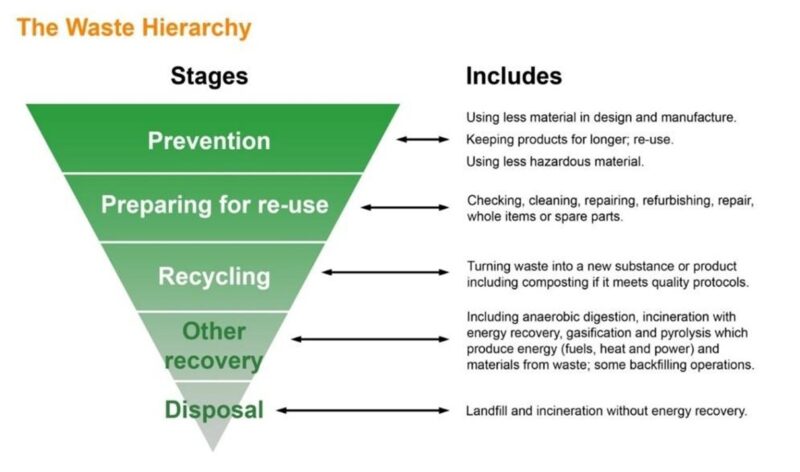
Our strategy is to follow the waste hierarchy and move towards a circular economy.
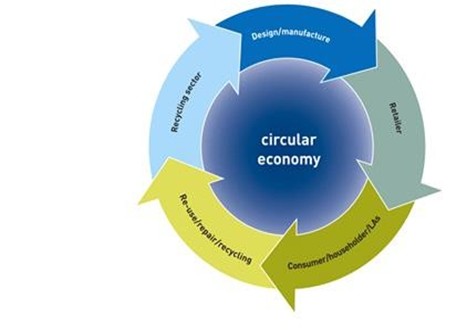
A circular economy is an alternative to the traditional linear economy (make, use, dispose) in which we keep resources in use for as long as possible, extract the maximum value from them while in use, then recover and regenerate products and materials at the end of each service life1.
The model of a Circular Economy reflects how waste is increasingly seen as a valuable resource and how more organisations are taking steps to recover value from the materials that were previously viewed as just waste. This has in turn led to improvements in efficiency which can save money and help to reduce our impact on the natural environment.
References
1 WRAP website February 2016
3. Objectives
Our main objectives are:
- To reduce the amount of waste we create in the first place by reviewing processes and systems,
- To ensure the re-use of redundant items in line with the Re-use policy,
- To increase our recycling rate,
- To reduce the amount of plastic waste produced.
4. Background
Waste generated from the Authority’s corporate estate has historically been managed at a local level by the Facility Management teams. The development of the recycling facilities across the estate has largely been driven by the Waste Management Team working in conjunction with Facilities Management staff.
Recycling of white office paper was first introduced at County Hall in 1996 with ad hoc arrangements in some other buildings. In 2004 the current multi material recycling system was trialled as part of the new Recycle@work campaign. Appendix 2 sets out the original Recycle@work aims and objectives set in 2006 along with the progress by 2016. Appendix 1 shows the 2017 action plan with progress.
The Waste Management Team (which is responsible for waste from Devon households and not the Authority’s own waste) took a leading role in developing and promoting the recycling systems for The Authority. However, the Waste Management team is not responsible for the contracts, staff or budgets associated with the day-to-day management of waste from the corporate estate. Now that the recycling system is well established there is no longer a remit for the Waste Management Team and it is more efficient and practical for the current FM teams/Devon Norse to formally take on responsibility for the recycling scheme in the premises that they manage. There was staff resource in the Waste Team for internal initiatives but this has been lost and since the pandemic waste has not been seen as a priority due to low staff numbers.
The Waste Management team will continue to provide a strategic and advisory role and will work with the Facility Management teams and Devon Norse to promote and develop sustainable waste management by the Authority and its partners.
4.1 Results of 2024 Waste Audit
In 2024, the Climate Change team organised a waste audit of the 3 main offices (Taw View, Great Moor House and County Hall). Waste data contributes to the Authority’s carbon footprint and, as work patterns have settled down since the disruption of the lockdowns, it is a good time to look again at waste. The main results are:
- DCC produced about 145 tonnes of waste in 23/24
- 69% of that waste was recycled
- Shredded paper made up 28% of all waste and recycling
- The carbon emissions associated with waste are relatively small as long as it is not landfilled and equate to 3.6 Tonnes CO2 equivalent.
- There was contamination of all the recycling waste streams from all the offices together with recyclable items in the general waste
- Labelling of bins has deteriorated and communications to staff rely on the information on the internal website
- Communications rely on this page Recycle at work – Inside Devon – tasks and guides
We propose to repeat this survey every three years.
4.2 Rethink, Reduce and Re-use
It is important to shift the focus further up the waste hierarchy and look to increase reuse across the authority’s properties. To this aim, the Action Plan identified the need for a policy for the ‘Reuse, Repair and Disposal of Surplus Items from Devon County Council Premises’. This was adopted in 2023.
4.3 Single-use plastics
A separate strategy for single-use plastics was developed in 2018, covering DCC’s own operations as well as county-wide initiatives. When it was reviewed in 2020 all of the actions apart from one relating to crisp packets had been completed. As county-wide initiatives are now covered by Recycle Devon, it is proposed to cover SUPs in this strategy and action plan.
4.4 New legal requirements
The Simpler Recycling Regulations require that non-domestic premises have to recycle specific materials in separate bins, including food waste, glass, metal, plastic, paper and cardboard where quantities per week of the recyclable materials.
In addition, electronic waste transfer notes will become mandatory in 2025 – now pushed back by a year.
There is a need to clarify where responsibility for ensuring compliance with new and existing regulations lies within the contract with Norse.
5. Proposed new plan
Objective: To reduce the amount of waste we create in the first place by reviewing processes and systems
| Proposed Action | Output measurement | By When | Additional resource required | Progress |
| Clarify roles and responsibilities with Norse Facility Managers and agree what is included in their work programme Clarify who is responsible for identifying and implementing new legal requirements | Documented agreement | Jun 25 | Look at agreement with Norse to see how waste management is covered. Procurement re waste contracts SW Norse Compliance Manager + central team | |
| Identify larger producers of confidential paper waste and encourage review of processes | Reduced confidential waste | Establish cost of confidential waste and main producers: Explore how best to track quantities | ||
| Consider clause in procurement processes re minimising packaging and longevity/recyclability of products | Documented agreement | Pick up through Low Carbon Procurement Strategy post | ||
| Roll out locked printing to all DCC printers | Reduce photocopiers by 50% Follow me print to be implemented | End of summer 2025 | Under way | |
| Repeat waste audit in 3 years time to measure progress as a minimum Explore what else can be done to improve data and get to more regular reporting | Comparable data available every 3 years | |||
| Look at training for FMs and other responsible persons | Number trained | TBD | BH to advise on possible training course – WAMITAB/CIWM |
Objective: To ensure the re-use of redundant items in line with the Re-use policy
| Proposed Action | Output measurement | By When | Additional resource required | Progress |
| Promote policy and re-use actions in the workplace to help create a culture of re-use amongst staff | Policy is easy to find on internal website | Jun 25 | None – part of revamp of internal website pages on environmental aspects | |
| Collate monitoring data on items re-used and publicise | Data published annually | Annually | Collected by staff | |
| Ensure need for resource is recognised and built into workplans of Estates and SW Norse | 2025/26 |
Objective: To increase our recycling rate
| Proposed Action | Reduced number of bins | By When | Additional resource required | Progress |
| Review and update the recycling bins and signage across the workplaces with recycling schemes, starting with the 3 biggest | Reduced number of bins | 31/03/2026 | ||
| Communications to staff re what can and can’t go in – tied to internal comms plan | Communications | 31/03/2026 | FMs re posters, messaging etc. Video available and on website | |
| Set up food collection bins at main workplaces in time for legal requirement | Bins in place by 31st March and contracts for collection in place | 31/03/2025 | List of people responsible for each building needed. |
Objective: To reduce the amount of plastic waste produced
| Proposed Action | Output measurement | By When | Additional resource required | Progress |
| Promote re-useable cups at Lucombe House café and amongst staff, especially when procuring refreshments. | Sale of re-useable cups at cafe | Sept 25 | Posters re re-useable cups available. | |
| Check whether packaging of food deliveries to Lucombe is taken back. | Documented response | Sept 25 | Ask Restaurant Manager | |
| 🔘Consider collection of plastic film for recycling as this is now collected by most supermarkets? | This would require additional resource and separate collection facilities and will be placed on hold. All businesses will need to separate plastic film packaging and plastic bags in the plastic waste stream by 2027, when it is hoped there will be a stronger market for these plastic types than there is now. | |||
| 🔘Audit of plastic use at 3 main offices | This would require additional resource. |
🔘= on hold