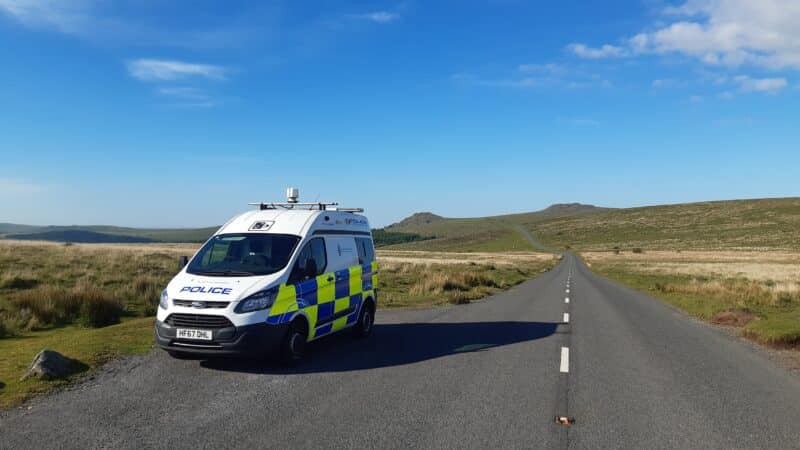
The number of people killed or seriously injured (KSI) on Devon and Cornwall’s roads has dropped to the lowest ever level in recent reporting history, new figures reveal.
Provisional figures* from the Department for Transport (DfT) show that in 2025, 49 people were killed and 495 seriously injured in collisions in Devon and Cornwall. This is the lowest number since modern recording systems were introduced** and almost 20% lower than the figure for 2024.
The provisional data also shows the number of KSI*** collisions in the region have decreased every year since 2022 (post-Covid), demonstrating a significant reduction.
The release of the figures coincides with the fifth anniversary of the Vision Zero South West road safety partnership, a collaboration between 17 organisations across the region – including Devon County Council, Devon & Cornwall Police, Devon and Somerset Fire and Rescue Service, Cornwall Fire and Rescue Service, South Western Ambulance Service Trust, and other local authorities, NHS Trusts, air ambulance charities, National Highways and the Office of the Police and Crime Commissioner.
The partnership has committed to reducing fatal and serious collisions by 50% by 2030 – and these latest figures suggest this target is within reach.
In the five years since it became operational, Vision Zero South West has funded numerous innovative and impactful road safety projects in the region, including:
• A state-of-the-art motorcycle simulator to train young riders in hazard prediction;
• A UK-first trial of AI cameras which detect seatbelt and mobile phone offences;
• Pedestrian training for thousands of primary school children;
• Groundbreaking research work from IMPACT: The Centre for Post-Collision Research, Innovation and Translation;
• The purchase of a Ford Focus RS car to help promote road safety to a younger audience through social media;
• Over £250,000 of community-led safety schemes through the “Call For Ideas” grant funding scheme.
Councillor Dan Thomas, Cabinet Member for Highways, said:
“These figures are positive news and it’s encouraging to see the results of the work being carried out by Vision Zero South West. Lives are being saved, which is exactly what this project is aiming to achieve. But we have to remember that we still had 49 people killed and 495 seriously injured on Devon and Cornwall’s roads last year. That is still far too many so there is still more to do and we are committed to working closely with our Vision Zero partners to continue to make our roads as safe as possible.”

Alison Hernandez, Police & Crime Commissioner for Devon, Cornwall and the Isles of Scilly, and chair of Vision Zero South West, said: “Our collective efforts – as partners and communities – to ensure road users are at their best are starting to make a real difference to people’s lives. While we are obviously delighted to see a significant decrease in the number of people being killed or seriously injured, there is still a lot of work to do. We must never forget what these numbers represent. These are real people killed in tragic and traumatic circumstances – loved ones and family members, parents and children, brothers, sisters and friends.
“We have worked tirelessly towards reducing these figures. This has involved embracing innovation and technology, being bold and trying new things, being relentless with our safety messaging and campaigns, and investing in things we know make a difference. Working in partnership has been absolutely key to every success we’ve had and I look forward to continuing this work with our partners in the future.”
Adrian Leisk, Head of Road Safety for Devon & Cornwall Police said: “This very welcome news demonstrates the effectiveness of the partnership approach to reducing the number of people killed or seriously injured on our roads. Whilst this reduction is encouraging, our thoughts very much remain with those who have lost loved ones in a road traffic collision.”
So what kind of projects does Vision Zero South West actually fund?
Walkability – Child Pedestrian Training Programme
Devon County Council’s Walkability programme, delivered by Active Devon and funded by Vision Zero South West, is a child pedestrian training program which sees road safety lessons delivered at primary schools across Devon.
Offering valuable practical and theoretical skills to pupils aged 7-11, the program has so far been delivered to more than 6,000 pupils at 77 schools.
Road safety is not a statutory part of the national curriculum, but Vision Zero South West feels strongly that every child should receive some formal training to help them stay safe on and around roads.
Emily Moore, Walkability Project Coordinator with Active Devon, said: “Walkability gives pupils knowledge of the Green Cross Code, what certain road signs mean and how to identify safer places to cross the road. The aim of Walkability is to see fewer pedestrian casualties among children and improve their safety when they are crossing the road. It really lays the foundation for safe pedestrian practices, and we hope to see this lead to more children walking to school, and in their free time. We are really grateful to Vision Zero South West for commissioning and funding the project and for making Walkability the success that it is today.”
“It’s excellent that thousands of children from across the county are taking part in our Walkability programme and benefiting from the road safety skills they’re learning. We can’t assume that every child already knows everything there is to know about staying safe on their local roads, and what they learn through this initiative gives them the vital skills and confidence that could potentially save lives. While this scheme itself is simple, it can play an important role in reducing incidents involving child pedestrians in Devon.”
Councillor Dan Thomas added:
“It’s excellent that thousands of children from across the county are taking part in our Walkability programme and benefiting from the road safety skills they’re learning. We can’t assume that every child already knows everything there is to know about staying safe on their local roads, and what they learn through this initiative gives them the vital skills and confidence that could potentially save lives. While this scheme itself is simple, it can play an important role in reducing incidents involving child pedestrians in Devon.”
(Notes)
* Provisional figures remain subject to further validation. These can change as collision investigations progress and conditions are updated.
** Injury Based Reporting Systems (IBRS) were introduced in 2015 in Devon & Cornwall. The DfT only reports figures from 2014 onwards. For more information visit: Guide to injury-based reporting and severity adjustments for road casualty statistics – GOV.UK
*** KSI stands for Killed or Seriously Injured and is a key data point used by the Department for Transport. For more information about the classification of injury severity, please visit: Guide to severity adjustments for reported road casualties Great Britain – GOV.UK