Attainment and achievement 2024/25
Contents
The aims of the Virtual School
Promote: High aspirations and excellent educational outcomes
Support: Children and young people, carers, schools and settings
Challenge: Anyone who does not deliver on our aspirations
Celebrate: All our successes
1. Introduction
This report has been designed to provide information on the attainment and achievement of the Local Authority’s (LA) looked after children in 2024/25, set against a background of our performance in previous years and national benchmarks.
This report is based on LA held pupil information and results from schools for 2024/25. As in previous years, the data in this report is constantly updated from first issue until all national data becomes available.
It is important to note, however, that due to the pandemic and the closure of schools for the summer term, that all areas are not comparable with previous years. This includes attainment, attendance, exclusions and progress.
The report also outlines the work of the Virtual School in 20234/25 – in working to advocate for the Local Authority`s Children in Care to ensure high aspirations and best possible outcomes for each young person. It also has a focus on our responsibility for Previously Looked After and Adopted Children and shows how our Virtual School has embraced the Extended role of the Virtual School promoting the education of all children with a Social Worker (CWSW). The purpose of this strategic role is to:
- make visible the disadvantages that children with a Social Worker can experience
- enhance partnerships between education settings and Local Authorities to help all agencies hold high aspirations for our valued children
- promote practice that supports children’s engagement in education, recognising that attending an education setting regularly and well, can be an important factor in helping to keep children safe from harm
- level up children’s outcomes and narrow the attainment gap so every child can reach their potential.
The work of the Virtual School is supported by a Governing Body, chaired by the Cabinet Member for Children`s Services and Schools and has Secondary and Primary Headteachers along with representatives from Further Education and partner groups* (Governance to be reviewed Autumn 2025). We publish an annual VS Team Development Plan in September each year, as we reflect on the successes of the previous year and identify areas for improvement. This is reviewed regularly within the team and shared with our Governing Body.
During 2024/25 we welcomed a new Interim Virtual School Head, the previous substantive Head retired at Easter 2024. The team have had a turbulent few months and have done their best in continuing to run the Virtual School. There have been some staff changes due to the current Inclusion & Learning re-design. The Virtual School will be entering our own re-design in Autumn 2025 to create a newly focused and fit for purpose service for our Devon children.
2. Celebration of success
We were thrilled to be able to hold our annual Celebration of Achievement Event at Exeter Racecourse in the summer. We really encouraged this event to be for all care-experienced young people in Devon and were particularly pleased with the number of Care Leavers who attended this year supported by their PAs. The event is jointly organised with our Social Care and Participation Team colleagues and very well supported by our Senior Leadership Team joining with families and young people to celebrate all they have achieved. 522 young people were nominated and invited to attend and we welcomed 210 young people with 252 of their family members/guests on the evening, awarding each young person with a personalised certificate and gift voucher. As well as lots of activities on offer and delicious food we were entertained and moved by some of our young people showcasing their talents playing guitar and singing as a group.
3. Summer School
Over the school summer holidays the DCC Participation Team organised a range of outdoor challenges and an art activity held across the County, fully-funded by the Virtual School.
Outdoor activities included: wakeboarding, sports day, visit to World of Country Life, Laser Tag, fun day, beach trip and High Ropes Adventure.
An art activity was also offered in Exeter for 11-16 year olds.

It was very special to see new friendships being made, young people with some very traumatic backgrounds stepping out of their comfort zone and challenging themselves, learning that they can do things they really did not think possible.
4. Improving outcomes for children in care
Personal Education Plans
For the last few years, post pandemic we have worked on a hybrid model where every child has at least one face-to-face meeting which we have attended, also two virtual PEP meetings most of which we have attended. We feel our work is based on positive relationships with our children, carers, social care colleagues and schools and that these are best formed in person. We work to support schools in owning the PEP as the central point of information about the child`s education journey. We advise on targets and positive use of Pupil Premium Plus funding. We have good relationships with our schools, early years providers and post-16 colleges, working together to ensure that every young person has a termly PEP and that it is of high quality, helping improve outcomes and support carers to help the child. This autumn we will be reviewing our attendance at PEPS due to the increasing number of CiC and the need for our schools and social care colleagues to lead on the PEP process. We will continue to attend where required and quality assure all the documents, offering constructive feedback to move learning on for our children.
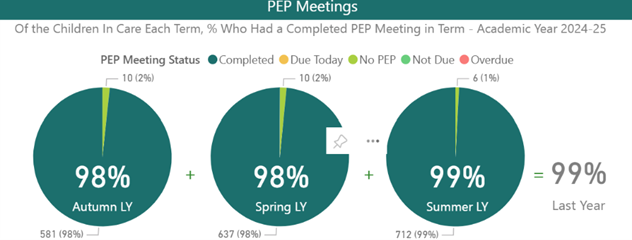
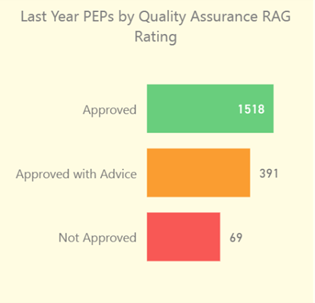
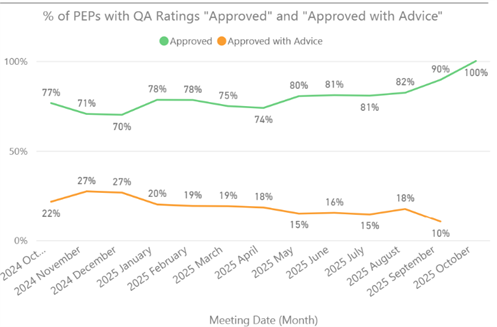
We continue to work with schools to complete PEPs within 5 working days of the meeting and can see improvements. We appreciate that Designated Teachers are extremely busy and focus on the quality of the meeting and the outcomes for each child. We regularly moderate the quality assurance of each PEP within the VS Team and have seen the quality of PEPs increase, with a higher percentage now being recorded as good. We continue with training for Designated Teachers on their role where we look at what makes a good PEP with 68 taking up the offer this academic year. Completed PEPs are now sent termly to Carers and uploaded onto the Social Care database Eclipse.
Training
Throughout the year we have been able to offer Designated Teachers, other school staff, Social Workers and Foster Carers a fully-funded training offer to support their work:
- Attachment Based Mentoring for schools: training for school staff to help them effectively support children with attachment difficulties and those who have suffered from Adverse Childhood Experiences. Our aim is that every secondary school in Devon has at least one member of staff who has attended the training, which is incredibly popular and always over-subscribed. It has been specifically developed for Children in Care on behalf of the Virtual School by the Educational Psychology and SEMH Teams and has been offered both virtually and face-to-face – it is incredibly popular and always over-subscribed bringing excellent feedback. There is also a 1-day course for senior leaders as an introduction to the learning.
- Training for newly qualified Social Workers has continued, covering the role of the Virtual School and the challenges for Children in Care in schools and now includes newly appointed Personal Advisors.
- Training for Foster Carers on supporting Children in Care in education.
- Training for Foster Carers on supporting a Child in Care with Special Educational Needs.
- A wide range of training for schools fully-funded from Psychology Associates, for example Behaviour and Language Development, Understanding ACE’s, School Non-Attendance, Therapeutic Approaches to Child-Based Play and Suicide Prevention.
- Emotional Logic Foundation Award training for schools and an offer of a funded EL Practitioner in school for one day a week to work with children, to give skills to manage classroom learning.
- Relational Policy and Practice support.
Relational Policy and Practice update September 2025
We have been continuing to work on our project to develop Relational Practice and Policy within schools. Over the past year the focus has been on supporting the Level 2 schools in completing their relational projects and working with the Level 3 schools on their journey to become Beacon Schools where relational approaches are embedded and their expertise in relational practice can be shared with other schools.
Support for the Level 2 schools has included training for whole school staff, workshops for smaller groups, consultation and supervision for key members of staff, parent workshops, strategy meetings as well as developing targeted approaches on the ground. There is currently a detailed evaluation of the work taking place looking at the impact of this support.
We have continued to work closely with our Level 3 schools. Much of the work has involved working strategically alongside senior leaders to develop new and alternative systems and policies. In addition we have worked closely with members of staff with a focus on skill development, and this has involved the formation of practice groups involving members of staff across the school. We have also trained some members of staff as coaches so that they can support the development of other staff and ensure that high quality practice is sustained. Our Level 3 schools have identified lead practitioners who are now in a position to provide training and guidance to other schools.
In addition to the schools involved in the project, the work has generated considerable interest in schools across Devon, this has led to us having the opportunity to provide CPD for a wide range of schools that will help them to support their Children in Care and Care Experienced children through the use of relational approaches and relational policies.
Working with education providers
Information, advice and guidance is provided by Area Learning Advocates and PEP Support Officers as requested. This is supported by our half-termly newsletters and Designated Teacher Network meetings, which are held virtually at the request of schools, they are very well attended with up to 100 Designated Teachers logging in each time for updates and a themed training input.
We purchased Social Emotional Mental Health Practitioner time for schools to access support and guidance around individual cases and time from a Senior Educational Psychologist to work on Emotionally-Based School Non-Attendance (EBSNA) helping to develop ways that schools can re-engage young people where anxiety is preventing attendance. We have also funded one day a week of Speech and Language Consultancy to support schools where they have concerns about how a child can access learning and how the school can best support.
Due to the disruption for the Virtual School, there has been no annual conference held 24/25. We have two events booked for November 2025 and Spring 2026 to re-instate our conference offer. We have however continued with our well attended Designated teacher networks each term – a positive learning session this summer with the DFE advisor for PREVENT provided a current picture and update for us all working in Education
REDS Programme
The Virtual School commission the Devon Educational Psychology Service (EPS) and the Social, Emotional and Mental Health (SEMH) Advisory Teacher team to deliver an intervention to Reduce Exclusions in Devon’s Schools (REDS) for Children in Care or children with care experience.
The REDS process works by promoting empathy and inclusive practice, in response to challenging or trauma-related behaviours. The aim of the intervention is to reduce the risk of exclusion and increase school placement stability for Children in Care or children with previous care experience. The process involves a package of Educational Psychologist (EP) and SEMH Advisory Teacher support to develop a needs-led understanding of challenging behaviour that informs a comprehensive support plan.
Reflections and next steps
REDS continues to be a highly successful intervention. A similar number of children were supported this year, and the risk of exclusion was considered to have decreased significantly, on average over 50%.
Some cases remain complex, for example, due to difficulties outside school such as placement instability which can impact action plans being implemented in school. This year EPs and SEMH advisory teachers continue to provide several plan-do-review cycles, when necessary, a high level of support for the staff including DTs, and additional support and interventions tailored to the child’s need.
Examples of support included:
- A meeting with the child’s teachers to develop a joint understanding, share the plan and highlight the role of the classroom teacher in providing predictable and reliable support to include the CYP.
- Supervision sessions with key staff supporting the child.
- Additional training on interventions such as restorative approaches.
- Facilitating person-centred planning meetings.
- Access to the online Attachment Based Mentoring course and places given on the face-to-face ABM course.
- Some schools with several REDS referrals were offered support at a systemic level.
This support was highly valued by staff and enabled the plans to be delivered by skilled and supported members of staff and crucially for the support to be sustained overtime. We will therefore continue to offer this support.
This year several REDS cases were interrupted due to children accessing alternative provision at the point of referral or partway through the REDS process. This sometimes meant that the process needed to be delayed or restarted due to changes with the adults working with the children. As a result of this issue, we have developed new referral guidelines where children will be referred at an earlier stage, as soon as difficulties are identified, or in some circumstances REDS will be used as a form of reintegration into school following a period of accessing alternative provision.
Funding
Pupil Premium
Pupil Premium should be discussed at the PEP meeting and joint decisions made about the best interventions for each young person to aid accelerated progress. The funding, of up to £660 per term, is released on completion of the PEP.
We have been creative again with Pupil Premium funding ensuring that it is used by those who need it most. We have supported some young people at high individual cost with education packages and interventions to enable them to remain included in the school. Examples of this are offering alternative provision for individuals for one day a week and Teaching Assistant support to help them regulate and stay in class.
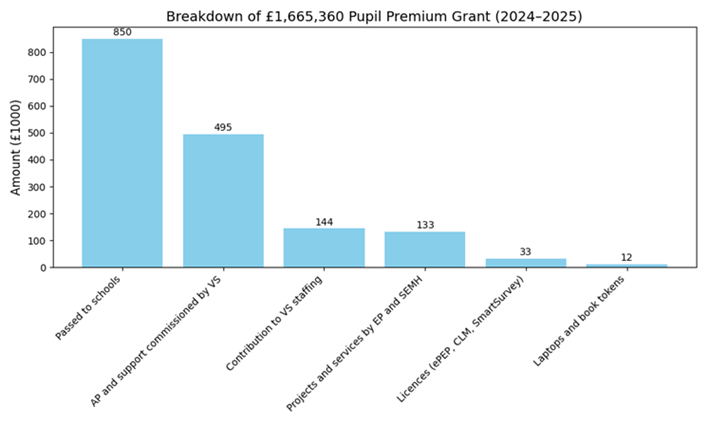
The Pupil Premium Plus funding for the financial year 2024/25 totalled £1,665,360 and was fully spent by the Virtual School.
The breakdown of spending is as follows:
- £850k – Support passed to schools (includes termly PP+ requests of £660 and any additional PP+ funding)
- £495k – Commissioned support by the Virtual School (includes alternative provision places, tutoring for children as a booster outside their school day or as part of a package, Emotional Logic, etc.)
- £144k – Contribution towards Virtual School staffing (SEND worker)
- £133k – Projects and services delivered by Devon EP and SEMH (including EP time, REDs, training, etc.)
- £33k – Cost of licences (ePEP, CLM, and SmartSurvey)
- £12k – Laptops for children and book tokens
Personal Education Allowance
Our aim is always that a Child in Care should have access to everything we would want for our own children, so applications can be made for funding up to £300 for children of statutory school age for extra-curricular activities and clubs or other enrichment activities. the financial year 2024/25, the PEA budget remained the same as in previous years at £64,000 and was almost fully spent.
We received a total of 258 PEA applications, of which:
- 238 were approved
- 20 were rejected
The main reasons for rejection were:
- The child was not of statutory school age
- The child had already received the full £300 PEA allocation
A total of 219 children benefited from the Personal Education Allowance. (Some children had more than one PEA application, but the total amount per child remained within the £300 limit.)
Targets Identified in PEA Applications (one PEA could support more than one target)
- 95% – Build self-esteem
- 93% – Develop social and emotional well-being
- 80% – Encourage a healthy lifestyle
- 63% – Try a new skill
- 39% – Improve engagement in learning
- 24% – Improve attainment
- 20% – Support a learning need
- 10% – Improve attendance
5. Education outcomes
Important definitions
Looked After Child: the term ‘looked after’ has a specific, legal meaning based on the Children Act 1989.
The definition is as follows – a child is legally defined as looked after by a Local Authority if he or she:
- is provided with accommodation for a continuous period of more than 24 hours;
- is subject to a Care Order; or
- is subject to a Placement Order.
Child in Care (CiC): The Department for Education and the National Statistics Office definition of a ‘looked after child’ (CiC in this report) is a child who has been continuously looked after for at least 12 months, up to and including 31 March of that year. Outcomes are for all children and young people who are subject to a Care Order or who are accommodated by the Local Authority, regardless of in which Authority they are being educated. This cohort is sometimes referred to as the OC2 cohort in reference to related statutory returns.
In order to add clarity to this report we have used the term Looked After Child when using the legal definition of a child looked after and the term Child in Care (CiC) with DfE LAIT/National Statistics methodology or comparisons.
Summary
- Both the number of Children in Care for 12 months or more (OC2) and the number of Children Looked After for any period of time fell in the last year.
- Percentage of Children in Care to Devon for 12 months or more with SEN has increased from 71.3% in 2023/24 to 73.9% in 2024/25
- During the 2024/25 academic year, Devon CIC for 12 months or more had an overall absence rate of 10.4% (7.7% authorised absence rate and 2.8% unauthorised rate)
- There was one permanent exclusion for a Devon Child in care from an out of county school.
- The overall number of suspensions rose slightly in the last year but the number of days lost fell. The number of Devon Children in Care with one or more suspensions also fell compared to last year.
- 74% of Children in Care to Devon for any period of time attend mainstream schools, this was the same as 2023/4.
- 73.4% of Devon Children in Care attend schools judged as good or outstanding. This was lower than the 85.2% in 2023/24
6. Data
Numbers of Children Care as of May 2025
The chart below has been split into 3 sections which relate to the categories identified on the previous page. The reference date which used is 31 May as this reflects numbers at the end of the 2024/25 academic year, before Year 11s were taken off school rolls. Whilst the Education Service supports all Children in Care, National comparisons are only possible for those under the CiC definition.
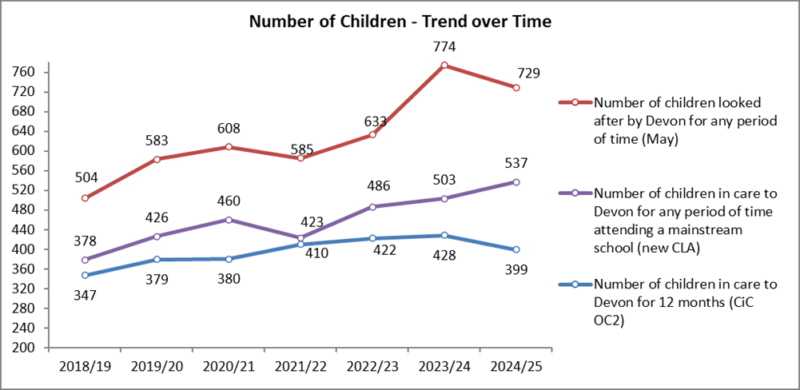
The graph above shows that the number of children who stay in Care to Devon for a period of 12 months or more has fallen by 6.8% to 399 (29 children). The number of children who have been in Care for any length of time has fallen by 5.8% to 729 (45 children).
The table below provides a further breakdown for children who have been in Care for 12 months or more. The number of pupils aged 4 to 7 years has increased slightly to 10% of the CiC cohort (previously was 9%). Those aged 8 to 10 years has fallen slightly to 25% of the cohort (26% previously) whilst 11 to 16 year olds have risen to 66% (previously 65% in 2023/24). As the trend lines in the table below indicate, the number of CiC aged 11 to 16 years have historically risen year on year but have fallen in the last year, whilst other ages fluctuate. Overall numbers have risen steadily over the previous 5 years with a decline this year.
| Number of CiC to Devon for 12 months | 2020/21 | 2021/22 | 2022/23 | 2023/24 | 2024/25 | Trend of no. of CiC cohort |
|---|---|---|---|---|---|---|
| Early Years (Reception) | 12 | 11 | 14 | 9 | 6 | |
| Key Stage 1 | 32 | 38 | 29 | 28 | 32 | |
| Key Stage 2 | 108 | 109 | 121 | 112 | 99 | |
| Key Stage 3 | 126 | 131 | 129 | 137 | 133 | |
| Key Stage 4 | 102 | 121 | 129 | 142 | 129 | |
| aged 4 to 7yrs (EY & KS1) | 44 | 49 | 43 | 37 | 38 | |
| aged 8 to 10yrs (KS2) | 108 | 109 | 121 | 112 | 99 | |
| aged 11 to 16yrs (KS3 & KS4) | 228 | 252 | 258 | 279 | 262 | |
| Total | 380 | 410 | 422 | 428 | 399 |
Data source: Virtual School, Devon County Council August 2025
SEN status of Children in Care for 12 months or more
Local information indicates that Devon continues to have a significantly higher percentage of Children in Care with Special Educational Needs than the latest available national average.
In 2024/25, 44.4% of CiC for 12 months or more (measured up to 31 March each year) have an EHCP compared to 31.9% nationally (2023/24 latest available data) with a further 29.6% having SEN Support (27.6% nationally).
Overall, 73.9% of Devon CiC have SEN needs, higher than the previous two years (66.7% in 2023/24 and 71.0% in 2022/23). The table below is based on latest available nationally published data and compares Devon to National and regional averages. 2024/25 data is due to be updated in March 2026.
Percentage of pupils with statement or EHC plan
| Area | 2018/19 | 2019/20 | 2020/21 | 2021/22 | 2022/23 | 2023/24 |
|---|---|---|---|---|---|---|
| Devon | 39.4% | 43.3% | 49.0% | 46.7% | 41.1% | 42.5% |
| England | 26.7% | 27.3% | 28.5% | 29.8% | 30.5% | 31.9% |
| South West | 33.3% | 34.9% | 37.8% | 39.1% | 37.5% | 38.5% |
| Statistical neighbours | 31.7% | 34.0% | 34.1% | 36.4% | 36.3% | 36.8% |
Percentage of pupils with SEN support
| Area | 2018/19 | 2019/20 | 2020/21 | 2021/22 | 2022/23 | 2023/24 |
|---|---|---|---|---|---|---|
| Devon | 31.8% | 29.5% | 25.4% | 26.1% | 30.0% | 24.2% |
| England | 28.4% | 27.9% | 27.1% | 27.1% | 27.1% | 27.6% |
| South West | 31.6% | 30.3% | 27.0% | 28.4% | 28.3% | 27.4% |
| Statistical neighbours | 29.9% | 27.6% | 27.0% | 25.9% | 26.2% | 27.2% |
Data source: DfE Outcomes for children in need, including children looked after by local authorities in England, 2024, published 10 April 25)
Attainment outcomes for Virtual School Roll children 2024/25
These figures are compiled from data provided by settings on results day. This year information was supplied by Welfare Call who were able to obtain many of the results. Not all results were provided and the collection is based on those on the Virtual School Roll at the time of collection. These are very early figures and should therefore only be considered indicative at this stage. This will be updated when more results are available.
Primary education (EYFSP, Phonics and KS2)
Local information on Primary phase assessments
Early Years Foundation Stage Outcomes (EYFSP) (local information)
At the point of collection there were 30 children in care to any Local Authority on the virtual school roll where results were available. Of these children 11 achieved a good level of development which is 36.7% of the cohort.
| EYFSP results | All CiC cohort | Results | GLD | % GLD (results received) | Devon* | National** |
|---|---|---|---|---|---|---|
| 2024/25 | 31 | 30 | 11 | 36.7% | 69.7% | 68.3% |
| 2023/24 | 34 | 32 | 9 | 28.1% | 69% | 67.7% |
*All Devon pupils ** National Figure from Nexus based on results from 153 LAs
| Date | 2023/24 | 2023/24 | 2023/24 | 2024/25 | 2024/25 | 2024/25 |
|---|---|---|---|---|---|---|
| EYFS | Cohort No. | Number achieved | % Good Level of Development | Cohort No.*** (2024/25) | Number achieved (2024/25) | % Good Level of Development (2024/25) |
| Devon CiC for 12 months or more (OC2 cohort) | 7 | 1 | 14% | 5 | 1 | 20% |
| Devon CiC for any period of time | 19 | 4 | 21% | 18 | 6 | 33% |
| Any funded CiC attending a Devon School | 26 | 7 | 27% | 27 | 10 | 37% |
Data source: Data & Assessment Team, DCC, August 2025
Phonics outcomes (local information)
At the point of collection there were 37 children in care to any Local Authority on the school roll where results were available for phonics screening. Of these children 12 passed the screening test which is 32.4% of the cohort.
| Phonics | Cohort | Results | Pass | Met standard (results received) | Devon* | National** |
|---|---|---|---|---|---|---|
| 2024/25 | 38 | 37 | 12 | 32.4% | 82.2% | 79.9% |
| 2023/24 | 37 | 34 | 20 | 58.8% | 81.7% | 80.2% |
*All Devon pupils ** National Figure from Nexus based on results from 153 LAs
| Date | 2023/24 | 2023/24 | 2023/24 | 2024/25 | 2024/25 | 2024/25 |
|---|---|---|---|---|---|---|
| Phonics Year 1 | Cohort No. | Number achieved | % Met standard | Cohort No. *** | Number achieved | % Met standard |
| Devon CiC for 12 months or more (OC2 cohort) | 9 | 4 | 44% | 14 | 1 | 7.1% |
| Devon CiC for any period of time | 20 | 10 | 50% | 26 | 8 | 30.8% |
| Any funded CiC attending a Devon School | 27 | 18 | 67% | 31 | 10 | 32.3% |
Data source: Data & Assessment Team, DCC, August 2025
KS2 outcomes (local information)
Children on the virtual school register performed best at reading with 30.8% of children in care to any Local Authority achieving the expected standard, 26% meeting this in writing and 28.8% in Maths.
| Date and subject | All CiC Cohort | Results | No. met standard | % met standard (results received) | Devon* | National** |
|---|---|---|---|---|---|---|
| 2024/25 Reading | 63 | 52 | 16 | 30.8% | 75% | 75% |
| 2024/25 Writing | 63 | 50 | 13 | 26.0% | 67% | 72% |
| 2024/25 Maths | 63 | 52 | 15 | 28.8% | 72% | 74% |
| 2023/24 Reading | 60 | 50 | 29 | 58.0% | 75% | 74% |
| 2023/24 Writing | 60 | 46 | 22 | 47.8% | 68% | 72% |
| 2023/24 Maths | 60 | 50 | 20 | 40.0% | 69% | 73% |
*All Devon pupils, **24/25 National taken from DfE KS2 headlines 08/07/25, 23/24 National from Provisional KS2 Results release 10/09/24
2023/24
| Key Stage 2 (% met expected standard) (exc. Independent schools) | Cohort No. | Reading | Writing | Maths | Reading, writing, maths |
|---|---|---|---|---|---|
| Devon CiC for 12 months or more (OC2 cohort) | 31 | 71% | 59% | 55% | 35% |
| Devon CiC for any period of time | 37 | 65% | 56% | 49% | 32% |
| Any funded CiC attending Devon school | 44 | 57% | 43% | 39% | 25% |
Source: Data & Assessment Team, DCC August 24. * KS2 cohort is based on those who sat KS2 assessments, it excludes pupils at independent schools.
2024/25
| Key Stage 2 (% met expected standard) (exc. Independent schools) | Cohort No.*** | Reading | Writing | Maths | Reading, writing, maths |
|---|---|---|---|---|---|
| Devon CiC for 12 months or more (OC2 cohort) | 26 | 26.9% | 33.3% | 36.0% | 12.5% |
| Devon CiC for any period of time | 36 | 19.4% | 23.5% | 30.6% | 8.8% |
| Any funded CiC attending Devon school | 46 | 30.4% | 22.7% | 30.4% | 9.1% |
Source: 24/25 Data & Assessment Team, DCC August 25. * KS2 cohort is based on those who sat KS2 assessments, it excludes pupils at independent schools. *** where results received
Secondary education
KS4 outcomes (local information) – CiC to any LA for any period of time
Of a cohort of 122 children, as at 01/09/25 we have received results for 78 (64%), with a further 18 (15%) not sitting exams.
- On average students in this cohort were entered for 5.6 exams/assessments, the most GCSE exams for a student being 9, whilst the most units undertaken for an entry level certificate was 20.
- 18 (23.1%) achieved English and Maths GCSEs at grade 9-4 (standard pass).
- 5 (6.4%) achieved English and Maths GCSEs at grade 9-5 (strong pass).
- 69 (88%) students were entered for English exams or qualifications (GCSE Language or Literature, Functional Skills).
- 68 (87%) students were entered for Maths exams or qualifications (GCSE, Functional Skills).
- 42 (53.8%) students were entered for Science exams or qualifications (GCSE double, Entry Level).
- 24 students achieved a 9-4 (standard pass) or higher In English Language or Literature GCSE (30.8% of results known cohort).
- 12 students achieved a 9-5 (strong pass) or higher in English Language or Literature GCSE (15.4% of results known cohort).
- 23 students achieved a 9-4 (standard pass) or higher in Maths GCSE (29.5% of results known cohort).
- 9 students achieved a 9-5 (strong pass) or higher in Maths GCSE (11.5% of results known cohort).
- There was a wide range of qualifications gained from Hospitality & Catering, Animal Care, Engineering Manufacture and Performing Arts.
KS4 outcomes (local information) – Devon CiC for 12 months or more at 31/03/25 (OC2 cohort)
Out of a cohort of 67 children in care to Devon for 12 months or more we have received results for 44 children, with a further 9 not sitting exams. Of the 44 with results, 25% achieved English and Maths GCSEs at grades 9-4 (standard pass) whilst 6.8% achieved grades 9-5 (strong pass).
Out of a cohort of 73 children in care to Devon for 12 months or more we have received results for 57 children. 12% have achieved English and Maths GCSEs at grades 9-4 (standard pass) whilst 7% have achieved grades 9-5 (strong pass).
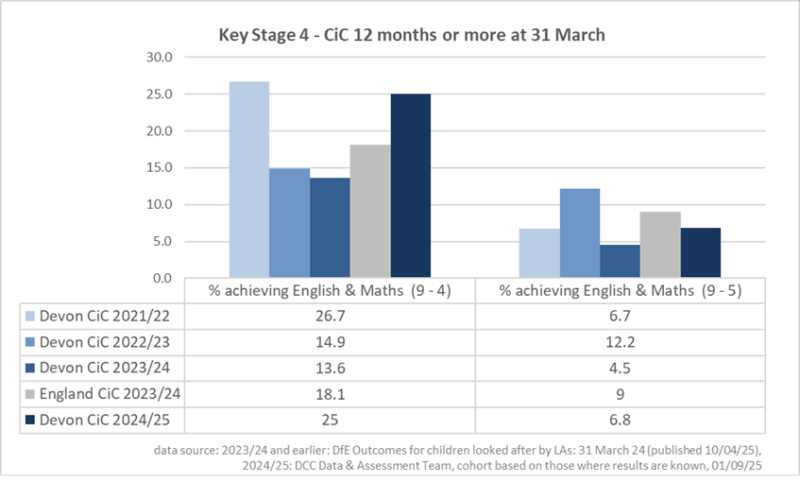
Published data – Percentage of pupils achieving GCSEs Grade 4 or above in English and Maths
Latest available published data indicates that Devon CiC for 12 months or more do not perform as well as nationally for GCSE English & Maths.
| Grade 4 or above in English and Maths | 2019/20 | 2020/21 | 2021/22 | 2022/23 | 2023/24 |
|---|---|---|---|---|---|
| Devon CiC for 12 months or more | 37.5% | 32.8% | 26.7% | 14.9% | 13.6% |
| England CiC for 12 months or more | 24.3% | 28.8% | 22.1% | 19.8% | 18.1% |
| Devon all pupils | 73.2% | 73.0% | 70.0% | 65.7% | 65.2% |
| England all pupils | 71.2% | 72.2% | 69.0% | 65.4% | 65.4% |
| Grade 5 or above in English and Maths | 2019/20 | 2020/21 | 2021/22 | 2022/23 | 2023/24 |
|---|---|---|---|---|---|
| Devon CiC for 12 months or more | 8.8% | 6.6% | 6.7% | 12.2% | 4.5% |
| England CiC for 12 months or more | 10.8% | 12.6% | 11.0% | 9.4% | 9.0% |
| Devon all pupils | 48.7% | 50.9% | 48.9% | 45.5% | 45.6% |
| England all pupils | 49.9% | 51.9% | 50.0% | 45.5% | 46.2% |
Data sources: CiC pupils: DfE Outcomes for children in need, in children looked after by LA in England 10/04/25, DfE GIAP CLA KS4 pupil list; All pupils: DfE Key Stage 4 performance 2022/23 academic year, published 01/02/24 (England state-funded school rate).
7. Destinations
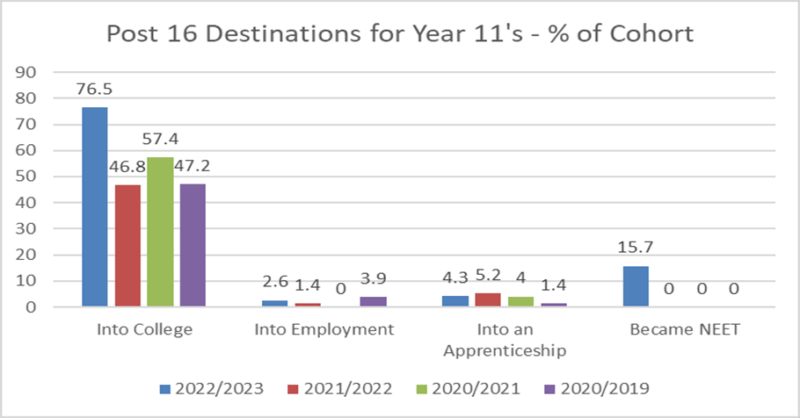
Year 11 Moving onto Post-16 Education, Training or Employment
The data below reflects the situation in September 2023 after the Year 11 destinations had been verified at the start of their Year 12.
8. Attendance
National Data – 2023/24 Academic Year (CiC for 12 months or more at 31 March)
Absence data for 2024/25 will not be published until March 26, this section therefore refers to the 2023/24 academic year. Overall absence rates for all schools are higher in Devon than nationally, however they are lower than regionally and statistical neighbours. Absence rates are higher in secondary schools than primary, both in Devon and Nationally. The overall absence rate for Devon CiC attending primary schools is lower than nationally whilst its higher than nationally in secondary schools. No data was published for Devon special schools.
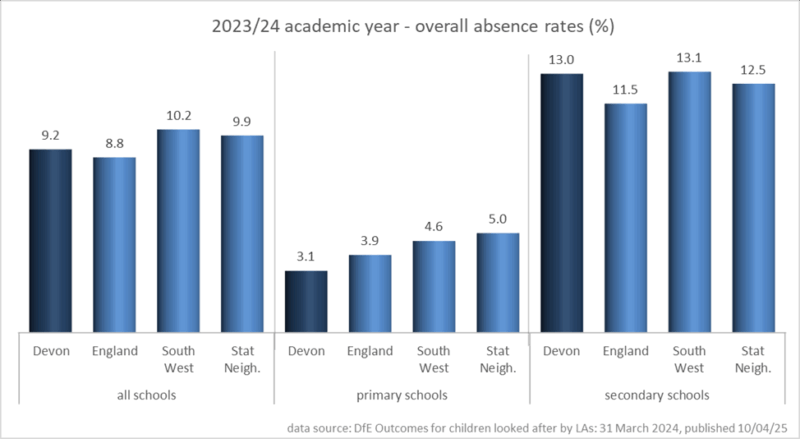
Note: ‘All schools’ consists of state funded primary, state funded secondary, special schools and PRUs.
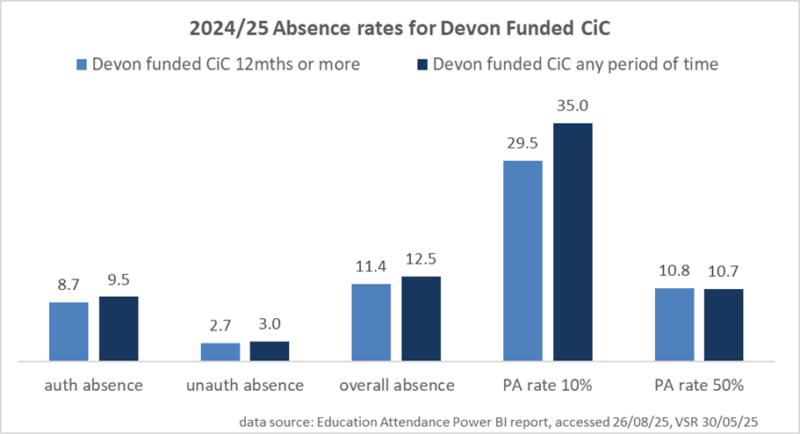
Attendance rates in this section of the report are based on local data for the 2024/25 academic year applied to Devon funded CiC on the Virtual School roll at 30th May 2025. As can be seen from the chart below, Devon CiC for 12 months or more have lower absence rates than the overall cohort who have been in care for any period of time. One in three Devon funded CiC for any period of time is classed as a persistent absentee with an absence rate of 10% or more. This falls significantly for those who are severe persistent absentees with absence rates of 50% or more, where one in ten Devon funded CiC is classed as severely absent.
Persistent absence (missing 10% or more sessions – National Data 2023/24)
Absence data for 2024/25 will not be published until March 2026. This section therefore refers to the 2023/24 academic year where the percentage of Devon’s Children in Care classified as persistent absentees fell to 22.3% (23.4% in 2022/23). Nationally rates rose in the 2023/24 academic year. Devon’s overall persistent absentee rate for all schools is higher than nationally (22.3% compared to 20.8% nationally). Devon primary schools are lower than nationally whilst secondary schools are significantly higher. No data was published for Devon special schools.
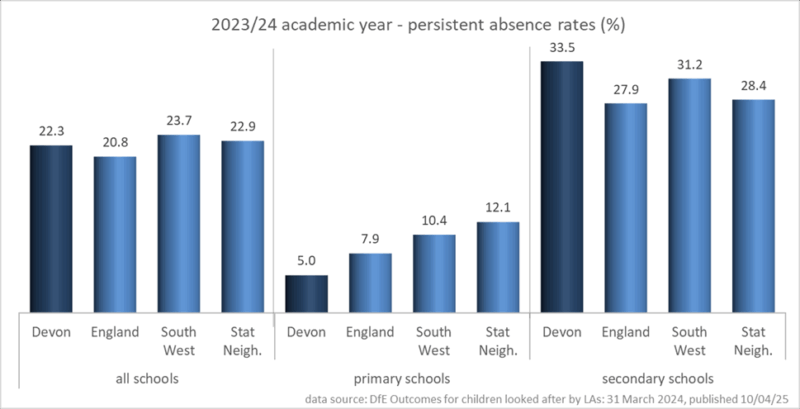
Note: persistent absentee rate is based on percentage of children in care with less than 90% attendance.
Severe absence (missing 50% or more sessions – National Data 2023/24)
Absence data for 2024/25 will not be published until March 2026. This section therefore refers to the 2023/24 academic year. The overall percentage of Devon’s Children in Care for 12 months or more classified as severe absentees has fallen to 4.8% in 2023/24 (6.6% in 2022/23). Nationally rates rose in 2023/24. Devon’s severe absence rate for CiC for 12 months or more is lower than nationally, 4.8% compared to 5.7% nationally.
At school phase level, Devon CiC attending primary and secondary schools have lower severe absence rates than nationally. Data for Devon special schools was suppressed so no comparisons can be made.

9. Suspensions
Overall Looked After Children face significant challenges and nationally are more likely to be permanently excluded from school and be subject to suspensions than other children.
Permanent Exclusions
There is a long delay in the release of National statistics for exclusions for Children in Care. One Devon Child in Care has been permanently excluded from an other LA maintained school. Prior to this, no Devon Child in Care has been permanently excluded since Autumn 2019 as we work hard to support schools and intervene early.
Suspensions – National Data 2022/23 (CiC for 12 months or more)
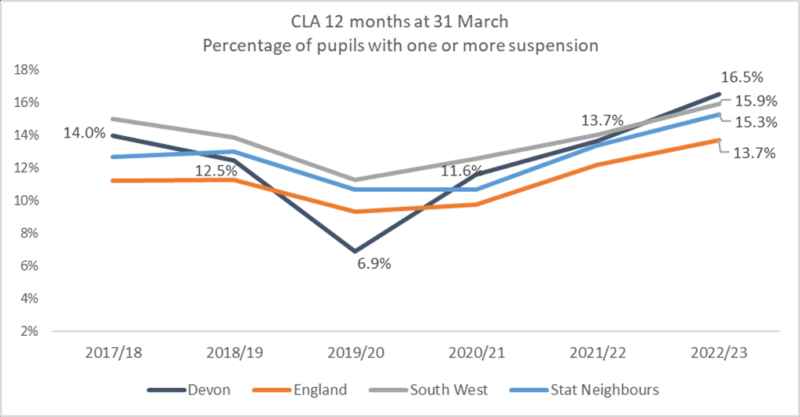
The latest available suspensions data released by the DfE relates to the 2022/23 academic year, as data is released two years in arrears. The next release in March 2026 will relate to suspensions in the 2023/24 academic year, with 2024/25 data not due to be released until March 2027. The chart below illustrates Devon’s position in relation to benchmarks for suspensions in the 2022/23 year.
Data source: DfE Outcomes for children in need, including children looked after by LA in England 2024, published 10/04/25
Suspensions – Local Data (All pupils and CiC)
Suspensions have risen over the last academic year for Devon CiC whilst they fell for all Devon pupils. The number of CiC to Devon for any period of time who were subject to a suspension fell by 6% last year to 61 pupils, similar to a 7% fall in the number of all pupils. This area of work remains high on our agenda as we work with schools to use relational approaches with children.
| Number of Suspensions | Pupils with one or more Suspensions | Days Lost | ||||
| Devon 2024/25 | Devon 2023/24 | Devon 2024/25 | Devon 2023/24 | Devon 2024/25 | Devon 2023/24 | |
| All pupils | 17,268 | 18,952 | 4,600 | 4,953 | 24,397 | 26,024.5 |
| Devon CiC any period of time | 265 | 252 | 61 | 65 | 359.5 | 386 |
| Suspension Rate (no. of Suspensions as % of Pupil Population) | Pupils with one or more Suspension (Pupils as % of Pupil Population) | |||||
| Devon 2024/25 | Devon 2023/24 | England 2023/24 | Devon 2024/25 | Devon 2023/24 | England 2023/24 | |
| All pupils | 18.0 | 18.87 | 11.31 | 4.8 | 4.93 | 4.04 |
| Devon CiC any period of time | 36.35 | 32.56 | not avail | 8.37 | 8.40 | not avail |
Data sources: Devon all pupils 24/25 local data (ONE database 04/08/25), Devon and national all pupils 23/24 DfE suspensions and permanent exclusions in England 23/24 published 10/07/25, Devon CiC local data from Virtual School team (August 24 and 25)
Suspensions – Local Data (CiC)
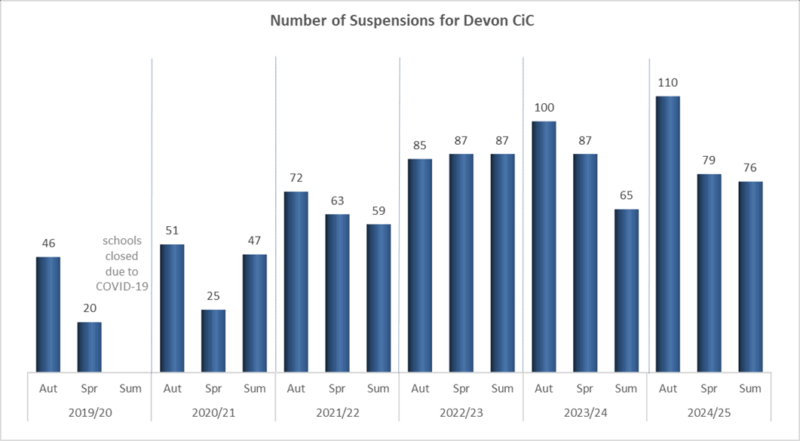
Suspensions in 2024/25 have risen slightly on the previous year, with 265 suspensions against Devon CiC for any period of time (252 previously). Suspensions continue to be higher than the period before the pandemic struck (2018/19), which is also the situation for suspensions against all pupils. 61 children in 2024/25 were subjected to a suspension (compared to 46 in 2018/19), with 265 suspensions compared to 117 in 2018/19.
Looking at suspensions on a termly basis, suspensions were highest in the 24/25 autumn term before reducing down in the spring term to lower numbers than the previous year. Suspensions reduced again in the summer but with higher numbers than the previous year. The number of CiC subject to one or more suspensions was the same in the autumn term as the previous year, whilst numbers fell slightly in the spring before falling further in the summer to numbers last seen in 2021/22.
Please note: comparisons to the 2020/21 Spring term should not be made as schools were closed for a period of time during this term.
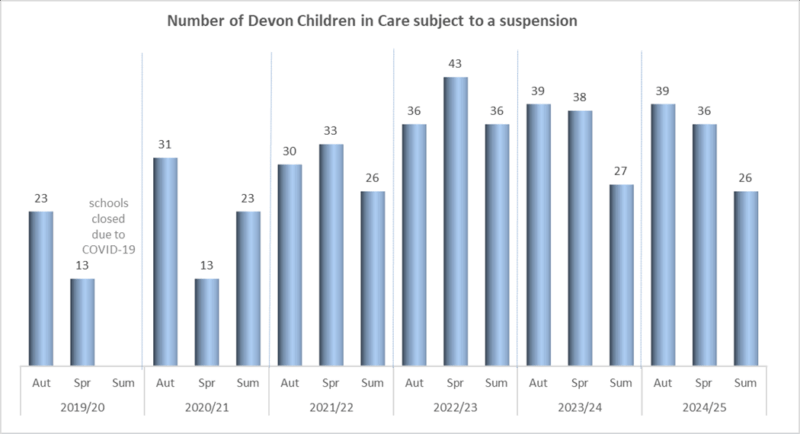
When reviewing Children in Care cohorts, suspensions for Children in Care to Devon for 12 months or more were highest in the autumn term (7.8%) and fell during the spring and summer terms.
Children Looked After for any period of time saw a similar pattern, with autumn having the highest rate (5.3%) before falling in the spring and summer terms. The table below provides a breakdown of the various cohorts.
Children in Care to Devon for 12 months (OC2)
| Academic year | 2023/24 Autumn Term | 2023/24 Spring Term | 2023/24 Summer Term | 2024/25 Autumn Term | 2024/25 Spring Term | 2024/25 Summer Term |
|---|---|---|---|---|---|---|
| Number subject to a suspension | 27 | 21 | 18 | 31 | 23 | 20 |
| Number in cohort | 428 | 428 | 428 | 399 | 399 | 399 |
| % subject to a suspension | 6.3% | 4.9% | 4.2% | 7.8% | 5.8% | 5.0% |
Looked After Children in Devon for any period of time (May each year)
| Academic year | 2023/24 Autumn Term | 2023/24 Spring Term | 2023/24 Summer Term | 2024/25 Autumn Term | 2024/25 Spring Term | 2024/25 Summer Term |
|---|---|---|---|---|---|---|
| Number subject to a suspension | 39 | 38 | 27 | 39 | 36 | 26 |
| Number in cohort | 774 | 774 | 774 | 729 | 729 | 729 |
| % subject to a suspension | 5.0% | 4.9% | 3.5% | 5.3% | 4.9% | 3.6% |
Devon funded Children Looked After (for any length of time) attending any mainstream school (any LA)
| Academic year | 2023/24 Autumn Term | 2023/24 Spring Term | 2023/24 Summer Term | 2024/25 Autumn Term | 2024/25 Spring Term | 2024/25 Summer Term |
|---|---|---|---|---|---|---|
| Number subject to a suspension | 38 | 37 | 27 | 36 | 35 | 24 |
| Number in cohort | 503 | 503 | 503 | 537 | 537 | 537 |
| % subject to a suspension | 7.6% | 7.4% | 5.4% | 6.7% | 6.5% | 4.5% |
Data source: Virtual School Team, Aug 2025, ONE database 04/08/25
Suspension reasons
The majority of suspensions continue to be for persistent disruptive behaviour (55.5% of reasons), followed by verbal abuse / threats against an adult (18.1% of reasons). The table below provides a breakdown by each type, comparing Devon CiC against suspensions for all Devon pupils.
| Suspension reason | CiC 2021/22 | CiC 2022/23 | CiC 2023/24 | CiC 2024/25 | All pupils 2024/25 |
|---|---|---|---|---|---|
| Abuse against sexual orientation | 0.5% | 0.4% | 0.4% | ||
| Abuse relating to disability | 0.04% | ||||
| Bullying | 0.4% | 1.2% | 1.5% | 0.9% | |
| Damage | 2.1% | 2.3% | 1.6% | 1.1% | 1.8% |
| Drug and alcohol related | 10.8% | 2.3% | 2.8% | 3.0% | 2.7% |
| Inapprop. use of social media/online tech | 1.5% | 0.4% | 0.4% | 0.4% | 0.6% |
| Persistent disruptive behaviour | 42.3% | 55.2% | 57.1% | 55.5% | 61.8% |
| Physical assault – pupil | 11.9% | 10.8% | 10.3% | 8.3% | 8.8% |
| Physical assault- adult | 7.7% | 4.2% | 6.3% | 6.8% | 5.1% |
| Racist abuse | 1.0% | 1.5% | 1.5% | 1.3% | |
| Sexual misconduct | 1.5% | 0.4% | 1.2% | 0.4% | 0.7% |
| Theft | 0.5% | 1.5% | 0.4% | 0.4% | |
| Transgression of public health measures | 0.5% | 0.4% | 0.1% | ||
| Use or threat of use of an offensive weapon | 3.1% | 2.3% | 0.4% | 1.5% | 1.1% |
| Verbal abuse / threats – pupil | 3.1% | 2.3% | 3.2% | 1.5% | 2.0% |
| Verbal abuse / threats – adults | 13.4% | 16.2% | 14.7% | 18.1% | 12.2% |
Data source: CiC Virtual School Team, August 2025, all pupils ONE database 04/08/25
Suspensions (Pre and Post-Care)
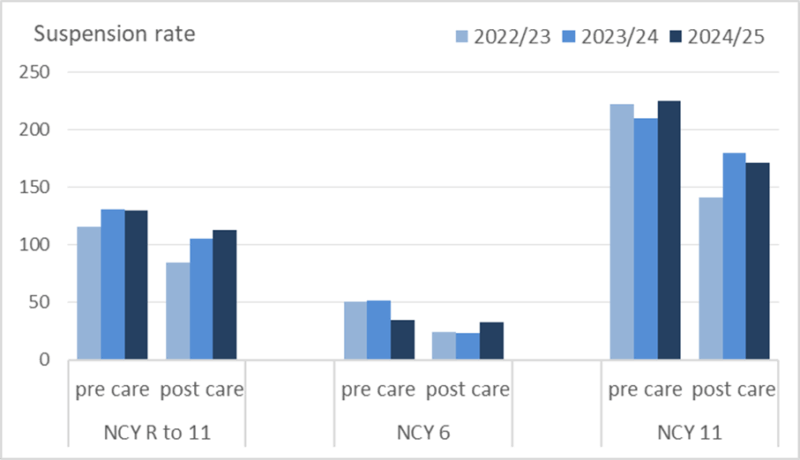
Local information indicates that the number of suspensions for Devon Children in Care are lower after they came into Care than before they were taken into Care.
Number of suspensions as % of the pupil cohort
Data source: VSR at 30 May 2025
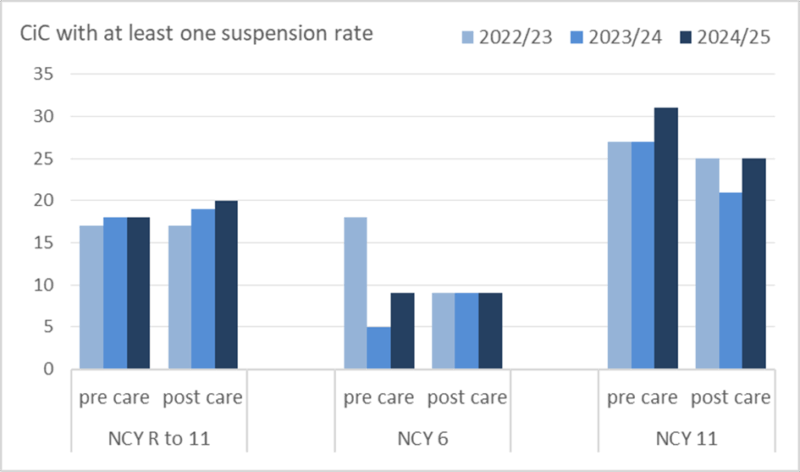
When we compare the percentage of CiC with at least one suspension we see that for the overall cohort (NCY R to 11) there was a slight increase post care. In 2024/25 children in NCY6 saw the same percentage with at least one suspension post care compared to pre care, whilst children in NCY11 saw a significant reduction post care.
Number of pupils with one or more suspension as % of pupil cohort
Data source: VSR at 30 May 2025
10. Quality of provision end of academic year 2024/25 (CiC to Devon for any period of time)
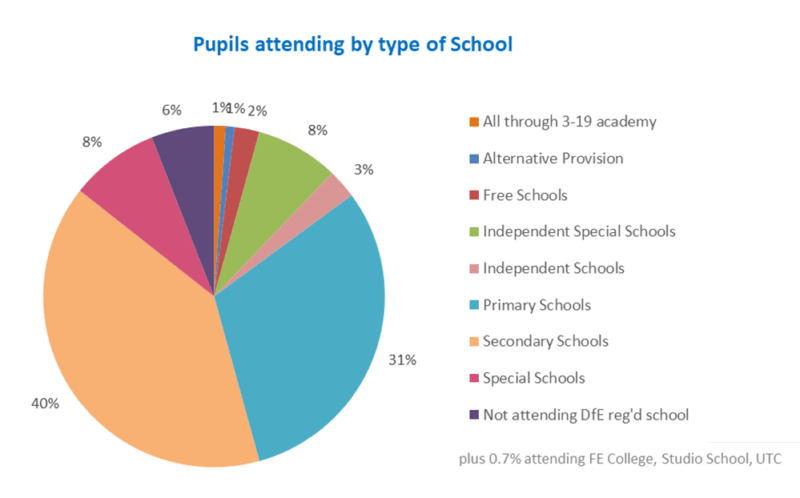
Nearly three in four Children in Care attend mainstream schools (74%), slightly more than the previous year (73%). The percentage of Children in Care attending state funded special schools has risen in the last year (8.4% compared to 7.6% previously). The percentage attending independent special schools has fallen (7.8% compared to 8.3% last year). Attendance at alternative provision has also fallen (0.8% compared to 1.9% previously). Those not attending a registered school has risen (5.9% compared to 5.4% previously). The chart below provides a breakdown of attendance by establishment type.
85.2% of Children in Care were placed in good or better schools, higher than the previous year (82.8%) and close to Devon’s general school population (87.5%1). Progress of pupils in RI schools is carefully monitored by the Virtual School and whilst we aim to only place Children in Care in good or better schools, we also recognise the importance of stability and would not move a young person from a school which became RI if the young person was making expected progress. The graphs below and overleaf show the percentage of Children in Care placed in each Ofsted category of provision (where schools have been inspected).
Note: some children are attending schools which do not have an Ofsted outcome – these are either academy converters not yet inspected since conversion or new schools. These have been excluded from the charts below which are based on schools with an official Ofsted outcome.
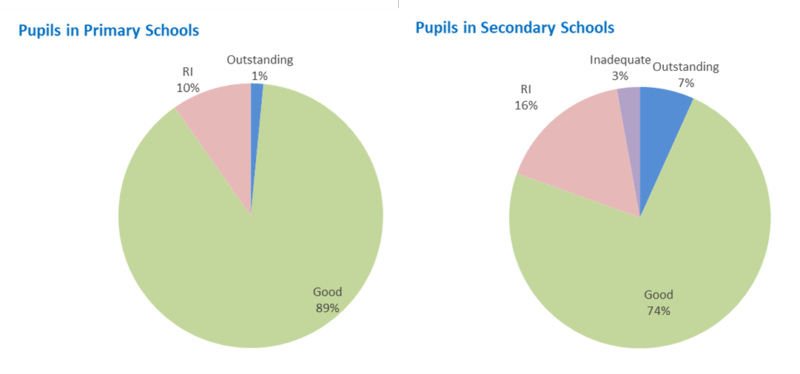
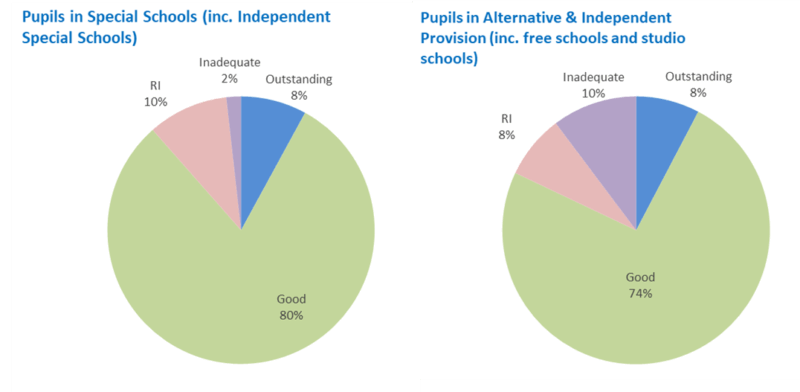
The following graphs show the percentage of children attending schools for each Ofsted Outcome by school phase.
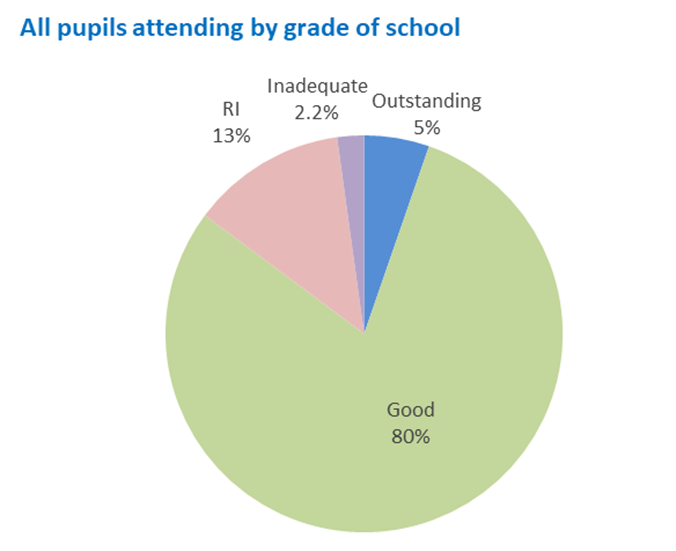
The percentage of pupils attending ‘good’ or ‘better’ primary schools has risen slightly to 90.3% this year (88.9% in 2023/24).
The percentage of pupils attending ‘good’ or ‘better’ secondary schools has also risen this year (80.5% compared to 74.9% in 2023/24). This is slightly better than the picture for Devon’s general secondary school population (80.0%) but lower than the National picture for secondary schools (86.9% *). This is due to some large secondary schools in Devon currently graded as requiring improvement.
Those attending ‘good’ or ‘better’ special schools has fallen this year (88.5% compared to 95.0% previously).
Note: some children attend schools which do not have an Ofsted outcome – these are either academy converters not yet inspected since conversion or new schools. These are excluded from the charts which are based on schools with official Ofsted outcomes.
*DfE School Inspections & Outcomes: management information at 31.05.25
11. Early Years
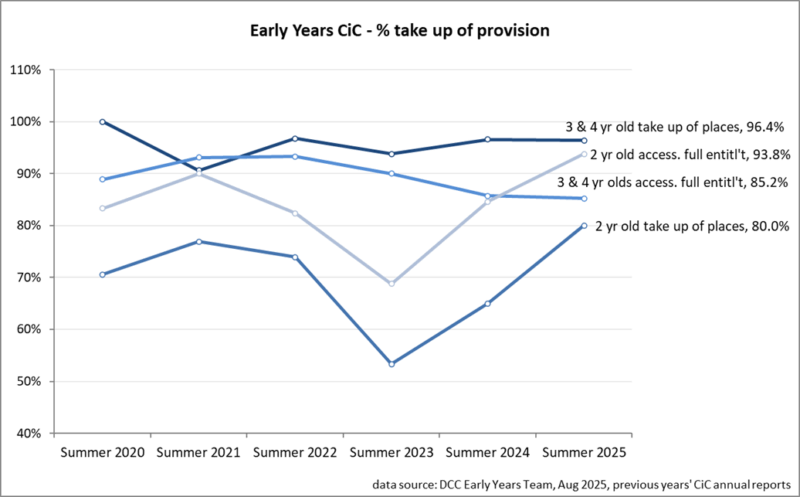
Take-up of provision by two-year-olds in Care was 80% (16 out of 20 children) in Summer 2025 and 93.8% (15) of these were accessing the full entitlement of 15 hours; this compares favourably with the Devon averages for all targeted funding of 75.8% and 75.6% respectively (Spring 2025). The take up of two- year-old places was higher than last Summer (65%) while the overall take-up of eligible two-year-olds across Devon has decreased markedly since then (91.7%). The reason for the decrease in the overall take-up of targeted funding for two-year-olds has been the introduction of the working entitlement. Parents who may be eligible for both entitlements have been prioritising the working entitlement over targeted funding. Indications are that most of the two-year-old children in care not taking up a place are likely to take up their entitlement in the future.
As of Summer 2025, 27 of the 28 (96.4%) three- and four-year-olds in Care were taking up some of the Early Years entitlement and 85.2% (23) of these were accessing the full entitlement of 15 hours; this compares with the Devon averages for all children of 94.4% and 91.3% respectively (Spring 2025). There were 6 children of those funded, also accessing the extended entitlement. There were 4 children accessing funded hours outside the County, including settings in the neighbouring authorities of Somerset (2) and Cornwall (1).
All children in the above figures were accessing funded settings in the private, voluntary and independent sector or were funded at academies or maintained schools.
12. Post-16 Children in Care/Care
- Percentage of year 11 starting in year 12 in Education, Employment and Training (EET) at the start of this academic year (Sept 24) – 70.66%
- Percentage of Post 16 in an apprenticeship at the start of this academic year (Sept 24) – 0.84%
- Percentage of Post 16 who were Not in Education, Employment or Training (NEET) at the start of this academic year (Sept 24) – 29.34%
NEETs – longer term trend analysis (2020 to July 2025)
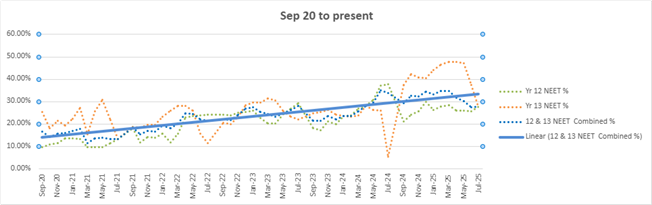
Post-16 NEET %
| Academic year | Cohort size (Years 12 and 13) in Sept | Number of NEET YP (Years 12 and 13) Sept | NEET % (Years12 and 13) Sept | Cohort size (Years 12 and 13) in July | Number of NEET YP (Years 12 and 13) July | NEET % (Years 12 and 13) July |
|---|---|---|---|---|---|---|
| 2020/21 | 185 | 31 | 16.75% | 121 | 16 | 13% |
| 2021/22 | 189 | 35 | 18.5% | 125 | 27 | 21.6% |
| 2022/23 | 180 | 40 | 22% | 131 | 37 | 28.2% |
| 2023/24 | 228 | 48 | 21% | 135 | 48 | 36% |
| 2024/25 | 242 | 71 | 29% | 148 | 41 | 27% |
Post-16 into care mid-year
| Start of academic year (31 Sept) | No of post-16 who came into care during the academic year |
|---|---|
| 2020/21 | 19 |
| 2021/22 | 32 |
| 2022/23 | 57 |
| 2023/24 | 38 |
| 2024/25 | 46 |
Post-16 out of county (OOC)
| Cohort | As of 31st July 2025 |
|---|---|
| Yr 12 OOC | 45 |
| Yr 12 OOC and NEET | 11 |
| % of Yr 12 OOC | 32.6% |
| Yr 12 OOC with an EHCP | 19 |
| Yr 12 OOC with and EHCP and NEET | 8 |
NEETs with SEND
This continues to be a contributing factor to young people being NEET
Combined Year 12 and 13 with an EHCP
| Academic year 2022 / 2023 | Academic year 2023 / 2024 | Academic year 2024 / 2025 | |
|---|---|---|---|
| December | 38.30% | 40.26% | |
| April | 32.43% | 33.33% | 44.64% |
| July | 40.54% | 37.50% | 43.90% |
Education, Employment and Training
With the exception of 2020/21, the following data shows the number of young people in EET declined from the start of the academic year to the end. The intention is to monitor drop out and potential reasons why.
| Academic year | Cohort size (Years 12 and 13) in Sept | Number of EET YP (Years 12 and 13) Sept | EET % (Years 12 and 13) Sept | Cohort size (Years 12 and 13) in July | Number of EET YP (Years 12 and 13) July | EET % (Years 12 and 13) July |
|---|---|---|---|---|---|---|
| 20 / 21 | 185 | 154 | 83% | 121 | 105 | 87% |
| 21 / 22 | 189 | 154 | 81% | 125 | 98 | 78.4% |
| 22 / 23 | 180 | 140 | 77% | 131 | 94 | 71.8% |
| 23 / 24 | 228 | 180 | 79% | 135 | 87 | 64% |
| 24 / 25 | 242 | 171 | 71% | 148 | 107 | 72.3% |
Movement within the post-16 cohort during the academic year 2024/25
Change in EET Status for Years 12 and 13 in academic year 2024/25
| Category | Number of young people |
|---|---|
| NEET to EET | 60 |
| EET to NEET | 26 |
| Dropped out of FE | 45 |
| New into Care – YASC | 6 |
| New into Care – Non YASC | 12 |
| New into Care and immediately NEET | 28 |
| Left Care – over 18 | 76 |
| Left Care – over 18 & NEET | 68 |
| Left Care – other reason | 9 |
College drop out – voluntary and non voluntary
All Post 16 who did not complete their Further Education journey were contacted and asked for anonymous feedback to help us understand why. Of the 45 young people who dropped out in AY 24/25, 9 responses were received:
- 55% quoted their Mental Health as one of the reasons
- 55% quoted they did not enjoy the course
- 22% found the work too much
There are many other potential reasons for young people not completing their FE journey:
- Due to poor academic performance in KS4, many of the courses the young people wanted to do were not open to them.
- 28% of Year 12s had no qualifications in Maths, and 17% did not sit their Maths Exam at the end of Year 11(these figures do not include YASC).
- 33% of Year 12s had no qualification in English, and 21% were reported as not sitting their English Exam at the end of Year 11(these figures do not include YASC).
- 11% were excluded.
- 44% withdrew themselves.
- 7% moved homes and could not continue attending their current provision.
Post 16 NEET Prevention Strategies during 2024/25 academic year
- Continued Extensive Aspiration Work Experiences developed by the Aspirations Officer such as those with the BBC and Met Office.
- KS3 Aspiration Days held at Petroc, Bicton, South Devon and Exeter Colleges.
- Aspiration Events held at Exeter, Falmouth and Plymouth Universities and offered to KS4 and KS5 LAC.
- SPACE Mentoring Project open to all Year 11 CiC and CIN and CP.
- Learn Devon Tutoring Programme for Functional Skills, GCSE Maths and English offered to NEET KS5.
- Continued development of the Exeter College PACE Project.
- Continued direct support for NEET LAC from the Devon Youth Hubs.
- All LAC Year 11s offered Devon Youth Hub Appointments.
Post 16 NEET Prevention Projects – Impact
| Project | Aim | Impact |
|---|---|---|
| End of Yr 12 outcomes in Maths & English – Children in Care. | Improved result in Maths and English from end of KS4. | 11 yr 12s improved their Maths result from the end of KS49 yr 12s improved their English Language result from the end of KS4. |
| Extra Curricula tuition for Yr 12 and 13 Children in Care. | To support Post 16 children in care achieve their best results in college – This was funded by the Post 16 Pupil Premium Plus Grant. | 18 Post 16 YP were referred for extra curricular tuition14 of the 18 were for tutoring to improve their Functional Skills / GCSE resultOf the 14 referred for FS / GCSE – only 2 of them improved on their original result with 1 of them achieving a GCSE grade 4.£24,000 was spent on Tuition for Post 16 CIC. |
| Work Ready Course for Devon CiC and those with a SW – Exeter. | To support NEET year 12 & 13 CiC and those with a SW to re-engage with Education, Employment or Training. This was funded by the Post 16 Pupil Premium Plus Grant. | Of the 8 starters, 5 attended the venue for 2 hours every day for 5 daysAttendees experienced skills such as teamwork, interview prep and CV writingThis course is planned again for delivery in the North of Devon in November and then in the South of Devon in the spring. |
| Online Employers Fayre for all CiC, Care experienced, Care Leavers and Children with a SW. | A “one stop shop” for everything to do with Education, Employment and Training for Post 16 CiC, Post 18 Care Leavers, Children with a SW, carers and professionals. This was funded by the Post 16 Pupil Premium Plus Grant. | Flagship event targeting Young People and the professionals supporting themIn the region of 30 exhibitors representing Industries in the South West11 attendees60% of attendees fed back they left the event with a better understanding of the opportunities available to Post 16 Young People80% of attendees fed back they learned something new about Apprenticeships80% of attendees fed back they learned something new about Employment Opportunities“There was lots of interesting information and the people I spoke to were all very helpful. The problem we have is getting our daughter to engage with the help!”. |
| NEET to EET. | To increase the number of Post 16 from being NEET to EET prior to turning 18. | In addition to the statutory PEPs, the Post 16 Lead for Education (CiC) meets monthly with all NEET young people and their professionals.In the Academic Year 23/24, 49 YP have moved from being NEET to EET in the Academic Year 24/25, 60 YP have moved from being NEET to EET |
| Learn Devon Maths & English for NEET yr 12 & 13 Children in Care. | To give Post 16 CiC who are NEET, the opportunity to improve their Maths and English. This was funded by the Post 16 Pupil Premium Plus Grant. | 19 NEET CiC in years 12 and 13 were referred to Learn Devon for Maths and / or English GCSE or Functional Skills10 started the course9 changed their minds and withdrew5 completed1 improved on their their original grade. |
| Exeter College – Award of the NNECL Quality Mark (National Network for the Education of Care Leavers). | For all Devon Post 16 providers of Education to be awarded the NNECL Quality Mark. The Lead for Post 16 Education (CiC) has raised the profile and encouraged engagement with this initiative. | In August 2025, Exeter College was awarded the Quality Mark and trail blazed in this area. They are now offering other Post 16 Providers support in achieving the Quality Mark. |
| KS3 Aspiration Days for Children in Care and Children with a SW. | To raise the profile of Further Education for CiC and Children with a SW in KS3 and KS4. This was funded by the Post 16 Pupil Premium Plus Grant. | Bicton, South Devon and Exeter Colleges continue to host this annual event for the 3rd consecutive year. 79% of the yr 11s had a confirmed Post 16 plan at the end of August 2025At the start of the AY in 2024 those in EET was 71%At the start of this AY (Sept 2025) those in EET is currently 76%. |
| SPACE Mentoring Project for Children in Care and Children with a SW. | To Target yr 10 and 11 Children in Care and those with a SW identified at Risk of NEET and offer them a mentor with a focus on Post 16 EET planning. SPACE Mentoring was commissioned to deliver this on behalf of the VS. This was jointly funded by the VS Post 16 Pupil Premium Grant and the Extended VS grant (80:20). | 10 week programme delivered to 45 Young People Across 8 Devon Schools96% of course completers gained clearer career direction, up from 48% before starting88% of course completers reported knowing their options after yr 11 up from 32% before starting. |
| Care Leavers attending University / Higher Education | To raise the profile of Higher Education with Post 16 YP so that the number of Care Leavers attending university increases | 36 Care Leavers progressed to university in the year starting 01/09/25, up from 23 the previous year, thanks to collaboration with Post-18 EET advisers. |
Post-16 Trends Summary
Between 2021 and 2024, the proportion of Post-16 young people not in education, employment or training (NEET) has risen significantly—from 16.75% in September 2021 to 29% in September 2024. Alongside this, the number of young people entering care during Year 12 or 13 has more than doubled, increasing from 19 in 2021/22 to 46 in 2024/25. A persistent challenge is the growing number of Post-16s living outside Devon, which stood at 32.6% of the cohort by July 2025, making engagement more difficult—especially as 42% of those living out of county also have an EHCP. More broadly, the proportion of Post-16s with EHCPs is rising, from 42% in July 2023 to 44% in July 2025, further compounding the complexity of support needs.
In addition, a significant challenge this year was the loss of the Post-16 Aspirations Officer due to them covering elsewhere within the Virtual School. This role was pivotal in supporting Year 11s with their post-16 planning and had contributed to reducing the number of Year 11s without a post-16 plan from 16% in 2023/24 to 10%. However, due to the vacancy, the proportion of Year 11s without a post-16 plan has now risen to 17%.
13. Young Asylum-Seekers (YAS)
In August 2025 we have 65 Young Asylum-Seekers in Care to Devon, with an additional 7 in Care to other Local Authorities but who live in Devon. This is an increase from 62 in Care to Devon at this time last year but is a significant increase from 23 in August 2022. The uplift in numbers is a direct consequence of the National Transfer Scheme becoming mandatory for unaccompanied arrivals in the UK. This continued increase in numbers will have a significant impact on the budget that the Virtual School uses to support education.
Of those of statutory school age, all 10 pupils are enrolled in schools and further education establishments,. 51 are post-16 age so will be in a college nearest to where they live, the majority of these being place in Exeter College. Tutoring and mentoring support is available for Young Asylum-Seekers when they arrive in Devon. This is used to support young people whilst applications are made to ESOL courses or awaiting a school place, We also provide tutoring to offer additional support to those who may need something extra to their formal education offer. An example of this is where a group of young people are accessing Science tutoring to support their aspirations for careers in medicine.
We continue to work closely with schools and college to ensure that all in this cohort have access to education and courses that will best support their futures. This year we have been able to fund a Learning Support Assistant to support our YAS cohort at Exmouth Community College.
The emotional welfare of these students is paramount, particularly given the significant trauma many have experienced on their journey to the UK. To support this, we incorporate the use of Emotional Logic—a structured approach to emotional resilience—which helps students understand and manage their emotional responses in a safe and supportive environment. This approach has already been successfully implemented in two of our larger educational settings in Devon, with further expansion planned for 2025–2026.
The Virtual School have established our own dedicated learning provision for young asylum seekers who arrive in Devon after the Exeter College enrolment deadline in early September, which would otherwise result in them missing up to a year of education. This tailored provision, delivered in partnership with Learn Devon, focuses specifically on ESOL (English for Speakers of Other Languages) and is designed to reflect the teaching standards and expectations of Exeter College. Delivered in smaller, locally based groups, it ensures that learners have immediate access to high-quality education and language support. This ensures a smooth transition to Exeter College when the following year’s enrolment begins, with no learning time lost. Since its introduction in November 2024, the provision has enabled students to enter higher-level ESOL classes at Exeter College, reducing the time needed to complete the qualification and allowing them to progress more quickly to courses that align with their interests, such as GCSEs or vocational pathways. An enrichment programme has also been offered to this group to experience some outdoor activities, pottery and cooking days.
The Virtual School aim to respond to the individual educational needs of each young person in Care so we work closely with our Young Asylum-Seekers Social Care team, with a Learning Advocate taking the lead with this group of learners. – Penny Rundle has responsibility for the educational progress of this group and started in the VS Team in September 2024, enquiries can be made via penny.goldsby-west@devon.gov.uk / telephone: 01392 383000.
14. Support for Previously Looked After Children and those in formal Kinship Care arrangements
Role of the Virtual School
The Virtual School‘s role is to promote the educational achievement of Previously Looked After Children (PLAC) – which includes those who have left care through Adoption Orders, Special Guardianship Orders, and Child Arrangement Orders – through the provision of information, advice and guidance to parents, guardians, schools, Social Care professionals and others.
From September 2024, the Virtual School has had an additional responsibility to support and promote the educational achievement of children and young people in formal kinship care arrangements (such as Special Guardianship arrangements), irrespective of previous care experience. Both for Previously Looked After Children, and those without care experience in formal kinship care, information, advice and guidance is provided following referrals to this service.
Eligibility
Previously Looked After Children are those who are no longer Looked After by a Local Authority in England and Wales (as defined by the Children Act 1989 or Part 6 of the Social Services and Wellbeing (Wales) Act 2014) because they are the subject of an Adoption, Special Guardianship or Child Arrangements Order; or were adopted from ‘state care’ outside England and Wales. The provision detailed below is open to children from the point at which they become eligible for free early education (which is currently the start of the term following a child’s second birthday) and concludes when they have completed the compulsory years of education (end of Year 11). A formal kinship care arrangement typically follows a period of Social Care involvement with the child, leading to them finding permanency in another home placement through either a Special Guardianship or Child Arrangement Order.
Education Adviser for Previously Looked After Children
Information and advice is provided by the Education Adviser for Previously Looked After Children. The Virtual School has appointed Education Adviser for Previously Looked After Children to offer advice regarding individual cases and enquiries from schools, parents, guardians and other professionals (including Post-Adoption Support and Special Guardianship Support colleagues), regarding educational issues affecting previously looked after and kinship care children. The Education Adviser for Previously Looked After Children and Kinship Care is Deryn Dewing, she can be contacted at email deryn.dewing@devon.gov.uk or tel: 07977 194 545 to discuss any individual cases or service offers detailed below.
Common issues of enquiry include: educational wellbeing issues, EHCP processes, admissions, transitions, advice when a child is at risk of exclusion, and signposting to available support and other services.
Information and advice through the Virtual School webpages
The Devon Virtual School website contains information and useful links for school staff, parents, guardians and other professionals regarding Previously Looked After Children and those in formal kinship care. The section for Previously Looked After Children can be accessed here. Information includes a grab pack for schools, information about Pupil Premium Plus, and a copy of the Support Plan for Adoptive and Guardianship Education (Support PAGE). This was previously known as an Education Plan for Adopted Children (EPAC) and can be used by schools to focus an individual plan and review process for a child.
Video Interaction Guidance
Information and Advice: Support for Parents, Guardians, and Schools through Video Interaction Guidance (VIG): A number of individual interventions using VIG have been commissioned from the Educational Psychology Service. VIG uses video to strengthen relationships and support appropriate interactions between children and their carers/parents/guardians, or between children and school staff. It is particularly suitable for younger children. This is an EP-led strengths-based intervention and includes several cycles of support and feedback. Further information about the intervention can be found here: Association for Video Interaction Guidance UK.
Support for Previously Looked After Children at risk of exclusion or finding it difficult to attend school
For individual case discussions, the Education Adviser for PLAC & Kinship Care should be contacted. Where appropriate, this could lead to a referral for EP-led support and interventions, including REDS, Emotionally Based School Non-Attendance (EBSNA) support, and Relational Support and Co-regulation Planning.
EP-led transition support
This can be particularly useful for young people transitioning from Years 6 to 7, or for mid-term transitions due to changes in circumstances. Other points of transition can also be discussed.
Information, advice and support with school place applications and transfers
Available through the Devon Admissions team – The Education Adviser for PLAC & Kinship Care can be contacted for further information regarding applications for previously looked after and adopted children.
Individual information and advice for guardians and adoptive parents
The Education Adviser for PLAC & Kinship Care can be contacted to discuss individual cases. Casework can also be supported through direct work with an EP to improve relationships and support positive change in schools, following a referral by the Education Adviser.
Education Adviser attendance to support or information sessions
The Education Adviser for PLAC & Kinship Care will attend regional Post-Adoption and SGO Support Meetings to give information and advice as requested and to respond to individual issues.
Advice, information and training
Ongoing information, advice and training is available to Designated Teachers through termly Designated Teacher Network meetings, the annual Designated Teacher Conference, the half-termly Virtual School Newsletter, and the Signpost Newsletter.
Referral focus
Below are the primary reasons for referrals for more in-depth IAG in the last academic year. Many referrals ‘ticked’ more than one focus, but this data gives an indication of the main areas of need for Previously Looked After Children and Young People.
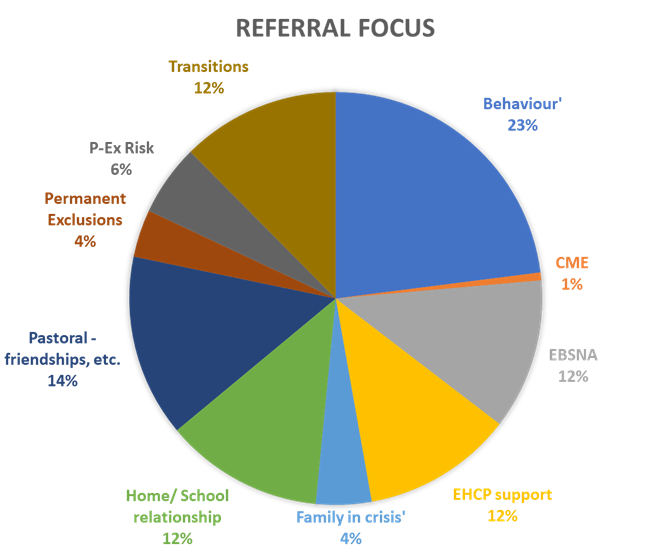
The data shows the main referrals over the year were for ‘behavioural’ (for example dysregulation, truancy; multiple internal or external suspensions), pastoral needs (including bullying or negative peer relationships, and self-harm or suicidal ideation), EBSNA, EHCP support, home or school relationship difficulties and transition support.
The referrals data also shows that over the academic year, six children or young people were permanently excluded. The referrals for these children and young people were often made when the students were already at risk of permanent exclusion, highlighting the need for schools to be more proactive in understanding and responding to the needs of these children and young people. This developmental work will continue to be a cornerstone of the Virtual School Development Plan for PLAC and Kinship Care over the next academic year.
From those referred into the Virtual School over the academic year for more in-depth IAG, data shows that attendance is an issue affecting Previously Looked After Children too – 12% or referrals were for Emotionally Based School Non-Attendance (EBSNA). Moreover 53% had persistent absences and 20% had severe absences.
Working with schools to improve attendance, through improved understanding, monitoring and proactive responses to meeting the needs of PLAC and kinship care CYPs will also continue over the next academic year.
Along with referrals often having more than one identified referral ‘need’, some Previously Looked After Children also had Social Care involvement during the year. This is a record of those with social care involvement at some point during the 2023-2024 academic year, not those who’d had social care involvement previously. This highlights the ongoing, complex needs for some Previously Looked After Children and young people: needs updating?
15. Working across the Local Authority
The Virtual School Team have been represented on a number of groups within the LA to ensure that education has a voice and so that education issues are considered in decision making:
- Care Panel
- Permanence Panel
- Unregistered placement panel
- Placement Review Panel
- Joint Agency County Panel for joint funding between Health, Education and Social Care
- Corporate Parenting Forum
- Adoption Panel
- Health and Wellbeing Board
- Farringdon Trust Board
- The Atkinson Centre Governing Body
- Corporate Parenting Health and Wellbeing Group
- Vulnerable Children Missing Education Panel
- Disabled Childrens Panel
- NEET Partnership Group
- Mockingbird Project Group
- Devon Youth Justice Partnership Board
- Improvement Board
16. Extended Role of the Virtual School Headteacher
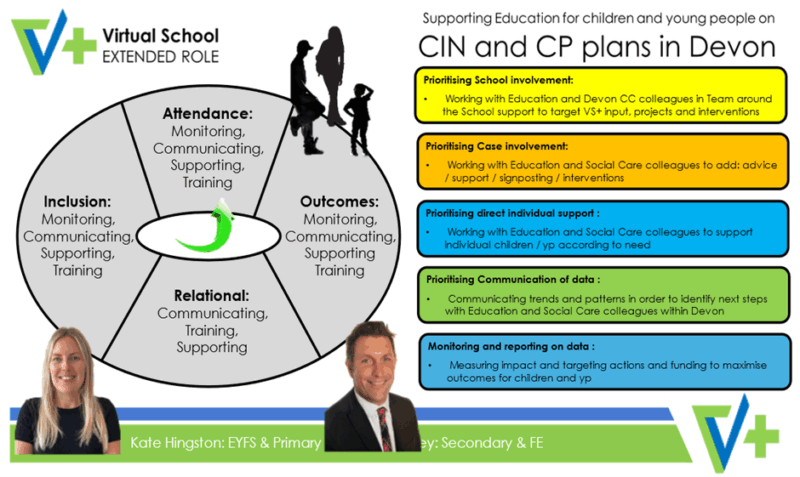
The Extended Role has been established to support children and young people with a Social Worker ie. children and young people on Child in Need and Child Protection Plans, in addition to the work of the Virtual School Team who support those who are Children in Care. We wait to see if this becomes a permanent, statutory duty within the Virtual School remit.
Kate Hingston (EYFS & Primary) and David Wibberley (Secondary & FE) were appointed as Virtual School Extended Role Education Advisors at the end of September 2021.
VS Extended Role aims as set out by the DfE:
- Enhance partnerships between education settings and the Local Authority so agencies can work together; helping to keep children on CIN and CP plans safe.
- Identify the CIN and CP cohort’s needs; make them visible and intervene to overcome barriers to poor educational outcomes; ensuring pupils reach their potential. Promote practice that supports pupil engagement in education.
- Support and advise key professionals to help children on CIN & CP plans make progress, including through increasing their confidence in using evidence-based interventions. Raise aspiration, levelling up attainment, narrowing outcomes gaps.
N.B. Kate Hingston and David Wibberley have been working with Social Care and Education colleagues to strategically support the progress of children and young people on CIN and CP plans. The DfE brief for the role does not stipulate case-work; some Local Authorities have interpreted the role as being strategic in terms of signposting on multi-disciplinary team panels. Monitoring data and sending advice and training opportunities to schools. In Devon we have sought to act strategically with for example CPD and the CP and CIN education proforma and also to case-work for example with cyp on a CP or CIN plan while severely absent. The cohort of children and young people on a CP and CIN plan has fluctuated between over 1600 and approximately 1300. The cohort is dynamic and it is not possible with 1.7 FTE staff to case-work a cohort of this size (a Social Worker typically has a cohort size in the 20s) so cases are prioritised by monitoring attendance, need and requests which come to the team via e-mail / phone-calls / conversations.
Key priorities
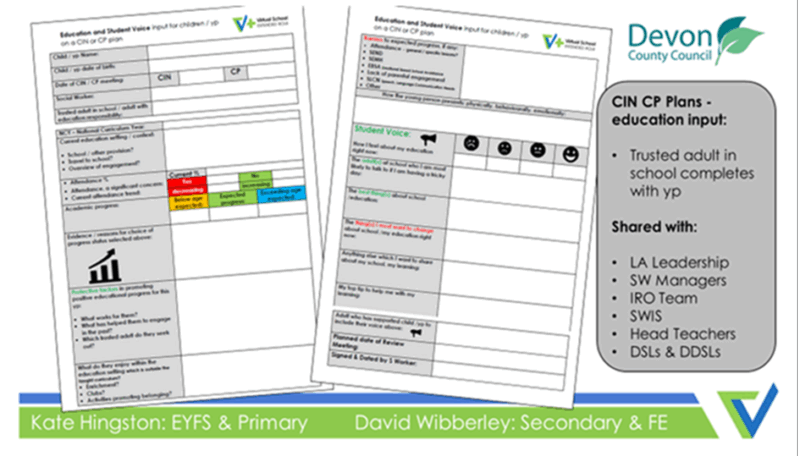
Education as part of the plan for all children and young people on CP and CIN plans
A CIN CP Education Proforma for schools to use in informing Core Group meetings for children and young people on a plan was created by Kate and David, following consultation with an experienced Social Worker a school based Safeguarding lead and an Independent Reviewing Officer.
- Social Care Managers, Head Teachers, DSLs and DDSLs in schools were all informed that it is available and should be used to support educational focus and outcomes.
- Feedback has been positive and the student voice element has been particularly welcomed with the emphasis on this being created with the best placed trusted adult and the young person.
Information, advice and guidance offer
The Virtual School Extended Role Education Advisors offer information, advice and guidance regarding individual cases and enquiries from schools and social workers. Such consultations relate to educational issues affecting children on CP and CIN plans including attendance, engagement with learning, wellbeing, transitions and children being at risk of suspension/ permanent exclusion.
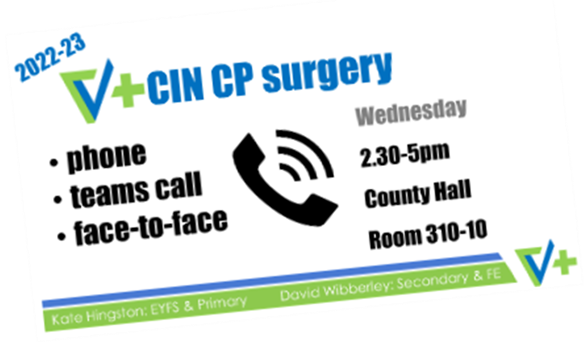
- Social work colleagues have made contact to seek advice on more complex cases.
- School Safeguarding Leads have also made contact to seek advice on additional support and interventions available.
- Referrals to CSW have been made during the surgery.
- Laptops have been provided as a result of requests made.
- School visits have been catalysed through contacts made during the surgery.
Supporting schools to support children and young people on CP and CIN plans
Extensive and bespoke support provided by the VS+ to promote wellbeing, engagement and improve attendance as well as reducing suspensions.

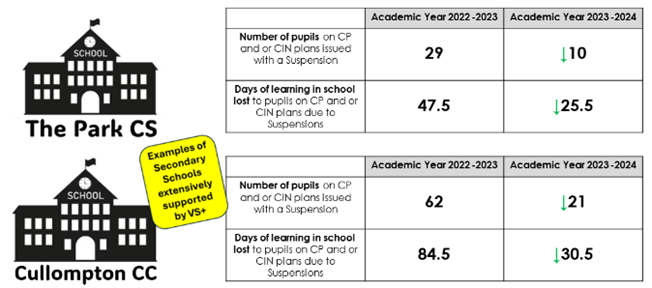
Attendance: monitoring, communicating, supporting, training
Improved attendance has been a national and county-wide focus for the Academic year 2023-24.
CYP on CIN and CP plans are often increasingly vulnerable when their attendance drops. This vulnerability may be due to risk factors in the family home, it may be contextual; in the community and it also includes educational vulnerability due to lost learning; anxiety and reduced engagement frequently results from gaps in knowledge caused by significant breaks in the cumulative nature of most curricula.
The two Virtual School Extended Role Education Advisors have had the support this Academic Year of an AIO (Attendance Improvement Officer) Becky Brooks, who has met with them fortnightly to support improved attendance of the CP, CIN cohort and the individuals within this group. The team have used a ‘case work’ approach to support cyp with severe absence; many meetings, actions and direct support have been offered and implemented, including attending core groups and leading Relational Support Plans (111+ cases for CP and CIN students in Secondary excluding Year 11s and 23+ cases for Primary), Home visits with Social Workers, providing a new laptop to facilitate blended learning (school and online at home), providing a wig for yp, school shoes, furniture, bespoke aspiration visits.
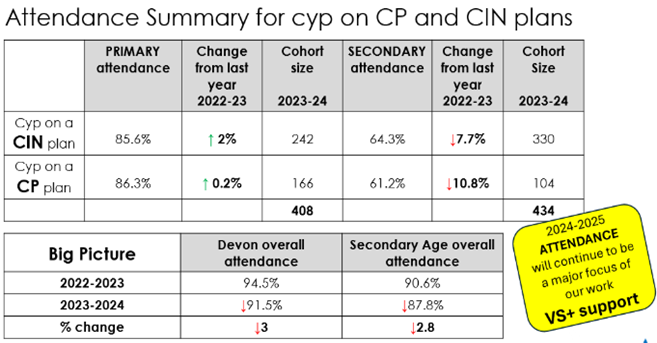
Inclusion – making the cohorts needs visible
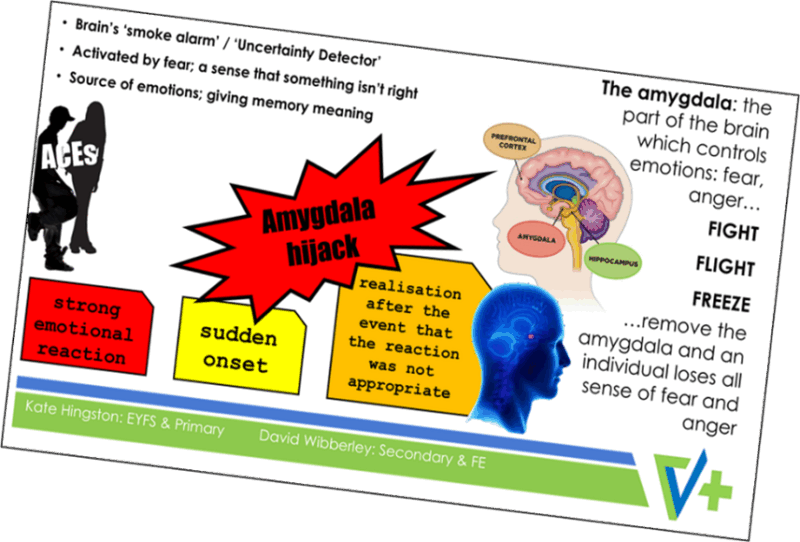
The Virtual School Extended Role Education Advisors have provided an overview of the needs of the CP/ CIN cohort of children as well as the role and remit of the VS+ to newly appointed and trainee Social Workers and newly appointed DSLs and DDSLs. A range of CPD, planned and delivered by the VS+ has taken place in schools, for social care colleagues, in FE colleges, at Plymouth University, to DT and DSL conferences and at the Devon Safeguarding conference.
VS+ support
Relational, trauma-informed high quality CPD created and delivered to over 900 colleagues:
- In schools and FE colleges
- Social care colleagues
- At Plymouth University
- To DT and DSL Conference
- At the Devon Safeguarding Conference
VS+ support – Primary aged child impact case-study
What was the situation for the child?
- Year 3 student on a CIN plan due to abuse or neglect (third episode of CIN planning).
- Highlighted in Oct 2023 through VS+/AIO attendance monitoring: school attendance Term 1: 53.63%.
- No Annex R in place.
- Personal history of poor mental health.
- Joined a new primary school in Summer Term 2023 after breakdown in previous placement.
- Presenting with dysregulated behaviour at school and home; considered flight risk.
What did we do?
- VS+ Education Advisor contacted school and social worker; invited to next CIN meetings.
- Ongoing involvement in CIN meetings.
- Led relational support planning with mum, school, SW & CYP (Nov 2023).
- Delivered whole-school CPD on relational practice (Jan 2024).
- Attendance monitoring and guidance on Annex R.
- Signposting to SEMH support.
What is the situation for the child now?
- Case closed to CSC (March 2024); Annex R closed (April 2024).
- Relational planning in place to ensure social, emotional, and mental health needs are met.
- Increase in school attendance:
- Term 2: 69.3%
- Term 3: 82.54%
- September 2024: 100%
- SEMH team involved for ongoing support.
What went well?
- Gradual increase in Annex R leading to full-time timetable.
- Significant improvement in attendance.
- Strong partnership between CSC and education.
- Strategic support to school through CPD and staff upskilling.
VS+ support – Secondary aged child impact case-study
What was the situation for the young person?
- ZZ is a 13-year-old on a CP plan for emotional abuse.
- Recently relocated to protect family identity following domestic violence.
- Now has 8 siblings, including infants (Sept 2024).
- Started at a South Devon school but stopped attending after bullying and mental health issues, then became CME.
- Attendance when VS+ became involved: 0%.
What did we do?
- VS+ liaised with Social Worker to understand family situation.
- Set up multi-agency meeting for ZZ and siblings.
- Provided a new laptop for ZZ and supported Social Worker to help Mum with Oak Academy online learning.
- Planned a new start at a different school with relational support.
- Provided food bank vouchers for essentials.
- Supported school with uniform and PE kit.
- Arranged transport with DCC and covered costs for train and bus passes.
What is the situation for the young person now?
- ZZ has attended school and made friends.
- Attendance improved from 0% to 47.6% in the summer term.
- Concerns remain about superficial self-harm.
- VS+ and Social Worker visited home in Sept 2024 to prevent elective home education.
- VS+ continues to support Mum and liaise with SEMH team.
What went well? What would we change?
Went well:
- ZZ started at Exeter Secondary School.
- Strong liaison between VS+ and Social Care led to a school placement and family support.
Would change:
- Improve communication from Social Worker.
- Avoid introducing a new SW at a critical time for education.
Challenges and next steps 2024-25
- Improved data and tracking the CP and CIN cohort.
- Ever changing, large cohort for 1.7 FTE staff members to support.
- Recording and tracking case support and involvement
- Agreed protocol for our input and communication to multi-agency and DCC team work.
- Review of impact and triaging of priorities.
17. Virtual School newsletters
These are published every half term – please contact kate.clarke@devon.gov.uk for details.