Foreword
This SEND Sufficiency Implementation Plan (2025 to 2030) sets out Devon’s approach to delivering a more inclusive, sustainable, and effective SEND system. It builds on our SEND Sufficiency Strategy and aligns with the ambitions of the ‘Every Child Achieving and Thriving’ White Paper (February 2026), particularly its focus on early intervention, strengthened mainstream inclusion, and local provision.
Through targeted investment and partnership working, we will expand capacity, improve support in mainstream settings, and create clearer pathways into adulthood—helping more children and young people with SEND to thrive within their communities while ensuring long-term sustainability.
The Implementation Plan sets out a five year programme which will see a significant expansion of SEND provision, countywide, in mainstream settings and support SEND reform in the county.
White paper: every child achieving and thriving
The Department for Education’s ‘White’ paper (February 2026) sets out a national vision for a more inclusive, consistent, and sustainable SEND and Alternative Provision system. It places strong emphasis on early intervention, strengthened mainstream inclusion, and clearer national standards, ensuring that more children and young people with SEND can have their needs met effectively within their local communities.
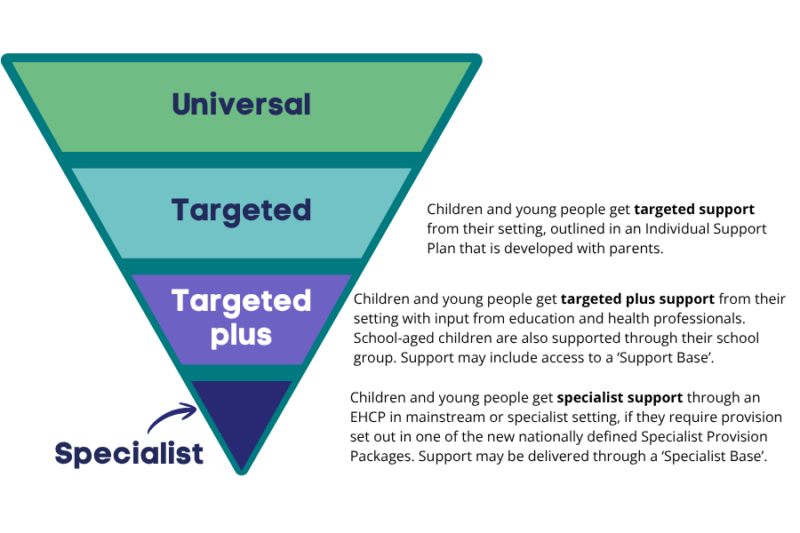
A key priority is the development of a coherent continuum of provision, reducing fragmentation and variability in support. This includes stronger ordinarily available provision in mainstream settings, alongside targeted and specialist support delivered through local, hub-based models. The white paper also highlights the importance of workforce development, improved transitions into adulthood, and a more joined-up system across education, health, and care.
Devon’s SEND Sufficiency Implementation Plan aligns closely with this national vision. Through investment in local provision, expansion of SEND specialist units, and a focus on early intervention and inclusion, the plan will support a more consistent and sustainable system. It also reflects the white paper’s emphasis on co-production, ensuring that children, young people, and parent carers are central to shaping services and improving outcomes.
SEND Sufficiency Strategy
This Implementation Plan directly translates the ambitions of the SEND Sufficiency Strategy 2025 to 2030 into a clear, phased programme of delivery. It aligns with the strategy’s focus on increasing local provision, strengthening mainstream inclusion, and developing a coherent continuum of support through a locality-based model. By prioritising early intervention, targeted investment, and locality-based planning, the plan ensures that sufficiency is achieved in a way that improves outcomes for children and young people while supporting a more sustainable and financially resilient SEND system.
It also reflects the strategy’s commitment to a needs-led approach, ensuring that provision is developed in the right locations and for the areas of greatest demand, including Autism, Social Emotional and Mental Health, and Speech and Language. Through the expansion of mainstream primarily and specialist capacity, the plan supports a more balanced system—reducing reliance on out-of-area placements and enabling more children and young people to access education closer to home and within their communities.
Importantly, the implementation plan embeds the strategy’s principles of partnership and coproduction. Ongoing engagement with children and young people, parent carers, schools, and wider partners will inform delivery, ensuring that provision is responsive, inclusive, and shaped by lived experience. This collaborative approach underpins a system that is not only sufficient in capacity, but effective in meeting needs and improving long-term outcomes.
Inclusion Support Bases
(SEND Sufficiency Strategy Priority 1, 3, 5)
Activity completed to date (April 2026)
Devon County Council is working in partnership with Olive Academies Trust to strengthen inclusive practice across mainstream schools, with a particular focus on the development of internal Alternative Provision (AP), support bases, and locality-based inclusion approaches. Current activity focuses on working directly with identified schools to review existing provision, assess inclusive practice, and support leadership teams to develop sustainable models of internal AP and support-base provision that increase schools’ capacity to meet a broader range of needs within mainstream settings.
Planned activity (2026 to 2030)
The next stage of delivery will focus on embedding and scaling this approach across a wider network of schools and localities. This includes supporting the development of Devon’s Inclusion Strategy, consultation activity with schools and partners, and the implementation of inclusion audits aligned to national frameworks. Schools and settings will be supported to develop settingspecific inclusion action plans and strengthen consistent approaches to inclusive practice. A key focus of the partnership with Olive Academies Trust will be the continued development of mainstream support bases, internal AP models, and locality-based inclusion hubs to strengthen early intervention and prevent escalation to specialist placements wherever appropriate.
This work will support schools to develop provision that enables children and young people with SEND and additional needs to remain within their local communities and mainstream education. Further activity will focus on workforce development, including assessing workforce needs, establishing workforce development strategies, and creating locality-based networking arrangements and Inclusion Champions to strengthen collaboration across the system. Alongside this, there will be a review of existing resource bases across the county to ensure they continue to deliver specialist support and align with the Experts at Hand strategy and the wider SEND Sufficiency Strategy. Ongoing evaluation activity will support continuous improvement and inform future delivery.
Timeline and outcomes (2026 to 2030)
Over the lifetime of the Implementation Plan, this partnership will evolve into a sustainable, locality-based model of support. By 2030, support bases and internal AP approaches will be fully embedded across Devon, contributing to a more connected continuum of mainstream provision. This will enable more children and young people with SEND and additional needs to be supported effectively within their local communities, reduce reliance on specialist and out-of-area placements, and improve outcomes through earlier, more consistent intervention.
SEND Specialist Units
(SEND Sufficiency Strategy Priority 2, 3, 5)
Activity completed to date (April 2026)
Initial work has focused on designing the SEND specialist unit model and identifying priority locations based on need. A pilot in Totnes King Edward VI Community College has successfully opened its specialist unit in the 2025/26 academic year, marking a key milestone in delivery. Alongside this, feasibility work and data-led analysis are underway for further units in Cullompton, Exmouth and The Park School, Barnstaple. These, alongside other planned locations, form part of a network of 12 specialist units, ensuring provision is targeted in areas of greatest demand. In parallel, existing provision has been reviewed to inform recommissioning and reshaping, supporting a more coherent, locality-based system.
Planned activity (2026 to 2027)
The next phase will focus on delivering the full network of 12 specialist units within mainstream school sites. This includes progressing units currently in feasibility through to delivery, using the evidence base to confirm need and shape provision. Collectively, these units will create approximately 240 additional specialist places within mainstream settings.
Timeline for delivery (2026 to 2028)
Delivery will be phased, with priority schemes progressing first and feasibility projects moving into implementation. The ambition is for all 12 specialist units to be operational by September 2028, establishing a strong network of provision embedded within mainstream schools. This will support earlier intervention, improve local sufficiency, and reduce reliance on out-of-area placements, with ongoing refinement beyond 2028 to ensure the model continues to meet local need.
Special School Places
(SEND Sufficiency Strategy Priority 2, 3 and 5)
Activity completed to date (April 2026)
Progress to date has focused on developing the pipeline of projects required to expand special school capacity across the county. This includes delivery of the new 150-place special school at Ivybridge (Castlebridge) by the Department for Education (DfE), alongside the provision of 30 additional places at Mill Water School in Seaton. Proposals for smaller-scale expansions to existing provision are also being explored where these can help meet local demand. Early-stage feasibility, site assessment, and preparatory work has also been undertaken to support the wider strategic approach to specialist and therapeutic provision.
Planned activity (2026 to 2027)
The DfE Free School programme are delivering the permanent new 150-place special school at Ivybridge (Castlebridge) which already has a satellite provision in Tavistock. Due to delays in the delivery of a the permanent site, further satellite (permanent or temporary) will need to be explored for September 26 and 27 intake An additional 30 places at Mill Water School in Seaton, planned for September 2026. Beyond these schemes, work will continue to identify and develop opportunities for additional places at existing special schools in order to expand capacity and respond to increasing demand across the county. The programme will also progress the development of 3–4 therapeutic schools as part of the wider approach to strengthening specialist and therapeutic provision for children and young people with complex needs.
Timeline for delivery (2026 to 2030)
Delivery of additional special school places will take place on a phased basis between 2025 and 2030, aligned with construction and development programmes. New places will be brought online incrementally as projects complete, including those delivered through Castlebridge and its satellite centres, as well as other expansion schemes. Therapeutic provision will be developed over this period. By 2030, this programme will support a planned continuum of provision, improving local sufficiency and reducing reliance on out-of-area placements.
Further Education Places
(SEND Sufficiency Strategy Priority 1, 4 and 5)
Activity completed to date (April 2026)
Significant progress has already been made to expand post-16 provision across Devon. This includes the creation of 250 additional places at North Devon College (Petroc). In addition, development work is underway with Exeter College to deliver a further 100 places, scheduled to open in September 2026. A joint project with South Devon College is also in progress, which will deliver an additional 38 places phased over three years. Alongside this, partnerships with FE providers have been strengthened and work has progressed to better understand demand and align provision with Preparing for Adulthood (PfA) pathways.
Planned activity (2026 to 2027)
The next phase will focus on completing current developments and continuing to expand capacity across FE settings. This includes bringing the Exeter College provision into operation and progressing the phased delivery at South Devon College. Work will also continue with FE partners to embed inclusive practice, strengthen SEND support within colleges, and develop Post-16 SEND specialist hubs aligned to the wider locality model. Provision will be shaped to ensure a broad range of pathways, including education, training, and employment-focused opportunities.
Timeline for delivery (2026 to 2030)
Delivery will continue on a phased basis through to 2030, with new places coming online incrementally as projects complete. By September 2026, the additional Exeter College places will be operational, with South Devon College provision fully delivered over the following three years. This programme will contribute to a sustained increase in Post-16 capacity, supporting improved transitions into adulthood and enabling more young people with SEND to access appropriate provision within their local area.
Recommissioning Special Schools
(SEND Sufficiency Priority 2, 3 and 5)
Current activity (April 2026)
Initial work has commenced focusing on developing a common understanding of specialist provision across Devon. Meetings with individual schools, federations or trusts will review age range, legal status, designation and analysis of scope of offer including curriculum pathways. The purpose of this exercise is intended to establish a common understanding of specialist provision across Devon and to support constructive area-wide planning.
The outcomes of this initial scoping exercise inform a cross-sector collaboration workshop with schools to inform the next stage of sufficiency and commissioning planning and create an ongoing collaborative approach
Planned activity (2026 to 2027)
Recommissioning will continue as an iterative process, working collaboratively with special schools to refine and develop their offer over time. This will include reviewing designations, place numbers, and the range of needs catered for, ensuring provision is flexible and responsive. The process will support better alignment with the wider SEND system, including specialist units, therapeutic provision, and mainstream inclusion, to create a more balanced and integrated continuum of support. Recommissioning activity will include the strategic role of Special Schools in supporting mainstream inclusion as set out in the White Paper Proposal, building on current Outreach commissioned activity.
Timeline for delivery (2026 to 2030)
Recommissioning will take place on an ongoing basis throughout the lifetime of the plan, with regular review points to respond to emerging needs and changes in demand. Rather than a single point of delivery, this will be a continuous cycle of assessment, engagement, and refinement. By 2030, this approach will ensure that special school provision remains dynamic, sustainable, and fully aligned to the needs of children and young people across Devon.
Appendix A: SEND Sufficiency Capital Programme 2026 to 2030
| Special School Expansions | Designation | Places | Approved in MTCP £,000 | Notional Allocation £,000 | Timescale |
|---|---|---|---|---|---|
| Lampard Vachell | ASC, SLCN | 20 | £150 | Sep-25 | |
| Ace Tiverton | ASC, SEMH | 20 | £290 | Sep-26 | |
| Castlebridge Special School | ASC | 150 | £5,850 | Sep-25 | |
| Mill Water Special School | SLD, PMLD | 30 | £1,740 | Sep-26 | |
| Total | 220 | £8,030 | £0 | ||
| Inclusion Bases – Specialist Bases | Designation | Places | Approved £,000 | Notional Allocation £,000 | Delivery |
| Wave 1 | |||||
| Totnes Kevicc | ASC | 20 | £520 | Apr-26 | |
| Exmouth Community College | ASC, SEMH | 20 | £510 | Jan-27 | |
| The Park Barnstaple | ASC, SEMH | 20 | £800 | Apr-27 | |
| Cullompton Community College | ASC, SEMH | 20 | £510 | Jan-27 | |
| Wave 2 | |||||
| Honiton Community College | ASC, SEMH | 30 | £550 | Sep-27 | |
| 7 Bases tbc | SLCN, ASC, | 170 | £5,000 | Sep-28 | |
| SEMH | |||||
| Total | 280 | £1,540 | £6,350 | ||
| Post 16 Expansion | Places | Approved £,000 | Notional Allocation £,000 | Delivery | |
| Exeter & North Devon – Tiverton and Barnstaple | PLMD, MLD, ASD, SEMH | 250 | £3,200 | Jan-26 | |
| Exeter & North Devon – Exeter | SEMH, ASD | 100 | £5,300 | Sep-26 | |
| South Devon College | SEMH | 38 | £400 | Jan-27 | |
| Total | 388 | £8,900 | £0 | ||
| Approved £,000 | Notional Allocation £,000 | Delivery | |||
| Inclusion Bases – Support Units | £8,000 | 2026 – 2009 | |||
| Therapeutic Schools | £3,200 | 2026 – 2029 | |||
| Recommissioning of Special Schools | £3,000 | 2026 – 2029 | |||
| Total SEND Implementation Capital Approval £,000 | £18,470 | £20,550 |
Appendix B: Continuum of provision to support children and young people with SEND