About the SEND transformation programme
Devon’s SEND transformation programme is a whole system approach. Read more about the overall programme objectives.
The programme contains four strands. Each work strand contains several projects looking at specific parts of the SEND system and is governed by the SEND Transformation Programme Board. Read more about the programme governance.
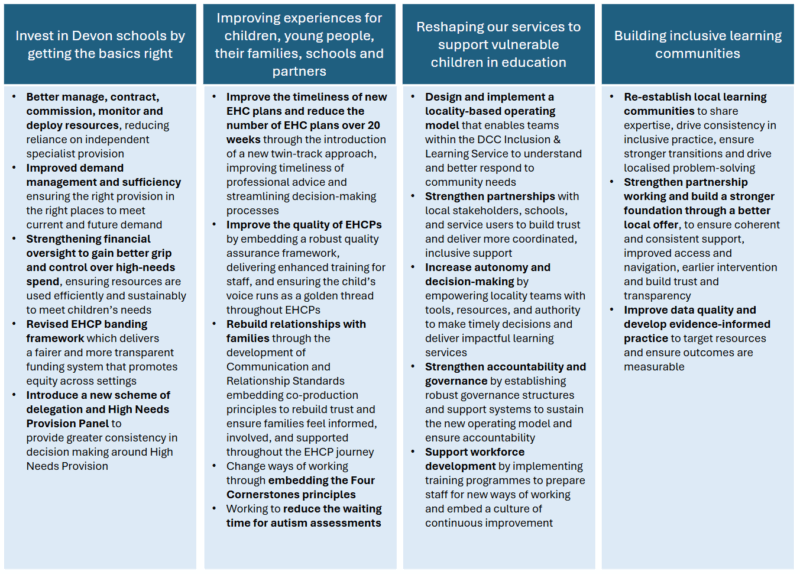
The four work strands, and what they are delivering
1. Investing in Devon schools by getting the basics right
We are fundamentally changing how we plan, commission, and deliver support for children and young people to create a sustainable, inclusive system focused on smarter resource use, stronger governance, and better experiences for families and schools.
By building capacity in mainstream education, strengthening partnerships with health, and using data-driven insights, we aim to reduce reliance on costly independent placements and deliver better outcomes.
- This will be achieved by
- Developing commissioning frameworks for Alternative Provision and Independent Sector provision, to improve accountability, standards, and value for money.
- Revising our EHCP Banding framework for fair, transparent funding aligned with children’s needs.
- Expanding specialist provision locally to reduce reliance on independent placements.
- Reviewing targeted services, such as mentoring and tutoring and therapies, for effectiveness, value, and impact.
- Resetting governance arrangements with strategic and operational oversight, including regular decision-support processes.
- Enhancing use of data insights to target resources and drive change.
Our goal is for every child and young person with SEND to have access to high-quality education within their local community, reducing unnecessary travel and ensuring stability.
- What this means for families
- More children and young people will experience more inclusive education in mainstream and local specialist settings, reducing independent placements and long-distance travel.
- Families will benefit from greater consistency and clarity, improving confidence and reducing stress.
2. Improving experiences for children, young people, their families, and partners
We are improving the way we undertake Education Health and Care assessments and reviews to make processes timelier, more efficient, and deliver a better experience for children and families.
- This will be achieved by
- Improving the timeliness of Education, Health and Care Plans (EHCPs) by streamlining processes, reducing delays, and meeting statutory timeframes.
- Embedding quality assurance throughout the EHCP process to ensure plans are robust, consistent, and outcome focused.
- Setting clear communication standards to make interactions with families more transparent, collaborative, and supportive.
- Aligning improvements with the Four Cornerstones of our SEND strategy: inclusion, collaboration, accountability, and sustainability.
Our goal is for children and young people to receive the right support at the right time, with families feeling confident and respected.
- What this means for families
- Education, Health, and Care Plans (EHCPs) will be issued within statutory timescales, ensuring timely support and reducing delays.
- Transparent processes will build trust and confidence among families and schools, reducing complaints and increasing satisfaction.
- Success will be reflected in these key performance indicators
- Reduced requests for EHC needs assessments – Monitoring the number of requests for an Education Health and Care Needs Assessment (EHCNA) to ensure early intervention and appropriate support (KPI 8).
- Improved decision timeliness – Increasing the percentage of EHCNA requests refused within 6 weeks where appropriate, reflecting robust and timely decision-making (KPI 9).
- EHCP timeliness – Ensuring a higher percentage of Education, Health and Care Plans (EHCPs) are issued within 20 weeks, reducing delays for families (KPI 10).
- Reduction in overdue plans – Lowering the number of EHCPs that exceed the 20-week statutory timeframe, demonstrating improved process efficiency (KPI 11).
- Reduction in overdue annual reviews – Decreasing the number of overdue annual reviews, ensuring plans remain current and responsive to children’s needs (KPI 12).
- Fewer appeals to SEND tribunal – Reducing the number of appeals, indicating greater confidence in decisions and improved quality of plans (KPI 13).
- Inclusive education placement – Increasing the percentage of children with an EHCP educated in mainstream settings, while monitoring those in special and independent schools to ensure placements reflect need and promote inclusion (KPI 14).
3. Reshaping our services to support vulnerable children in education
We are reshaping services for vulnerable children by transitioning to a locality-based operating model to deliver more responsive, coordinated, and equitable support for children and families. By fostering stronger local partnerships and promoting cross-functional collaboration, we will reduce duplication, improve alignment, and strengthen accountability.
This approach empowers teams with the tools, resources, and authority to make timely decisions and deliver inclusive, impactful services tailored to community needs.
- We will achieve this by
- Creating a local way of working to help teams understand and respond to area-specific needs.
- Fostering stronger relationships with stakeholders to enhance collaboration and trust.
- Promoting cross-functional collaboration and knowledge sharing to improve service integration.
- Reducing duplication and improving alignment of goals across the service.
- Increasing autonomy and decision-making at locality level for faster, more effective responses.
- Equipping teams with tools and resources to deliver inclusive learning services.
- Strengthening accountability through clear governance structures.
- Supporting staff development to build skills and sustain improvement.
Our goal is for vulnerable children to have consistent, joined-up support that keeps them engaged in education and achieving positive outcomes.
- What this means for families
- The locality-based model will deliver responsive, coordinated support, reduce duplication, and strengthen accountability.
- Teams will have the tools and authority to make timely decisions, ensuring inclusive services that meet community needs.
- Governance and feedback mechanisms will drive continuous improvement, while workforce development builds sustainability.
- Success will be reflected in these key performance indicators
- Improved attendance – Increase attendance rates for children with SEN Support and those with an EHCP, reflecting better engagement and access to mainstream provision (KPI 1).
- Reduced permanent exclusions – Lower the number of permanent exclusions for children with SEN Support and EHCPs, demonstrating more effective early intervention and inclusive strategies (KPI 2).
- Decrease in elective home education for non-lifestyle reasons – Reduce the number of children electively home educated due to unmet needs, indicating improved confidence in local provision (KPI 3).
- Fewer part-time timetables – Minimise the number of children with SEN Support or EHCPs on part-time timetables, ensuring equitable access to full-time education (KPI 4).
- Address missing education – Significantly reduce the number of children with EHCPs who are missing education, supported by robust attendance strategies and locality-based interventions (KPI 5).
- Lower EOTAS placements – Decrease the percentage of children educated other than at school (EOTAS), by strengthening mainstream and specialist provision (KPI 6).
- Improved post-16 outcomes – Increase the proportion of young people with EHCPs in education, employment, or training (EET), reflecting successful transition planning and inclusive pathways (KPI 7).
4. Building Inclusive Learning Communities
We are building an education system where inclusion is central to decision-making, creating communities that celebrate diversity, promote equity, and ensure all learners have access to high-quality education.
Inclusive education is the foundation for strong communities, ensuring all learners feel a sense of belonging and have equitable opportunities. By removing barriers, mainstream schools will make inclusion the norm, reducing reliance on specialist interventions and improving outcomes for every learner.
Educational settings will adopt relational and restorative practices that prioritise emotional safety, empathy, and constructive conflict resolution.
- We will achieve this by
- Establishing local hubs to provide early, coordinated support close to home.
- Integrating inclusive practices across partnerships to reduce inequalities and improve access to mainstream education.
- Collaborating with families, schools, and professionals to co-create solutions beyond the classroom, fostering a culture of inclusion.
- Formalising joint planning with schools and health partners through shared objectives and measurable engagement targets.
- Developing a training framework to build workforce skills and confidence in delivering inclusive education.
We have commissioned an independent Strategic Inclusion Advisor to strengthen diversity, equity, and inclusion by advising leaders, shaping policy, and promoting a culture where all colleagues feel valued. Their role includes:
- Challenging and supporting mainstream inclusion focus.
- Aligning Devon’s Inclusion & Learning strategy with DfE’s vision.
- Defining a consistent approach to inclusive practice and collaborating with leaders to establish locality-based communities of practice.
- Developing a self-evaluation toolkit and ongoing QA processes with meaningful family involvement.
Our goal is for every child and young person to thrive in mainstream education, supported by timely interventions and inclusive practices that reduce barriers and promote positive outcomes.
- What this means for families
- Embedding inclusive practices and strengthening collaboration will create learning environments where all children, particularly those with SEND, can thrive.
- Schools will be better equipped to support all learners.
- Families will feel involved and listened to.
- Success will be reflected in these key performance indicators
- Improved attendance – Increase attendance rates for children with SEN Support and those with an EHCP, reflecting better engagement and access to mainstream provision (KPI 1).
- Reduced permanent exclusions – Lower the number of permanent exclusions for children with SEN Support and EHCPs, demonstrating more effective early intervention and inclusive strategies (KPI 2).
- Decrease in elective home education for non-lifestyle reasons – Reduce the number of children electively home educated due to unmet needs, indicating improved confidence in local provision (KPI 3).
- Fewer part-time timetables – Minimise the number of children with SEN support or EHCPs on part-time timetables, ensuring equitable access to full-time education (KPI 4).
- Address missing education – Significantly reduce the number of children with EHCPs who are missing education, supported by robust attendance strategies and locality-based interventions (KPI 5).
- Lower EOTAS placements – Decrease the percentage of children educated other than at school (EOTAS), by strengthening mainstream and specialist provision (KPI 6).
- Improved post-16 outcomes – Increase the proportion of young people with EHCPs in education, employment, or training (EET), reflecting successful transition planning and inclusive pathways (KPI 7).
Want to know more?
- Read more about the programme objectives
- See how the programme is managed