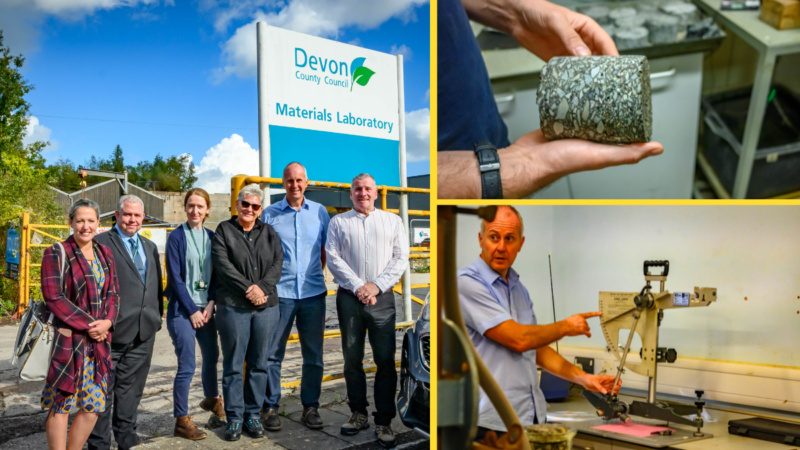
A cylinder of tarmac may not look particularly revealing, but in the hands of a small team of Devon County Council specialists, it can show how well a road was constructed and whether its layers are performing as they should and where problems are developing.
It is one example of the largely unseen work carried out by the Council’s Materials Laboratory, a service whose expertise is built into roads and bridges across Devon.
Devon has the largest road network of any local highway authority in England, with more than 13,000 kilometres of roads and looks after 4,834 bridges and thousands of other highway structures.
Choosing the right materials, checking the quality of construction and diagnosing defects are essential to keeping the public safe, avoiding unnecessary future repairs and ensuring the council’s finite resources are used when and where they are needed the most.
The laboratory has been operating since 1952 and has been based at Rockbeare Hill Quarry since 2014. Its specialists test soil, asphalt, concrete, aggregates and other construction materials in the laboratory and on site, providing evidence that engineers can use to make informed decisions.
Core samples from roads under construction are analysed to check the type, depth, density and composition of the materials laid by utilities and contractors. Samples from older roads help the Council’s asset management team understand their condition and select the right treatment, work that can prevent money being spent on a repair that does not address the underlying problem.
Other equipment measures skid resistance and the strength of road foundations, while testing can identify hazardous materials before maintenance begins. The team also checks the salt and brine used by the Council’s winter fleet.
Councillors Neal Raleigh, Cheryl Cottle-Hunkin, James Buczkowski and Jacqueline Fry saw the work at first hand during a tour led by laboratory manager Peter Dyer and materials engineer Graeme Peace.
They were shown asphalt cores and specialist testing equipment and heard how the results influence the design, construction and maintenance of schemes.
“This team works behind the scenes, but its expertise is built into roads and bridges across Devon,” said Councillor Raleigh. “The visit showed how much careful investigation sits behind decisions that most of us never see.”
The work extends beyond highways. Ground investigations and soil testing help establish whether land is suitable for construction, how water will move through it and what foundations roads in a new development may need. The laboratory also supports bridge investigations, drainage design, slope stability work and surveys.
Its findings help engineers design safer, more durable schemes and protect the Council’s investment in its infrastructure. They can also reduce waste and carbon: if work is carried out correctly first time and a longer-lasting material is chosen, there is less need for repeat repairs.
Councillor Cottle-Hunkin said: “Having this knowledge in-house helps us make sound decisions and get better value from our projects. It means the advice is there from the earliest stage, not simply when something has gone wrong.”
Few councils retain this breadth of testing and technical expertise and while the laboratory principally supports Devon County Council, its value is recognised across the region with work coming in from other local authorities, developers and private businesses.
Customers can use one team for investigation, testing, analysis and technical reports, with the income generated making the facility cost-neutral to run.
The testing is accredited by the United Kingdom Accreditation Service and is of the highest standard with rigorous procedures supporting results that engineers can rely on. “It is a real asset for Devon and for the organisations that use its services,” said Councillor Buczkowski. “It combines specialist public-service knowledge with a commercial offer that helps meet the cost of running it.”
For Councillor Fry, the visit brought the people behind the testing into focus. She said: “These highly skilled specialists deserve far more recognition for the vital work they do. Their work is rarely visible, but the benefits are all around us.”