Executive summary
Devon County Council is working to develop its Best Start in Life (BSiL) Local Plan and preparing for the implementation of Best Start Family Hubs, supported by the national development grant. This report outlines the evidence, decision‑making, and proposed delivery model that will shape Devon’s pilot Best Start Family Hubs.
National government has set the ambition to increase the proportion of children achieving a Good Level of Development (GLD) to 75% by 2028, recognising early attainment as a key determinant of social mobility and long‑term health.
Devon’s local GLD target to achieve by 2028 is 78% and 59.5% for children in receipt of free school meals. Most recent data (2024/25) show these rates stand at 68.3% and 51.3% respectively.
Other persistent disparities also exist, particularly for children with special educational needs (SEN), summer‑born children, and those with English as an additional language.
Devon’s rural and coastal geography creates additional barriers to access, requiring flexible and digital approaches. The development grant provides an opportunity to reduce these barriers while strengthening parenting support, and the home learning environment.
Analysis of local attainment data, deprivation indices, absolute numbers of children requiring support, and predicted levels of speech and language need has informed the selection of three pilot Best Start Family Hub sites, one in each locality: Torridge, Exeter, and Newton Abbot. These areas reflect both high deprivation and lower GLD outcomes, ensuring pilot work targets communities with the greatest need.
The county will adopt the Understanding Your Child’s Behaviour programme from Togetherness (formerly the Solihull Approach). Additional parenting programmes, including Video Interaction Guidance (VIG) and Incredible Years, are under consideration.
For universal HLE support, the EasyPeasy app will form the digital offer, providing practical tools for parents of 0–5‑year‑olds to enhance interaction, play, and learning at home.
Through targeted site selection, evidence‑based programme delivery, and a blended model of in‑person and digital support, Devon aims to maximise the reach and impact to improve GLD. This builds on existing infrastructure and focuses resources where we can deliver the greatest improvement in early childhood development.
Scope
The purpose of this paper is to set out Devon’s progress in developing the Best Start Local Plan and to outline how we are preparing for the implementation of Best Start Family Hubs. It describes the steps taken to analyse local need, the data sources used to understand disparities in early development, and the methodology for identifying the most suitable pilot sites. The scope also includes a summary of the activity undertaken with partners to shape the offer, early considerations for workforce and delivery planning, and how Devon will use the development grant to strengthen early identification, parenting support and the home learning environment within the selected pilot hubs.
Background
Part of the Government’s policy Giving Every Child the Best Start in Life is a commitment to improve Good Level of Development (GLD) by 2028 (Department for Education, 2025). GLD is measured in the Early Years Foundation Stage Profile assessment which is completed by reception teachers before 30 June each academic year.
The national target is to improve proportion of children achieving Good Level of Development to 75% (DfE, 2025a). This is to ensure that children are equipped to get the most out of school. By age 5, discrepancies in attainment already exist and these continue to widen with age (DfE 2025a). Improving a child’s attainment can improve a child’s social mobility and thereby their health (Clarke et al., 2017).
Discrepancies in GLD attainment have implications for a child’s future outcomes (DfE, 2025b). These are demonstrated in table 1.
Table 1
| Group | Proportion of children achieving GLD in 2023/2024 | Proportion of children achieving GLD in 2024/2025 |
|---|---|---|
| Overall | 67.7% | 68.3% |
| FSM eligible children | 51.5% | 51.3% |
| FSM not eligible children | 72% | 72.5% |
| All SEN (inc. EHCP) | 19.7% | 20.6% |
| SEN (excl. EHCP) | 24.9% | 26.4% |
| EHCP | 3.8% | 4% |
| No SEN or EHCP | 75.6% | 76.5% |
| Male | 60.7% | 61.6% |
| Female | 75% | 75.3% |
| Autumn born | 75.6% | 75.6% |
| Spring born | 69.5% | 70% |
| Summer born | 60% | 61.1% |
| First language English | 69.7% | 69.9% |
| First language not English | 63.5% | 64.7% |
| White | 69.2% | 69.7% |
| Mixed / Multiple ethnic groups | 69.5% | 69.9% |
| Asian / Asian British | 66.9% | 67.7% |
| Black / African / Caribbean / Black British | 62.9% | 62.3% |
| Other ethnic group | 60.2% | 60% |
| Unknown ethnic group | 50.4% | 54.4% |
Table 1 demonstrates national discrepancies between groups of children in 2023/4 and 2024/5 EYFSP results from DfE (2025c).
Nationally, there are over 400 family hubs, DHSC/DfE guidance states that family hubs can deliver the following services, though there is local variation in how these services are provided:
- Single front door to provide a clear access point for signposting families to services for families with children 0-19 years old (or 0-25 years old with SEND).
- Delivery of the universal Start for Life offer.
- Support for families with parenting; mental health; home learning environments; feeding and parent–infant relationship support.
- Advice and guidance.
- Identifying need early and preventing escalation of need.
- Collecting data to aid local system improvements.
- Hosting parent and carer panels where caregivers share their views on the design and delivery of support (DfE, 2025b).
Family hubs are already a trusted partner who are ideally placed to support parents and enhance the home learning environment. The initial Best Start in Life development grant is intended to enhance capacity of selected pilot Best Start Family Hubs to deliver evidence-based support to families prior to national rollout (DfE, 2025f).
Local context
Devon is a large, rural county; this presents a challenge to how we effectively deliver support to meet local targets given that many people must travel significant distances to access family hubs in face to face. Moreover, Devon has many coastal communities, it is known that children living in coastal areas have poorer educational attainment compared to those living inland (DHSC, 2021[VH1] ). The barriers of a large geographical area and transport difficulties have informed our changes to our offer by using apps, Microsoft Teams and outreach services to make our offer as accessible as possible.
Where we are and where we need to get to
Here, the most recent proportions of children in Devon meeting GLD are shown from central government statistics (DfE, 2025c). 2023/2024 data is also shown in tables 2 and 3 because this is what the targets from central government were based on.
Table 2
| Group | Proportion meeting GLD 2023/2024 | Proportion meeting GLD 2024/2025 | Local Target to reach by 2028 |
|---|---|---|---|
| Overall | 69% | 69.7% | 78% |
| FSM children | 50.5% | 46.3% | 59.5% |
Table 2: Devon’s GLD proportions overall and for FSM children compared with local targets set by central government. Source: DfE (2025c)
Comparing children eligible for FSM to the overall cohort, it is evident that, consistent as with national trends, FSM children are significantly less likely to achieve GLD. This has implications for their ability to achieve within and beyond school (DfE, 2025a).
Differences in proportion with no specified target from central government are shown in table 3 to demonstrate where additional need exists.
Table 3
| Group | Proportion meeting GLD 2023/2024 | Proportion meeting GLD 2024/2025[VH2] |
|---|---|---|
| All SEN (inc EHCP) | 18.9% | 21.9% |
| SEN (excl EHCP) | 23% | 28.1% |
| EHCP | 5.6% | 3.2% |
| No SEN or EHCP | 75.9% | 76.7% |
| Male | 62.3% | 62.5% |
| Female | 76.1% | 77.1% |
| Autumn born | 77.9% | 76.6% |
| Spring born | 70.3% | 70.6% |
| Summer born | 60.3% | 63.2% |
Table 3: recent GLD proportions for Devon according to child characteristics. Source: DfE
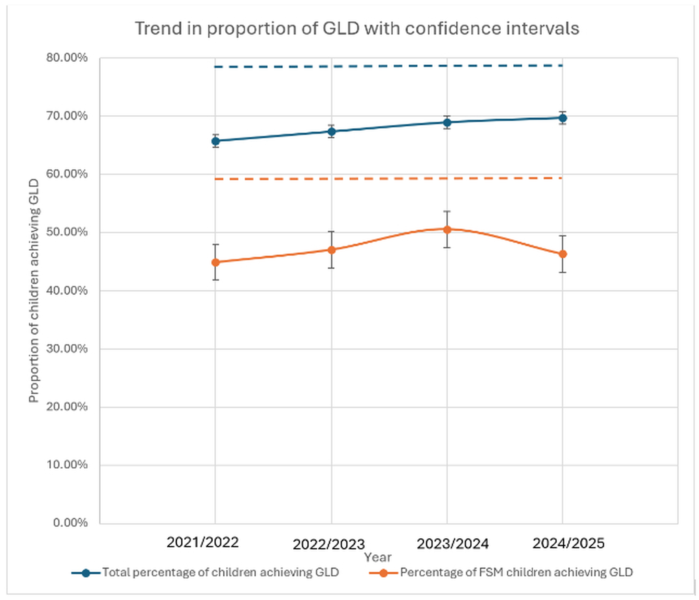
Figure 1: Graph demonstrating trend in proportion of GLD overall and for children eligible for FSM in Devon with 95% confidence intervals. Target for total percentage is 78% and for FSM specific 59.5%, shown by dotted lines in corresponding colour. Source: (DfE, 2025c).
Intersections of characteristics serve to make some children even less likely to achieve GLD, analysis undertaken by DCC intelligence team on the 2023/24 dataset found significant interactions between factors. For example, the proportion of male summer born children eligible for free school meals is only 26.8%. These children likely require extra targeted support.
Current offer
Devon has an established early help system with several universal and targeted services that Family Hubs connect with. These include:
- Public Health Nursing Health Visitor service: provides universal, targeted and specialist support to all families with children aged 0–5 years. Health visitors deliver the Healthy Child Programme, completing mandated developmental reviews at key ages and offering evidence‑based interventions on feeding, growth, safer sleep, attachment, emotional wellbeing, maternal mental health, behaviour management and home learning environments. Websites, an advice line and chat health texting service support this service.
- Infant feeding support with a triage service and corresponding programmes including a triage system with Latch and Attach or an infant feeding clinic being offered depending on need, supported by the Devon Breastfeeding Peer Support Network.
- Early Help Assessments (EHAs) be submitted by anyone working with children to access multiagency support. The Right for Children online system helps family hub workers triage enquiries and arrange signposting. These are followed up by Team around the Family meetings that bring the family and all professionals supporting them together to agree action points and track progress.
- Nursery Plus and Early Years Complex Needs Service (EYCN) are tailored to children with Special Educational Needs and Disabilities (SEND). Nursery Plus supports providers who are receiving early years funding to meet the needs of children with SEND whereas the EYCN service provides targeted support to children with significant developmental needs.
- Families First Programme, a streamlined approach to child social care and child protection (DfE, 2025d).
Existing Family Hubs
Devon has five family hub sites distributed between three localities. Each locality has a family hub team made up of a team manager, family hub navigators, partnership leads, and support workers:
- Exeter and East
- Chestnut Family Hub
- North and Mid
- Bideford Bay Family hub
- Ilfracombe Family Hub
- South and West
- Newton Abbot Family hub
- Totnes Family Hub
A sixth hub is in development in East Devon, we are working to identify the most appropriate site for this, it will be located in a library building or another trusted community venue.
Current Family Hub offer
The core offer of family hubs:
- Single sessions. Families can self‑refer or be referred by professionals. These one‑hour sessions support families to explore a specific issue with a family hub team member, identify strengths, and consider further support. Sessions are delivered face to face or via MS Teams.
- Advice and guidance line. Available Monday–Friday, 10am–4pm. Family hubs staff provide advice and signposting to parents and professionals. An online request‑for‑contact option is also available.
- Practitioner‑led programmes. Practitioners across Devon deliver a range of evidence‑based programmes, outlined in the Programmes provided section of this report.
- Countywide partnership meeting for sharing learning.
- Practitioner meeting to help early help practitioners: schools, social care, police, libraries share knowledge and best practice.
- Practitioner Forums to support early help practitioners.
Programmes currently provided
Let’s Talk Read and Play
LRTP is a Devon specific approach to improving literacy for 2-year-olds, it is made up of universal screening (Early Language Identification Measure (ELIM) done at 2 – 2.5 year old developmental reviews) and a flexible menu of responses where children are struggling with their literacy, these can be delivered by Public Health Nursing, Early Years settings, or Family Hubs. Family Hubs offer a support group or individual sessions (either face to face or digital). Following this, family and practitioner fill out an LRTP measure proforma which helps decide if the family need more support from the family hub or from speech and language therapists.
LRTP capacity will not be upscaled using development grant funding. However, there may be potential funding to carry out a local evaluation of effectiveness of this intervention using a small portion of the development grant. The outcome of this evaluation would help DCC ascertain how effective LRTP is in our context and allow us to make evidence-based decisions based on strong local data in the future.
Changes proposed using development grant
Best Start Family Hub pilot site location
Central government have determined that pilot sites should meet the following criteria:
- Be located in an area of high deprivation.
- Maximise reach to families who stand to benefit the most, ensuring that the site is positioned to engage those who may face barriers to accessing support.
- Be based in a trusted community setting, ideally building on existing. infrastructure such as children’s centres, early years settings, schools.
- Be welcoming and accessible to local families.
- Include space for the delivery of parenting and Home Learning Environment (HLE) interventions and Stay and Play sessions.
- Include space for the co-location of wider services and staff (DfE, 2025f).
Due to the large geographical area of the county, it was decided that three Best Start Family Hub pilot sites should be selected, one in each locality. It was decided that using existing buildings would be the most financially efficient option as well as carrying the benefit of being known points of contact for families.
Sites are located in the most deprived three deciles of the Income Deprivation Affecting Children Index (IDACI). Disaggregated data regarding the proportions of children reaching GLD in each area were also examined. Selected sites have lower rates of attainment compared to other parts of Devon with two below Devon GLD average (Bideford and Newton Abbot) and one (Exeter Central) being very close to Devon’s average.
The social gradient of GLD attainment in Devon is evident, as shown in Figure 2:
| East Devon | Mid Devon | North Devon | West Devon | |
|---|---|---|---|---|
| Total | 72.1% | 67.4% | 65.2% | 70.0% |
| 1 | z | z | 42.9% | z |
| 2 | 65.7% | z | 62.5% | z |
| 3 | 51.3% | 65.9% | 59.2% | 70.0% |
| 4 | 72.5% | 52.0% | 63.6% | 73.1% |
| 5 | 62.3% | 63.7% | 71.2% | 66.3% |
| 6 | 72.4% | 69.5% | 62.9% | 59.2% |
| 7 | 77.0% | 69.9% | 65.5% | 75.0% |
| 8 | 73.3% | 65.2% | 66.2% | 79.5% |
| 9 | 73.3% | 79.5% | 74.0% | 88.0% |
| 10 | 80.0% | 81.3% | 63.2% | z |
Figure 2: 2024/25 GLD attainment proportion according to IDACI deciles 1 is most deprived and 10 is the least deprived area. Data source: (DfE, 2025c)
These decisions were also cross referenced with SLCN data from the population propriety framework devised by better communication on the Balanced System framework This is a national framework used to estimate expected levels of speech and language communication need based on local population characteristics. Speech and language development is an essential domain of the Early Years Foundation Stage Profile Assessment (DfE, 2025e). All family hub sites were in areas where there is a significant predicted SLCN (The Balanced System, nd).
Absolute numbers of children in each area were also considered because targeting areas with low GLD, but small numbers of children would not maximise how many children we can reach with the initial development grant.
The sites that have been decided upon in each locality operation group are below, the existing family hubs in each area are also listed. Lower super output area (LSOA) deprivation data is from Office for National Statistics Index of Multiple Deprivation (IMD) and Income Deprivation Affecting Children Index (IDACI) data explorers (Ministry of Housing, Communities & Local Government, 2025). GLD data for each area was obtained from the education intelligence team at DCC, to keep the report consistent with government targets, disadvantaged is defined as whether the child is in receipt of FSM, data presented below is from 2025.
- North and Mid Devon: Torridge
- The existing family hub is Bideford Bay Hub (LSOA Torridge 003C)
- IMD: Most deprived 30% of neighbourhoods
- IDACI: Most deprived 30% of neighbourhoods
- Overall GLD proportion 24/25: 65.4%
- Non disadvantaged children: 68.8%
- Disadvantaged children: 49.1%
- Exeter and East Devon: Exeter
- The existing family hub is Chestnut Family Hub (LSOA Exeter 013D)
- IMD: Most deprived 20% of neighbourhoods
- IDACI Most deprived 10% of neighbourhoods
- Overall GLD proportion: 69.9%
- Non disadvantaged children: 72.6%
- Disadvantaged children: 54.8%
- South and West: Newton Abbott
- The existing family hub is Newton Abbott Family Hub (LSOA Teignbridge 015A)
- IMD Most deprived 20% of neighbourhoods
- IDACI Most deprived 40% of neighbourhoods
- Overall GLD proportion: 67.6%
- Non disadvantaged children: 69.0%
- Disadvantaged children: 59.2% 56.6%
As per DfE guidance, all sites are in areas of high deprivation, have existing and trusted family hub infrastructure, and can support delivery of new aspects to our offer funded by the development grant. The Newton Abbot Family Hub is marginally not located in one of the most 30% deprived areas, being more deprived than 69% of neighbourhoods in England. However, the selection of this choice fulfils the following criteria determined by DfE:
- There is an existing family hub centre in this location.
- It is located in close proximity to bus stops and Newton Abbot train station, meaning that it is accessible to rural families that do not own a car.
- The Totnes family hub (the other option to cite a pilot centre in South and West region) is also in IDACI decile 4 but Newton Abbot LSOA Teignbridge 015A ranks lower in all types of deprivation including education and skills when compared to the Totnes South Hams 003A. The areas surrounding the Newton Abbot family hub are more deprived than those surrounding the Totnes family hub.
- Moreover, Newton Abbot has a higher absolute number of children in need of support to achieve GLD. Table 4 demonstrates the number of children in each local learning community of selected pilot sites as well as Totnes; it demonstrates that there are far more children in selected pilot site areas as compared to Totnes as well as more absolute numbers of children requiring support in the selected pilot site areas.
Table 4
| Local learning community | Overall number of children | Overall % achieving GLD | Overall absolute number achieving | Overall absolute number not achieving | FSM number of children | FSM % achieving GLD | Absolute FSM number achieving | Absolute Number not achieving |
|---|---|---|---|---|---|---|---|---|
| Bideford | 289 | 65.4% | 189 | 100 | 57 | 49.1% | 28 | 29 |
| Central and chestnut | 384 | 69.5% | 267 | 117 | 62 | 54.8% | 34 | 28 |
| Newton Abbot | 346 | 67.6% | 234 | 112 | 53 | 56.6% | 30 | 23 |
| Totnes | 212 | 78.8% | 167 | 45 | 23 | 56.5% | 13 | 10 |
Table 4: Overall and FSM children % achieving GLD and absolute numbers who achieved and did not in 2025. Source: DCC intelligence.
Our ambition to reach those who have greatest need is demonstrated by choosing wide dispersion across a large geographical area and examining absolute numbers of children in these areas. Rurality has not only informed our selection of pilot site locations but is also a key consideration in what changes we make to our offer as a result of the development grant.
Proposed modification to current offer
All changes to current offer will be evidence-based. Interventions will either be focussed on supporting positive parenting or creating a good home learning environment (HLE). Devon’s choices are justified below. Positive parenting and HLE will be supported by utilisation of the national online parenting intervention to improve home learning environments.
How commissioned services are delivered will be developed with family hubs and service users to ensure that our Best Start Family Hubs are suited to local population needs. Local adaptation is essential to make the most of existing valuable VCSE partnerships that vary throughout the county.
Positive parenting
The Strategic Steering Group for the BSiL development grant at DCC have thus far agreed to use funds to start providing the Togetherness programme.
Togetherness
Togetherness (formerly the Solihull Approach) is a parenting model that aims to strengthen parent–child relationships and promote children’s emotional and social development. The core programme, Understanding Your Child’s Behaviour, is delivered over ten weeks to groups of up to twelve parents (Foundations, 2025a).
DCC have previously invested in Togetherness, our family hub practitioners are grounded in this approach and already use elements of it in support currently offered such as in managing behaviour. As per DfE guidance, utilising previous training is the most efficient use of funds as it builds on existing infrastructure (DfE, 2025f).
The Foundations assessment places the Understanding Your Child’s Behaviour at evidence level 2 (Foundations, 2025a). Level 3 requires evidence establishing causality. There exists some emerging evidence that meets this requirement from a randomised controlled trial. This trial found significant improvements in child prosocial behaviour, reductions in conduct issues, lower parental anxiety and stress, and better parent–child relationships. Additional pre‑ and post‑evaluation studies report increased parental confidence, improved parent–child interactions, and reductions in behavioural and emotional difficulties. The trial had a large sample size of 223 participants and was conducted in Wales and England meaning that findings are largely applicable to Devon’s context (Douglas and Johnson 2019).
Other evaluations and qualitative work form the evidence base for a level 2 rating (see Appendix 2). Our strong foundation of practitioner training in the approach, using this grant for Togetherness aids speed of implementation and utilises previous investment. As such, DfE have accepted our exemption application from the provided menu to use the Understanding Your Child’s Behaviour programme.
Potential parenting programmes, pending approval
Video interaction guidance (VIG)
VIG consists of a practitioner videoing interactions between parent and child and then working with parents to highlight positive moments. This helps parents recognise their strengths and build their confidence. It creates a precedent of parents reflecting on how their behaviour can improve attunement with their child (AVIG, nd).
VIG is recommended by the National Institute for Health and Care Excellence (NICE) in three guidelines:
- In PH40: Social and emotional wellbeing in early years to improve maternal sensitivity and mother–infant attachment (NICE, 2012).
- To improve parental sensitivity or the child’s attachment where children are in care or at high risk of going into care (NICE, 2015).
- To support families with children with autism to enhance joint attention, engagement and reciprocal communication between parent and child (NICE, 2021).
Supporting emotional wellbeing and attachment can help children develop to their full potential (O’Hara et al, 2019). An assessment by the Welsh Health Technology Assessment board in 2024 concluded VIG should be recommended for families where a child is at risk of maltreatment to mitigate the significant effect maltreatment can have on a child’s development (HTW, 2024). DCC have submitted an exemption form to DfE to see if previous investment in VIG can be utilised as part of our modified family hubs offer.
Incredible Years
Incredible Years is a set of parenting programmes which are tailored to different groups of children. Incredible Years Preschool is a parenting programme for parents who have concerns about the behaviour of their 3- to 6-year-old children. The intervention consists of eighteen to twenty group sessions with two facilitators that aim to equip parents with strategies to better manage their children’s behaviour.
Three large randomised controlled trials have been conducted in the UK, meeting foundations level 3 criteria. This evidence demonstrates some causality but is also generalisable to Devon’s population (Foundations, 2025b)
The steering committee at DCC are balancing taking stock of what funding still exists to determine if Incredible Years Preschool should be added to our pilot offer.
Home learning environments
EasyPeasy
The EasyPeasy app will form our universal digital offer and will be funded by the development grant. The smartphone app offers parents of 0- to 5-year-olds strategies and games to enhance the home learning environment (EasyPeasy, nd).
It is evidence level 2+ in the Foundations Guidebook and was recommended by DfE in the menu of interventions suggested for improving HLE (Foundations, 2025c).
Parents will be signposted to the app by practitioners working in early years settings and healthcare professionals. We will also advertise the app using social media platforms so that even parents not in contact with services are invited to access this resource.
References
Appleton, R., Douglas, H., & Rheeston, M. (2016). Taking part in ‘Understanding Your Child’s Behaviour’ and reported positive changes for parents.
Community Practitioner, 89(2), 42–48.
Baladi, R., Johnson, R. and Law, G. (2018). Strengthening Child-Parent Relationships. Community Practitioner. November, pp 45-47
Bateson, Delaney and Pybus. (2008) Meeting expectations: the pilot evaluation of the Solihull Approach Parenting Group. Community Practitioner, 81(5), pp. 28–31.
Bryggman, M., Berger, E., Bäck-Pettersson, S. and Olsson-Tall, M. (2025). Specialist Nurses’ Experiences of Working with Parental Support in Each and Every Encounter, According to an Evidence Based Model in Child Healthcare. Open Journal of Nursing, 15, 198-210
Clarke, B. et al. (2017) Helping parents to parent. report. Social Mobility Commission.
Department for Education. (2025a) Giving every child the Best Start in Life, Department for Education.
Department for Education. (2025b) Family Hubs and Start for Life programme guide 2025–26.
Department for Education (2025c) Statistics: early years foundation stage profile [online]. GOV.UK. (Published 21 Nov 2012; Last updated 27 Nov 2025).
DfE. (2025d). The Families First Partnership (FFP) Programme guide.
Department for Education (2025e) Early years foundation stage profile handbook. GOV.UK:
Department for Education (2025f). Best Start Family Hubs: Development Grant 2025‑26 guidance.
Department of Health and Social Care (2021) Chief Medical Officer’s annual report 2021: Health in coastal communities [PDF]. London: Department of Health and Social Care.
EasyPeasy (no date) For local authorities.
Foundations (2025a) The Solihull Approach (Understanding Your Child’s Behaviour) [online].
Foundations (2025b) Incredible Years Preschool [online].
Foundations (2025c) Guidebook intervention information sheet: EasyPeasy [PDF].
Johnson, R., & Wilson, H. (2012). Parents’ evaluation of ‘Understanding Your Child’s Behaviour’. Community Practitioner, 85(5), 29–33.
National Institute for Health and Care Excellence (2012) Social and emotional wellbeing: early years (Public health guideline PH40). London: NICE.
O’Hara, L., Smith, E. R., Barlow, J., Livingstone, N., Herath, N. I., Wei, Y., Spreckelsen, T. F., & Macdonald, G. (2019). Video feedback for parental sensitivity and attachment security in children under five years. Cochrane Database of Systematic Reviews, 2019(11), CD012348.
The Balanced System (no date) The Balanced System®.
Vella, L., Butterworth, R., Johnson, R., & Law, G. (2015). Parents’ experiences of being in the Solihull Approach: an interpretative phenomenological analysis.
Child: Care, Health & Development, 41(6), 882–894.)
What is VIG? | AVIGuk. (n.d.). Association for Vide.
Appendix 1: Glossary
GLD: Good Level of Development. Reception teachers complete a early years foundation stage profile assessment for their 5 year old students towards the end of the academic year. Children are assessed on 17 developmental outcomes, if they are achieving 12 core outcomes, they are said to be at a good level of development. GLD is often expressed as a proportion of children that are achieving GLD.
IDACI: Income Deprivation Affecting Children Index. A measure which uses proportion of children aged 0-15 living in income deprived households at the lower super output level. Every area is ranked and then split into deciles. The most deprived decile is named 1 meaning this group fall into the 10% most deprived area and the least deprived is decile 10.
IMD: Index of Multiple Deprivation, a measure of relative deprivation in England. Each lower super output area is assessed in 7 domains, these are combined to give an overall measure. Each area is then ranked and then split into deciles. The most deprived decile is named 1 meaning this group fall into the 10% most deprived area and the least deprived is decile 10.
EHCP: Education Health and Care Plan – a legally binding document which details the educational needs of a child, where health and social care factors might impact their education, what goals there are and what extra provision is required to meet these goals. Provision required is beyond what a school can normally provide.
SEND: Special Educational Needs and Disabilities. It is a broad term which explains the extra support some children require with their communication, social skills and mental health to learn at school. The term SEN – special educational needs is used interchangeably.
Lower Super Output Area: Small geographic unit used in England for statistical analysis. LSOAs typically contain 1000-3000 residents.
Appendix 2: Additional evidence for understanding your child’s behaviour
Research supporting RCT findings consist of pre and post evaluation surveys, such as:
- Johnson and Wilson: Parents’ evaluation of ‘Understanding Your Child’s Behaviour’ (2012).
- Post evaluation results demonstrated greater confidence for parents in understanding their child’s behaviour.
- Appleton et al. Taking part in ‘Understanding Your Child’s Behaviour’ and reported positive changes for parents (2016).
- Post evaluation surveys showed improved interactions in parent-child dyads greater confidence for parents.
- Bateson, Delaney & Pybus Meeting expectations: the pilot evaluation of the Solihull Approach Parenting Group. (2008)
- Improvements were seen in child prosocial behaviour, there were reductions in behavioural problems and improved emotional regulation in children.
- Baladi, Johnson & Law Strengthening Child-Parent Relationships (2018).
- Evaluation showed improvements in child behaviour and emotional functioning with improved wellbeing for parents.
Qualitative evidence also demonstrates perceived effectiveness of the programme Vella et al.’s work (2015) concluded these parents were more able to manage their child’s behaviour and developed more empathetic parenting approaches.