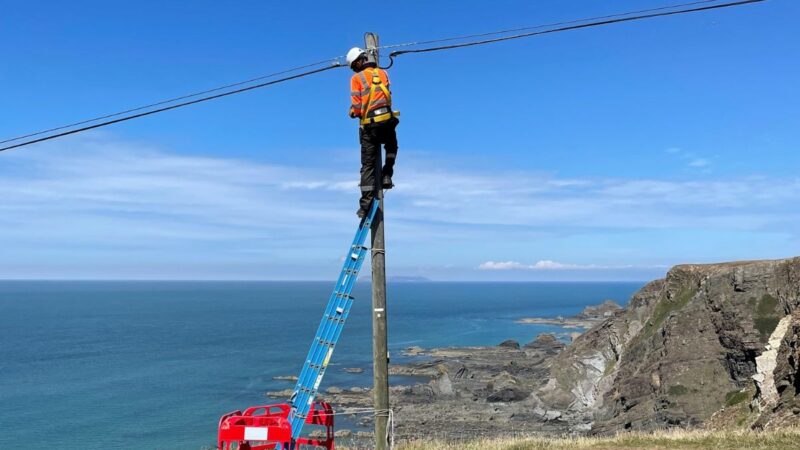
Concerns over rural areas and hard-to-reach communities missing out on broadband connectivity are to be raised with government.
Devon County Council’s Cabinet today considered a request from the Council’s Corporate Infrastructure and Regulatory Services (CIRS) Scrutiny Committee to review current national broadband policy.
Councillors also welcomed the establishment of a Task and Finish group by the (CIRS) Committee to monitor the delivery of the national broadband voucher scheme and consider any opportunities to improve connectivity in Devon.
Councillor Cheryl Cottle-Hunkin, Cabinet Member for Rural Affairs and Broadband, is already lobbying national government on rural connectivity.
She and seven of Devon’s MPs, National Park Chairs, and Chief Executives of Devon Communities Together and Citizens Advice recently sent a letter to the Minister for Digital Economy, outlining the significant impacts on businesses, access to services and rural isolation.
Their letter stressed the critical importance of developing a national strategy for connecting very hard-to-reach premises and offered to discuss Devon acting as a location to test, trial or pilot solutions, technologies and models for delivery of rural broadband solutions.
Councillor Cheryl Cottle-Hunkin, Cabinet Member for Rural Affairs and Broadband, said:
“I’ve been working closely and collaboratively with Devon’s Members of Parliament to drive a co-ordinated, cross-party effort to tackle the growing challenges of rural connectivity across our county. A joint letter has already been sent to the Digital Minister, and we are actively seeking an early meeting to make the case for a more consistent, long term and equitable approach to rural connectivity that ensures no community is left behind.
“Digital connectivity is no longer a luxury, it is a fundamental necessity. It underpins how our residents access healthcare, education, employment and vital public services. Yet too many of our rural communities remain significantly disadvantaged, with no clear or comprehensive plan from central government to address this growing divide.
“The scale of the challenge in Devon is stark and cannot be ignored. Recent Ofcom data shows that Torridge has the highest levels of sub 2 megabit coverage anywhere in the country, worse than even the Highlands and Shetland, while West Devon has the highest proportion of sub 10 megabit speeds in the United Kingdom. These are not just abstract figures. They represent real people, real businesses, and real communities being held back. In many of these areas, residents already face limited public transport and reduced access to physical services. They are now experiencing a double disadvantage, with barriers to both physical and digital access.
“This reality has also been recognised nationally. During our recent engagement with Sir Chris Whitty, it was clearly highlighted how the challenges faced by rural communities are being intensified as more services, including healthcare, move online. Without reliable broadband, digital inclusion becomes impossible, and inequality deepens.”
