For accessibility purposes, graphs in this report are accompanied by the plain text data.
What is the gender pay gap (GPG)?
The GPG is the difference between the average earnings of males and females, expressed as a percentage difference relative to male earnings.
It is an indicator of the differences in opportunity and choices of males and females within the workplace. It is not a measure of equal pay – that is, whether males and females receive equal pay for equal work.
It is important to remember that a gap does not necessarily mean an organisation has acted inappropriately or discriminatorily.
See Appendix 1 for reasons why we only report on binary gender identities and Appendix 2 for calculation methodology.
Devon County Council’s gender make up
The gender demographic at Devon County Council in numbers:
- Full-time females 46.3% (down 2.7% from 2024).
- Part-time females 25.8% (up 1.3% from 2024).
- Full-time males 24.7% (up 1.2% from 2024).
- Part-time males 3.1% (same as 2024).
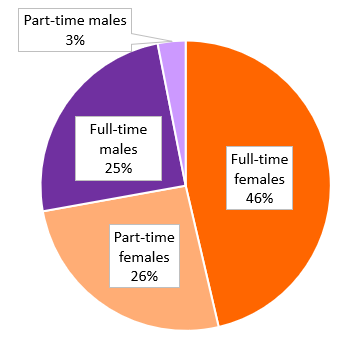
Anyone working over 30 hours per week is considered full-time, anyone working less than 30 hours per week is considered part-time. Gender ratios of part-time and full-time staff exclude casual and variable staff.
Devon’s GPG figures
Mean hourly earnings (all employees)
- Male: £20.87
- Female: £19.50
The mean gap is 6.56%, this is down 1.52% from 2024.
Median hourly earnings (all employees)
- Male: £19.65
- Female: £17.86
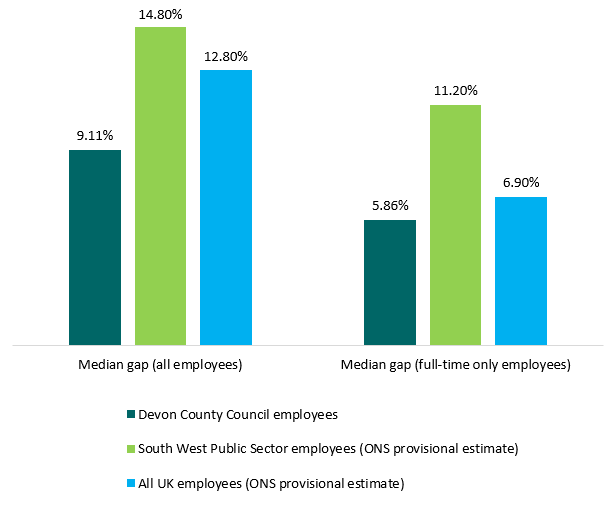
The median gap is 9.11%, this is down 3.86% from 2024.
Median hourly earnings (full-time employees)
- Male: £19.88
- Female: £18.71
Median gap is 5.86%, this is down 1.52% from 2024.
Quartiles
Quartiles are when a ranked set of data is divided into four equal groups, each comprising a quarter of the data so that the lower quartile is the bottom 25%, the lower middle is the next 25% and so on.
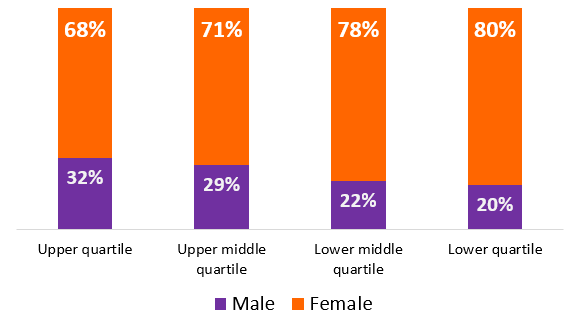
For the purposes of GPG reporting, the total headcount is divided into four equal groups based on their hourly pay. These groups are then analysed to determine the percentage of males and females in each group.
Graphic showing male and female hourly pay divided into four quartiles.
Upper quartile
- Male: 32% (33% in 2024)
- Female: 68% (67% in 2024)
Upper middle quartile
- Male: 29% (31% in 2024)
- Female: 71% (69% in 2024)
Lower middle quartile
- Male: 22% (21% in 2024)
- Female: 78% (79% in 2024)
Lower quartile
- Male: 20% (20% in 2024)
- Female: 80% (80% in 2024)
Bonuses
Devon County Council does not pay bonuses so the percentage difference between male and female bonuses is 0.
Gap analysis
The Council’s gap is mainly caused by a high percentage of females in lower-graded posts rather than a high percentage of males in higher-graded posts. To reduce the gap, there needs to be a balance in the gender ratios through the grades.
Both nationally and in the Council, the gender pay gap is higher for all employees than it is for full-time employees. This is because females fill more part-time jobs, which in comparison with full-time jobs have lower hourly median pay. In the Council, 64% of females work full-time, compared with 89% of male employees.
Council and national statistics show that the gap increases significantly for people over 40. It is widely speculated that this is partially due to more females taking career breaks and working part-time to facilitate caring responsibilities. Perimenopause and menopause typically occur between the ages of 45 and 55 which also impacts female staff. A high proportion (73%) of the Council’s workforce is over the age of 40.
Provisional estimates provided by the Office for National Statistics (ONS) indicate that Devon County Council’s median gender pay gap for all employees and full-time only employees are below both the gender pay gap for all UK employees and for public sector employees in the South West.
Contributing factors
The Council has a high proportion of front-line services that are traditionally female-dominated such as caring and administrative roles which are typically paid at lower hourly rates.
A higher proportion of low-graded posts are either advertised as or can be performed part-time, this combined with the Council’s flexible working offer and family-friendly policies more commonly attract females as it is compatible with their personal requirements such as caring responsibilities.
72% of the Council’s workforce are female (down 2% from 2024). The Council has over eight times more females than males working part-time and compared to full-time hourly rates, part-time staff have a lower median hourly pay.
Reducing the gap
We are pleased that the gap has decreased by 3.86% for all employees and 1.52% for full-time employees.
The high proportion of females throughout the organisation indicates that the Council provides great employment opportunities for females across Devon, however, to reduce the gap, the Council will continue to support and encourage:
- females into more senior posts
- females into traditionally male-dominated roles
- males into traditionally female-dominated roles
- males to make use of the flexible working and family-friendly policies
- an environment where staff feel safe and supported
Next steps
Commitments to support the reduction of the gender pay gap will be included in our corporate EDI Action Plan.
Further information
Please contact the Policy, Reward and Relations team, Devon County Council, County Hall, Topsham Road, Exeter, EX2 4QD.
Email humnres.policyrewardrelations-mailbox@devon.gov.uk.
Appendices
Appendix 1 – gender identity
Whilst the requirement is to produce a gender pay gap report, in accordance with current gender pay gap reporting requirements, gender must be reported in a binary way and as per a person’s legally recognised (or ‘certified’) sex. Currently, non-binary or intersex is not recognised under UK law and therefore sex can only be described as either (the binary) female or male. This means that the gap and figures in this report, do not consider non-binary or other identities.
Under UK law, a transgender person’s sex or assigned sex can only be changed for pension purposes if a Gender Recognition Certificate (GRC) is in place. Therefore, the data in this report is represented as required by HMRC records, so will not reflect the gender identity for trans people who do not have a GRC.
In 2021, the Council approached the Equality Commission regarding the limitations of binary reporting. They have said that employers can voluntarily report the gap using employee’s self-reported gender (which includes non-binary and other identities), however, self-declaration rates aren’t complete, and the relatively small population of non-binary and other identities means that data may be identifiable.
In 2023, the Council asked the HMRC whether it intends to broaden the gender categories. They advised that current recording is in line with the government data strategy and that it is a matter for the Government Equalities Office and Cabinet Office to take forward and determine whether it requires all government departments in the future to reflect wider gender recognition.
Appendix 2 – calculation methodology
The mean is adding up all the values and dividing by the number of items. The median is lining up the hourly rates of pay for males from low to high and selecting the middle salary, repeating this process with female rates of pay to identify a median male and female rate.
The median is often viewed as a more representative measure of the pay gap because it is not affected by outliers (a few individuals at the top or bottom of the range).
The ONS conducts much of its analyses on full-time employees only as it is perceived to be the most reliable measure for comparisons. For these purposes, full-time employees are considered as those working 30 hours per week or more.