February 2026
Concrete in construction can account for 1.5% of all CO₂ emissions in the UK and 8% of global emissions.
The process of making cement, which binds the concrete, produces greenhouse gasses which attribute to these carbon emissions. Approximately 1.7 million tonnes of cement are used annually in the UK.
One of the commitments for the A382 project is to review current concrete designs and to implement lower carbon mixes. One of these changes is by using a low carbon cement substitute known as GGBS (Ground Granulated Blast furnace Slag), which is a by-product from the iron making industry will reduce the embodied CO₂ by around 650kg per tonne.
By swapping the cement to the lower carbon mix to construct the culverts we are already saving 13.94 tonnes of carbon dioxide equivalent (tCO2e).
Other examples where low carbon concrete will be used on the scheme are:
• Gabion basket foundations
• Kerb backing which keeps the kerbs in place
• Fence and signpost foundations
• Drainage
• Headwalls – a retaining wall built at the entrance/exit of culverts, storm drains and pipelines
December 2025

We’ve worked out the project’s carbon footprint and pinpointed the biggest hotspots where we can make the most impact. Now, you might think concrete and asphalt are the obvious culprits – and yes, they’re big players – but here’s the surprise: the day-to-day running of the project adds up too. So, how do we cut that down? Great question!
Here are a few smart steps we’ve already taken…
- You’ve probably seen hundreds of diversion signs across the network but did you know managing them can be surprisingly carbon-heavy? Every single sign needs multiple checks, and that adds up fast. So, we’ve come up with a smart innovation to tackle this challenge head-on. We’re projected to save 145.14 tCO2e (tonnes of carbon dioxide equivalent) over the next two years by utilising “intellitags” on all of our diversion signage across the network. These tags have sensors which can recognise when a sign tilts, falls over or is removed from the network. They can be digitally viewed and monitored, providing regular updates, with the ability to send an alert if a sign has fallen or been moved, at which point, we can send out our traffic management operators to assess and reinstate. These savings equate to an average diesel van driving around the Earth’s equator 14 times!
- Ever driven past our Forches Cross compound and wondered how we’re cutting carbon? Here’s the scoop: we’re taking heating and cooling seriously. Instead of sticking with traditional systems, we’ve installed an air source heat pump to boost energy efficiency—saving an impressive 22.1 tCO2e over the life of the project! This isn’t something you see every day in construction, but with the UK pushing for wider adoption of air source heat pumps, we’re showing the industry just how beneficial this approach can be, wherever it’s possible.
- Fuel usage forms a large proportion of the project’s carbon baseline, so we’ve adopted the use of HVO fuel across the project which has a 90% reduction in carbon, as well as lowering further air pollutants. HVO is a hydrotreated vegetable oil, used as fuel in our vehicles, plant and machinery, our HVO is accredited and certified, ensuring the sustainable procurement of the supply! Not only this, but we have EV site vehicles for our team to get around to each phase of the site, this simple switch has allowed us to further reduce our carbon footprint by 8.84 tCO2e.
We’re off to a fantastic start, bringing these innovations to life on the project, and we’re not stopping there. We have even more ideas in the pipeline as we keep pushing forward to cut carbon wherever we can. Keep your ears and eyes peeled for further updates throughout the duration of this project.
January 2024
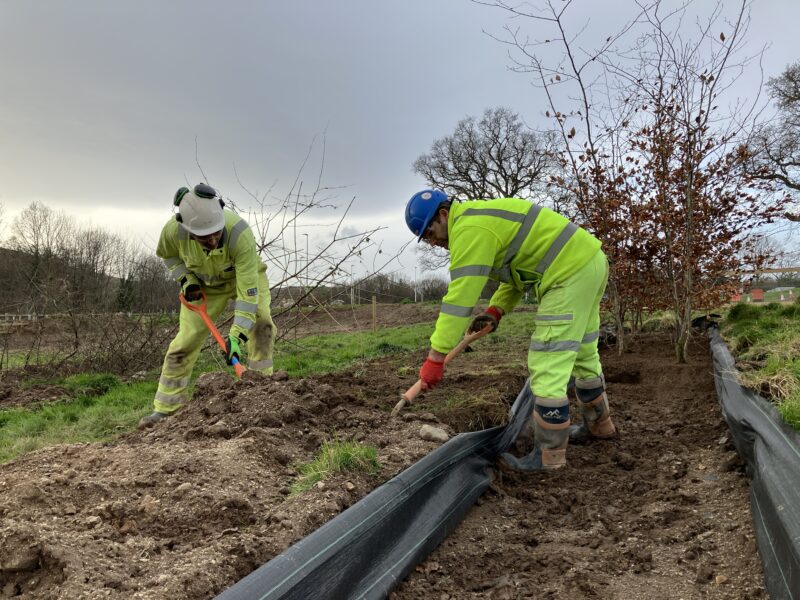
As many trees as possible will be preserved or re-used as part of the A382 improvements.
Devon County Council is hoping to pioneer the development of the A382 link road near Newton Abbot as the UK’s first “carbon negative” highway.
It is one of seven projects receiving a share of £30 million through the Live Labs 2 programme, funded by the DfT (Department for Transport) and organised by ADEPT (Association of Directors of Environment, Economy, Planning & Transport), to decarbonise the construction and maintenance of the road.
The A382 project is aiming to change established approaches within civil engineering, infrastructure and construction sectors in order to reduce carbon emissions.
Although some trees are being removed from the development site in November in order to create space for the road, every effort will be made to relocate or re-use as many as possible.
A temporary nursery is being established to store around 2,000 trees which are being relocated. This will enable established trees to be re-planted as part of the landscaping for the scheme.
Harvested wood which is processed at sawmills will be used for a variety of construction elements of the scheme. This is expected to include fencing, waymarkers, and possibly lighting columns.
Specialist cuts of wood can be donated to local wood turning groups and wood chip will also be donated to local community groups.
Any other waste wood will be converted into biochar, a form of charcoal which captures carbon and improves soil quality.
Councillor Andrea Davis, Devon County Council Cabinet Member for Climate Change, Environment and Transport, said: “Although some trees need to be removed to progress with the project, every effort is being made to relocate or re-use as many trees as possible. The Live Labs 2 projects is enabling this scheme to look at doing things differently and if the temporary nursery for 2,000 trees proves successful, hopefully it could become best practice for all road development schemes in future.”
Nicole Turley, Sustainability Manager at Milestone Infrastructure, said: “We are proud to be supporting Devon County Council on this project where we can challenge and improve the business-as-usual approach to the protection of resources on site in order to conserve the natural environmental whilst reducing carbon emissions and wastage. We are looking forward to continue to innovate on all aspects of the project as we move towards construction.”
Other carbon saving proposals being considered as part of the project include using local recycled materials, ensuring construction plant and equipment are sustainably powered, installing street lighting that can generate power, and establishing low maintenance verges and hedgerows.
The team working on the A382 pilot will also be working in partnership with other Live Labs 2 projects to share pioneering findings. This includes the Wessex partnership of Somerset County Council, Cornwall Council and Hampshire County Council, which is working on its Net Zero Corridors, and Liverpool City Council, which is trialling its ‘Ecosystem of Things’ driving a low-carbon economy.
For more information about Live Labs 2 please visit https://www.adeptnet.org.uk/livelabs2.