Guidance for Applicants
Introduction
The Re-imagined Library Spaces Fund is part of Devon County Council’s Libraries Transformation and Rural hubs fund and supports projects that improve library buildings and related community spaces so they can become more accessible, welcoming, inclusive and sustainable community hubs. The fund forms part of Devon’s wider library transformation programme, which aims to strengthen libraries as places for community activity, partnership working, access to services and community-led innovation
Libraries play an important role in communities across Devon. This fund supports projects that help libraries and related community spaces become more accessible, welcoming, flexible and sustainable.
We want to support projects that respond to local need, increase community use of library spaces, remove barriers to participation and make the best use of community assets.
We are particularly interested in projects that:
- Improve access to library buildings and services.
- Create more welcoming and inclusive spaces.
- Increase community use of buildings.
- Support collaboration between organisations
- Improve the long-term sustainability of library spaces.
- enable new and innovative uses of library spaces and add value

Important: Before submitting an Expression of Interest, applicants must have spoken to the library where the project would take place and received agreement in principle that the proposal is suitable for that space and complements existing activity Applications should not be submitted unless the relevant library is aware of the proposal and has given this initial green light.
If you would like to discuss your project idea before applying, please contact the Team on LibrariesGrants-Mailbox@devon.gov.uk or telephone Kathryn H Blake 01392 380261 or Vanessa Davies on 01392 383379.
Fund Overview
Total Fund Available: £200,000
Maximum Grant Available: £20,000 per project (excluding any match funding)
Match Funding: Match funding is encouraged where possible. Match funding may include cash contributions, fundraising, grants from other organisations or appropriate in-kind support.
Applications that clearly demonstrate community benefit, strong partnership working, inclusion, improved or innovative use of library spaces.
Objectives and Outcomes
Devon’s library vision recognises libraries as inclusive, trusted and welcoming community spaces at the heart of local communities. The Re-imagined Library Spaces Fund supports projects that help libraries work more closely with communities and partners, make better use of buildings and technology, and create flexible, sustainable spaces that respond to local needs.
Projects should contribute to outcomes such as:
- Increased community use of library spaces.
- Improved access and inclusion.
- Stronger community partnerships.
- More sustainable and flexible buildings.
- Increased opportunities for local people to take part in activities and services
Successful projects may also demonstrate outcomes such as increased library visits, additional community activities, greater use of digital services and Wi-Fi, increased access to local services, or new opportunities to extend how library spaces are used.
Applicants should identify the outcomes most relevant to their proposal and explain how they expect their project to contribute towards them.
Fund Requirements
Applications must clearly demonstrate how the project will contribute towards these fund requirements:
1. Deliver Clear Community Benefit
Explain how the project will improve the library or related community space and the lasting difference it will make for local people.
2. Improve Outcomes for Priority Communities
Show how the project supports one or more priority communities or helps address deprivation, inequality or disadvantage.
3. Improve Sustainability
Demonstrate how the project will improve financial, operational or environmental sustainability, or reduce ongoing delivery costs.
4. Be Community-Led or Locally Informed
Provide evidence that local people have helped shape the proposal or identified the need.
5. Involve Local Partners
Partnership applications are particularly welcome. Explain how organisations will work together to achieve greater impact.
6. Deliver Innovation or Transformation
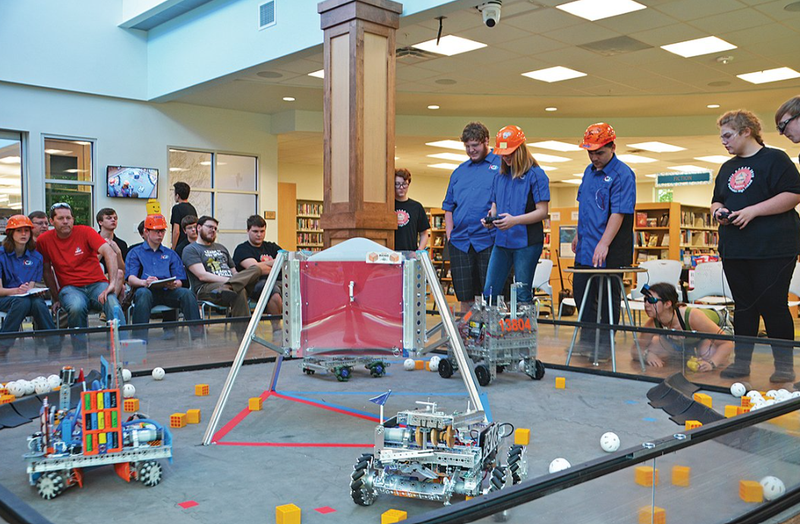
Describe what is new, different or transformative about your proposal, including how it could enable communities, partners or local organisations to use the space in new ways.
7. Improve Accessibility or Remove Barriers
Explain how the project will remove physical, digital or other barriers and increase opportunities for people to participate.
8. Enable Additional Services or Wider Use of Buildings
Demonstrate how the project will create opportunities for additional services, activities, partnership working or community use.
Applications are welcome from organisations that can demonstrate clear community benefit and a connection to a library or library-related community space.
Who Can Apply?
Applications are welcome from organisations that can demonstrate clear community benefit and a connection to a library or library-related community space.
This may include:
- Friends of Library groups.
- Community and voluntary organisations.
- Registered charities.
- Community Interest Companies (CICs).
- Social enterprises.
- Town and Parish Councils.
- Public sector organisations.
- Partnerships involving libraries and community organisations
- Businesses and private sector organisations where the project delivers clear community benefit and does not result in grant funding being used primarily for private profit.
Not sure if you’re ready to apply?
We recognise that community organisations vary in size and experience. If you have a project idea but are unsure whether your organisation meets all the requirements, please get in touch before applying. LibrariesGrants-Mailbox@devon.gov.uk or telephone Kathryn H Blake 01392 380261 or Vanessa Davies on 01392 383379.

Before you apply: check that you are eligible
To be eligible, applicants must:
- be an organisation or partnership able to enter into a grant agreement and manage public funding;
- have the relevant library’s agreement in principle before submitting an Expression of Interest;
- have an appropriate governing or legal document;
- have a bank account in the organisation’s name with at least two unconnected signatories, or equivalent financial controls;
- keep annual accounts or suitable financial records;
- have at least three unconnected committee members, trustees or directors;
- have the permissions, insurance and policies needed to deliver the project, or a clear plan and timetable for obtaining them;
- be able to maintain and manage any equipment or improvements funded;
- use the grant for community benefit rather than primarily for private profit.
- have appropriate safeguarding and equality policies where relevant;
What We Will Fund
Examples of eligible projects include:
Building Improvements
- Refurbishment or renovation.
- Minor building works.
- Internal reconfiguration.
- Improvements that create more flexible spaces.
- Adaptations that support wider community use.
Accessibility and Inclusion
- Accessibility improvements for example Open Plus
- Adaptations that reduce barriers to participation, eg people with disabilities.
- Improvements that make spaces more welcoming and inclusive.
- Facilities that support underrepresented or excluded groups.
Partnership and Service Integration
- Improvements that enable co-location of services.
- Facilities that support community groups and partner organisations.
- Improvements that support outreach and integrated service delivery.
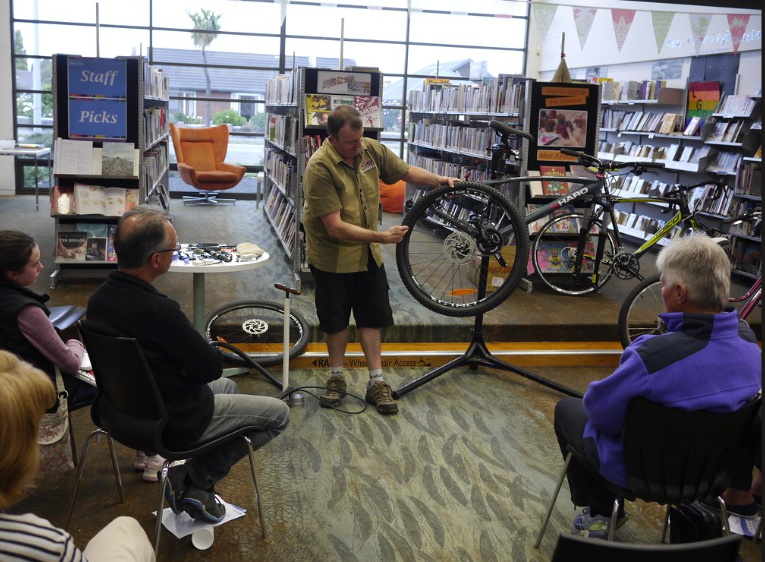
- Projects that create opportunities for new community activities.
Sustainability
- Energy efficiency measures.
- Environmental improvements.
- Changes that improve the long-term viability of library buildings and services
We cannot fund:
Legally or operationally ineligible expenditure, such as:
- retrospective costs;
- another public body’s statutory responsibilities;
- activity intended primarily to generate private profit;
- projects with no connection to a library or related community space;
- projects where the applicant cannot establish the necessary authority, ownership or permissions.
We are unlikely to fund
Projects that are technically eligible but poor priorities, such as:
- routine maintenance with no wider community benefit;
- general running costs;
- proposals with weak evidence of need;
- proposals offering little additional community use or benefit;
- projects that mainly continue existing activity without clear improvement or transformation.
Practical Application Tips
When completing your application:
Keep It Clear
Avoid acronyms, technical language and jargon where possible. The assessor may not be familiar with your organisation or sector.
Explain the Need
Clearly describe the problem, challenge or opportunity your project is responding to. Do not assume that assessors will already understand local circumstances.
Focus on Community Benefit
Explain who will benefit, how they will benefit and why the investment is needed.
Demonstrate Local Support
Show how local people, partners or stakeholders have helped shape the proposal.
Be Realistic
Ensure your costs, timescales and delivery plans are realistic and achievable.
Tell Us Why It Matters
Strong applications explain not only what will be delivered, but also what difference it will make.
Terms and Conditions
Please read our TERMS AND CONDITIONS here
Application Process
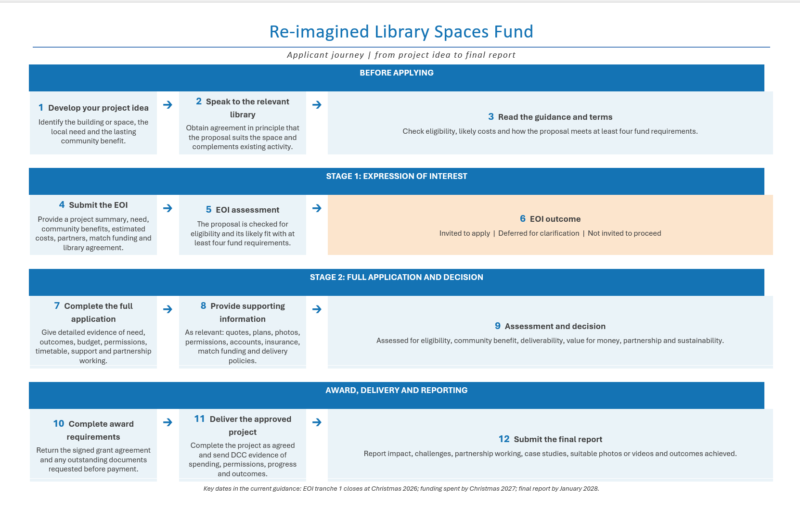
Stage 1: Expression of Interest
EOI timetable: Tranche 1 Expressions of Interest will open in October 2026 and close at Christmas 2026. Tranche 2 Expressions of Interest will reopen in January 2027.
Spending deadline: All grant funding must be spent by Christmas 2027.
This is your opportunity to tell us about:
- The proposed project.
- The building or space involved.
- The need you have identified.
- Confirmation that you have discussed the proposal with the relevant library and received agreement in principle.
- The community benefits you expect.
- Estimated project costs
- Potential partners and match funding.
The Expression of Interest is designed to be straightforward. At this stage we only require summary information about your proposal. Detailed supporting documents will only be requested if you are invited to submit a full application.
Following assessment, there may be three outcomes:
- Invited to submit a full application.
- Deferred pending clarification or additional information.
- Not invited to proceed.
Stage 2: Full Application
If invited, you will be provided with a link to the online Application Form and asked to include more detailed information such as:
- Detailed project description.
- Evidence of need.
- Project outcomes.
- Budget and funding breakdown.
- Match funding evidence where applicable.
- Permissions and approvals.
- Delivery timetable.
- Evidence of community support and partnership working.
- A clear explanation of which fund requirements the project will meet and how these will be delivered
Supporting Information
All applicants invited to Stage 2 will need to provide:
- governing or legal document;
- latest accounts or appropriate financial records;
- project budget;
- quotations or evidence of costs;
- evidence of the library’s support;
- delivery timetable;
- evidence of community need or support;
- details of permissions required and their current status.
Depending on the project, we may also require:
- building plans or photographs;
- owner’s or landlord’s consent;
- planning, listed building or building regulations approvals;
- lease, licence or other evidence of authority to alter or use the space;
- insurance evidence;
- safeguarding, equality or other relevant policies;
- match-funding evidence;
- partnership agreements;
- access and inclusion plans.
Assessment and Decision Making
Applications will be assessed against the fund requirements and the strength of the evidence provided, including:
- Eligibility.
- Community benefit.
- Deliverability.
- Value for money.
- Partnership working.
- Sustainability.
- The extent to which the project meets at least four of the fund requirements.
Projects will then be considered through the agreed decision-making process established for the fund.
Monitoring and Reporting
Successful applicants will be required to provide a brief project report after delivery. See here for TEMPLATE:
Final reporting must be submitted no later than January 2028.
This report should include:
- The impact of the funding.
- Challenges encountered and how they were addressed.
- Examples of partnership working.
- Positive stories and case studies.
- Photographs or videos where available and appropriate.
- Evidence of outcomes achieved.
The Council may request additional information for larger or more complex projects.
Final Thoughts
The strongest applications demonstrate a clear need, strong community support, practical deliverability and a lasting benefit for local people. We are particularly interested in proposals that help libraries become more inclusive, flexible and sustainable community hubs that support wider partnership working and improve access to services