Financial targets are set for all the areas of activity that are undertaken by the County Council. Day-to-day expenditure and income are referred to as revenue, and investment in assets is referred to as capital.
Elected members approve all budgets of the Authority and throughout the year monitoring of expenditure and income is undertaken to ensure that spending remains under control.
The funding for the budget currently comes from several sources including Council Tax, business rates, government grants, and fees and charges.
The settlement sets out the Authority’s Core Spending Power, which is a government measure of the resources available to local authorities to fund service delivery. Core Spending Power includes funding available from the updated fair funding allocation, Council Tax, business rates retention and central government grant.
For England, Core Spending Power for local government is increasing by 15.1% across the three year settlement period since 2025 (24.3% since 2024). For the authority, core spending power is set to increase by 14.1% across the three year period since 2025 (22.5% since 2024). The authority’s increase in Core Spending Power from 2024/25 to 2028/29 is slightly above average when compared to other county councils in England.
For 2026/27, with the Council Tax requirement excluded, the Authority will see an initial Core Spending Power increase of £857,000 (+0.3%) from 2025/26, but a reduction in future years of £6.7 million for 2027/28 (-2.3%) and a further decrease of £6.7 million (-2.3%) for 2028/29.
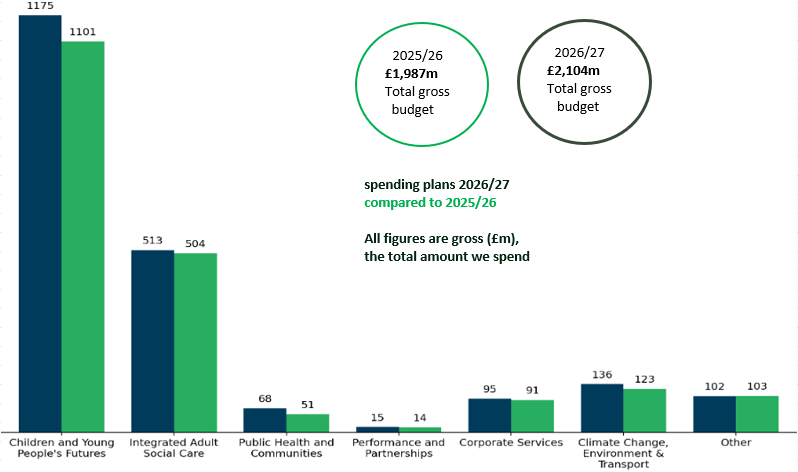
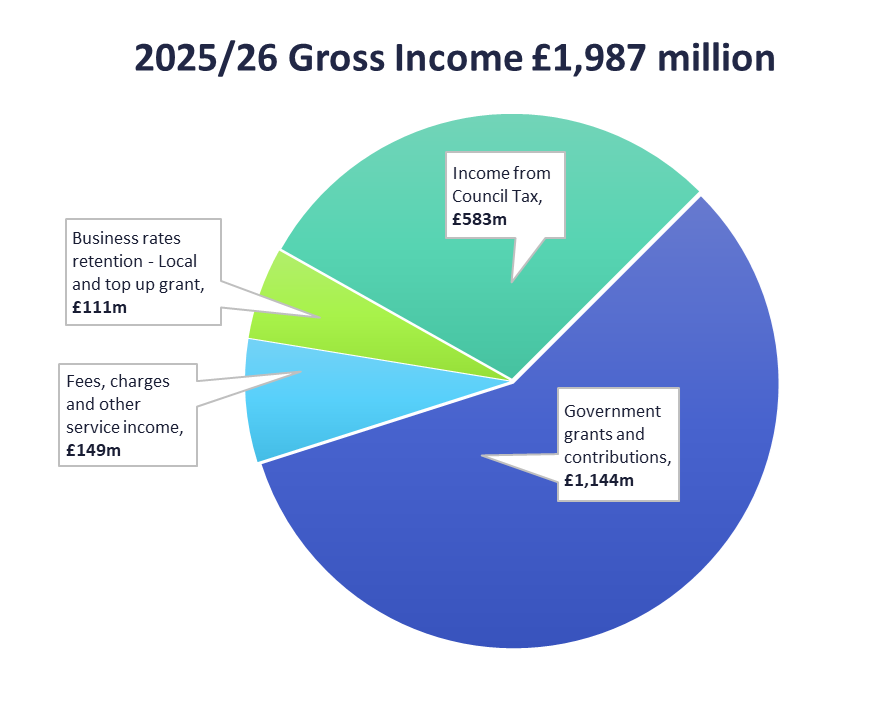
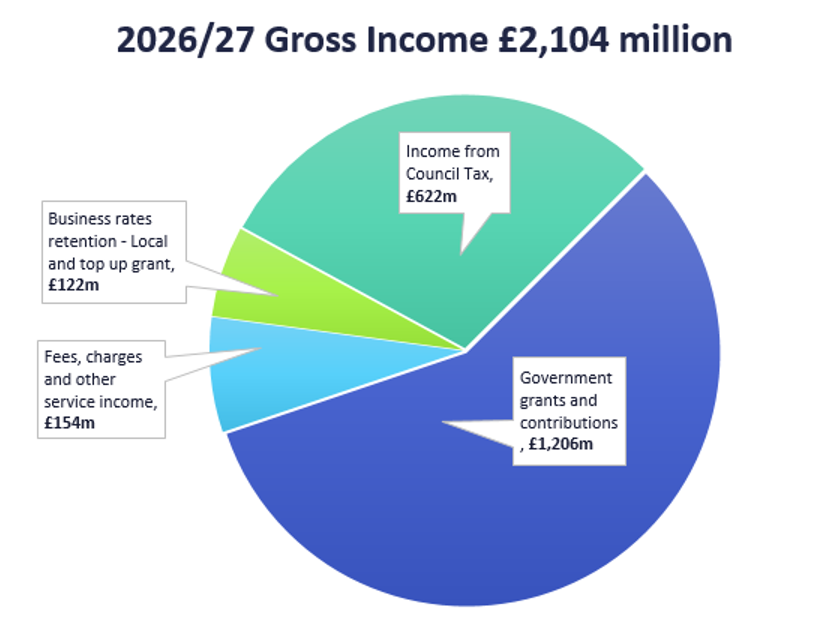
The settlement is not enough for the Authority to set a balanced budget for 2026/27 without making budget savings and generating additional income, with inflation, national living wage together with demand for services driving cost increases well above the increase in available funding. Savings and new income of £39 million are reflected within service budgets to ensure services remain affordable.
Delivery of the savings and the improvements in services through change programmes will not be easy but the level of commitment from teams working together as one organisation and the level of assurance gained through the rigorous budget process provide confidence in the ability of services to deliver within financial targets.
Budget
- Budget Book 2026/27
- Budget Book 2025/26
- Budget Book 2024/25
- Budget Book 2023/24
- Budget Book 2022/23
- Budget Book 2021/22
- Budget Book 2020/21
- Budget Book 2019/20
- Budget Book 2018/19
- Budget Book 2017/18
- Budget Book 2016/17
- Budget Book 2015/16
- Budget Book 2014/15
- Budget Book 2013/14
- Budget Book 2012/13
- Budget Book 2011/12
- Budget Book 2010/11
Revenue and capital outturn
- Revenue and capital outturn report for 2025/26
- Revenue and capital outturn report for 2024/25
- Revenue and capital outturn report for 2023/24
- Revenue and capital outturn report for 2022/23
- Revenue and capital outturn report for 2021/22
- Revenue and capital outturn report for 2020/21
- Revenue and capital outturn report for 2019/20
- Revenue and capital outturn report for 2018/19
- Revenue and capital outturn report for 2017/18
- Revenue and capital outturn report for 2016/17
- Revenue and capital outturn report for 2015/16
- Revenue and capital outturn report for 2014/15
- Revenue and capital outturn report for 2013/14
Devon County Council is a precepting authority and does not administrate Council Tax. Enquiries about payments, rebates or benefits should be made to your district or city council.
More information
We take accessibility seriously and recognise that some of the information presented in the files available on this page may not be fully accessible to someone using assistive technology such as a screen reader. If you need guidance or an alternative format, email devonfinanceservices-mailbox@devon.gov.uk with details of any preferred format and the assistive technology you use.