
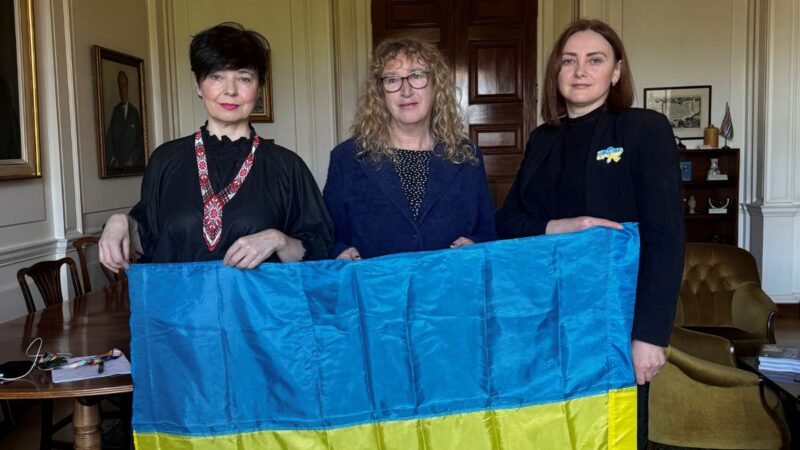
Founding members of the Devon Ukrainian Association were invited to address Devon County Council’s Full Council meeting today, the fourth anniversary since the Russian invasion of Ukraine.

“Today, we were honoured to be invited to open the meeting of Devon County Council’s Full Council at County Hall, marking the fourth anniversary of the full-scale invasion of Ukraine,” said Olya Petrakova, Executive and Founding Director of the Devon Ukrainian Association.
“We spoke about the lived experiences of those who were forced to flee Ukraine in 2022 and in the years that followed — about loss, resilience, rebuilding, and the reality of starting again in a new country while war continues at home.
“We are deeply grateful to Devon County Council for this invitation and for their continued support of Ukrainians across Devon. In particular, we would like to thank the Chair of the Council, Cllr Caroline Leaver, for her leadership and for her clear resolve to stand with Ukraine.
“We also extend our sincere thanks to the Migration and Resettlement Team for their sustained commitment, care, and practical support for families who have found refuge here.
“Four years on, the war continues. So does our community. And so does our shared commitment to dignity, solidarity, and hope.”
Olya Petrakova was joined by fellow Directors of the Devon Ukrainian Association, Oksana Kryviak, Bryan Brown, and Anastasiia Kuznetsova (unable to attend due to family illness).
Both Oksana andAnastasiia (read by Olya) gave moving accounts of their own experiences in fleeing their native Ukraine.
Anastasiia’s testimony began,
“Today we mark four years of full-scale war,” she said.
“But for me, this war started 12 years ago — in Donetsk.
“I had to flee in 2014. My older daughter stayed with relatives for almost a year while I tried to build a new life in Kyiv. Without her.
“We rebuilt our life. We bought a home. We started again. Then 2022 came — and we had to leave again. This time with two children.
“For four years, my husband and I live apart. Sometimes we don’t see each other for six or seven months.
“After our last visit, my younger daughter couldn’t sleep for a whole month. Every night. She missed her dad. She was four when we left. She has friends here. She loves her English school. But she dreams of going home. So do I.
“When we visit Kyiv, we don’t sleep during attacks. We check where the rockets are going. This January we had no heating and no electricity — on the 22nd floor.
“My daughter saw snow for the first time in four years. That moment of joy mixed with fear and pain for every Ukrainian living like this.
“But as a mother, I know — we made the right choice. Here we can sleep. We have warmth. We are safe.
“Devon welcomed around 2,000 Ukrainians. That is 2,000 saved lives. I want to thank the Homes for Ukraine programme, the local authorities, and the ordinary British people who opened their homes to families in grief and despair. This is true heroism.
“Safety is not a small thing. It is the ability to live.”
Oksana is a mother of mother of six and the head of the Ukrainian School here in Devon. She said:
“I want to speak about something that worries me deeply. As a Ukrainian woman. As a mother.
“When I look at my children, I think — what will they carry with them? What will stay from Ukraine, here, so far from home? The language? The songs? The feeling of knowing who they are?
“We are integrating well here. We are learning new things, discovering British culture — and this is genuinely enriching. A real exchange, going both ways. But some things don’t change. We will always be Ukrainian.
“Because this war is not only about killing and territory. It is ideological. Russia is trying to destroy us as a nation. And this is not a new story — for over 400 years, Ukraine has been fighting for the right to exist. For its language. For its culture. For itself.
“The numbers speak clearly. More than 4,000 schools and universities have been damaged or destroyed. 519 cultural sites — museums, libraries, churches. In occupied territories, Ukrainian books are being taken away and burned. At least 117 writers, artists and musicians have been killed. This is not accidental. This is a system.
“And this is why what exists here, in Devon, is not just community work. It is resistance.
“Devon Ukrainian Association was born in the first days of the full-scale invasion. Olya and Bryan — people who already lived here — simply could not stand aside. They met us, helped us find our feet, made sure we didn’t get lost in a foreign country at the hardest moment of our lives. From that grew an association — Easter services in Ukrainian language, mental health support, English courses, business support, cultural events. A real, living community of hundreds of people.
“This is the third school year of our Ukrainian School. This year it grew — we opened a new group for the youngest children, four and five year olds. Children who have barely lived in Ukraine. But they are learning the language, the traditions, the culture. They sing Ukrainian songs. They know who they are.
“For me personally, this matters more than I can say. I want my children to grow up as Ukrainians — wherever they live.
“All of this is possible because of Devon County Council, Exeter City Council, and the UK Government. Thank you. Sincerely.”
Councillor Caroline Leaver, Chair of Devon County Council, said:
“Today is the fourth anniversary of the invasion of Ukraine by the Russians.
“I am here with Olya and Oksanna from the Devon Ukrainian Association.
“They will be speaking to open our council meeting today in recognition of the terrible plight of their country and their countrymen.
“I would like us all to remember just how traumatic this is, not only for people still in Ukraine, but for people here and across the world and their friends and families.
“I would like to thank Devon people for the welcome that has been offered to people from Ukraine who have come here.
“And I’d like to express my deep sympathies and condolences for all of the losses that have happened in Ukraine.”